Knowing how to accept international payments in India is essential for any business selling to customers or clients overseas. Whether you're an exporter, freelancer, SaaS company, or e-commerce brand, the payment method you choose affects how quickly you get paid, how much you keep after fees and currency conversion, and how easily you meet RBI compliance requirements. This guide compares the most common ways to receive international payments in India, including SWIFT transfers, payment gateways, virtual accounts, and digital wallets, so you can choose the option that best fits your business.
📌TL;DR
•Indian businesses can accept international payments through four main routes: bank wire transfers (SWIFT), payment gateways, virtual international accounts, and digital wallets, each with different costs and speeds.
•Costs vary widely. Some methods run 4 to 6% all-in, while virtual accounts can sit under 1.5% with better exchange rates. The exchange-rate markup often matters more than the headline fee.
•Every inbound payment needs the right compliance trail: an RBI purpose code, proper invoicing, and remittance proof (FIRA). A good provider automates this.
Imagine this: You have landed your first international client, and now you are stuck on how to actually get paid. The methods you have heard about either charge heavy fees, take weeks to clear, or come wrapped in confusing compliance requirements.
How you get paid from overseas clients matters more than it looks. Your payment method decides how much money you actually keep, how fast it arrives, and whether you stay compliant with the rules. This guide breaks down every way to accept international payments in India, what each one really costs, and how to set it all up without the usual friction.
What does it mean to accept international payments in India?
Accepting international payments in India means receiving funds from customers, clients, or businesses outside India, usually in foreign currencies such as USD, EUR, or GBP. These are cross-border transfers, so they involve currency conversion, compliance checks, and proper documentation before the money lands in your account.
A simple example: if you are a software developer in India billing a client in New York, that invoice is an international payment. The client's money travels through banking networks, gets converted from dollars to rupees, clears compliance checks, and finally settles in your Indian bank account. Every method below handles those same four stages differently, and that is where the cost and speed differences come from.
Benefits of accepting international payments
Getting paid globally does more than add revenue. For an Indian business, it changes what growth is possible.
Higher revenue potential. Billing in strong foreign currencies can mean more rupees per invoice and healthier margins.
Wider market reach. You can serve global customers without setting up a physical presence abroad, which keeps expansion cheap and simple.
More resilient cash flow. Earning across several countries and currencies reduces your dependence on any single market's ups and downs.
Stronger credibility. Being able to accept international payments cleanly signals professionalism to global clients.
Future-ready growth. A scalable payment setup supports you as you move into new markets, instead of becoming the thing you have to rebuild.
Four ways to accept international payments in India
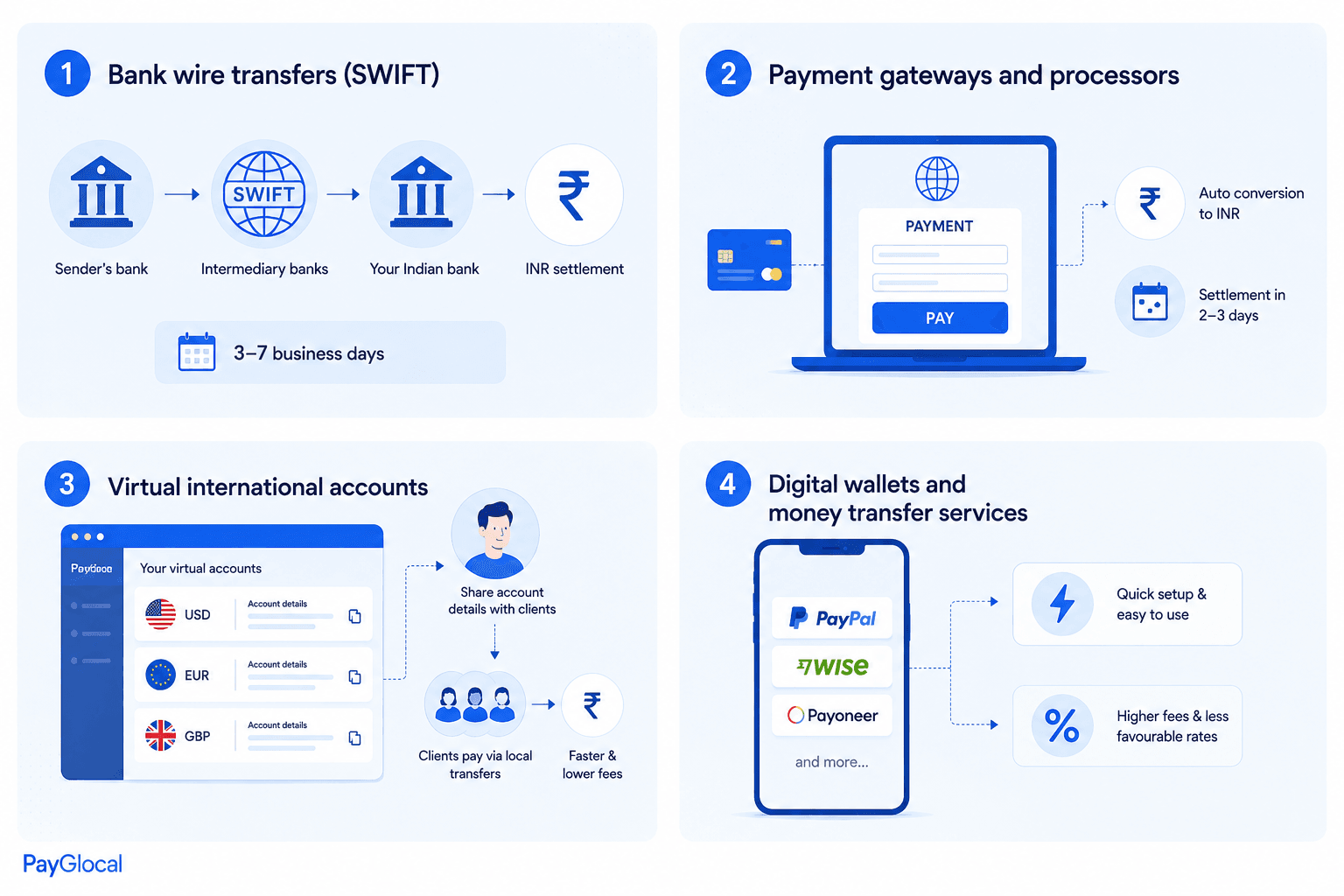
Indian businesses have four main options, each with real trade-offs on cost, speed, and effort. Different ways to collect international payments, in a gist.
1. Bank wire transfers (SWIFT)
Traditional bank-to-bank transfers over the SWIFT network are the most established method. Your client initiates a wire through their bank, and the funds pass through one or more intermediary (correspondent) banks before reaching your Indian account, converted to rupees on the way. When a US client sends $10,000 by SWIFT, each institution in that chain can deduct a fee, and processing usually takes 3 to 7 business days. Reliable and universal, but slow and often opaque on cost.
2. Payment gateways and processors
Modern payment gateways let you accept international card payments and alternative methods directly on your site. They handle currency conversion automatically and settle faster than traditional banking. An e-commerce store on an international gateway can accept payments in 100+ currencies, with automatic conversion to INR and settlement within 2 to 3 days. Best when you sell online and want cards plus local methods in one place.
3. Virtual international accounts
Virtual accounts give you local bank details in major currencies (USD, EUR, GBP) without opening a physical overseas account. Your client then pays as a cheaper, faster local transfer rather than an international wire. A freelance consultant, for example, can share USD account details with American clients, who send the money as a domestic US transfer, so it arrives faster and costs less. Best for recurring invoicing to clients in a few key currencies.
4. Digital wallets and money transfer services
Wallets and transfer services offer quick setup and interfaces international clients already recognise. They are convenient, but usually carry higher fees and less favourable exchange rates than dedicated business solutions. Best for occasional or low-value payments where convenience beats cost.
How to set up an international payment acceptance system in India
Setting up acceptance is mostly about getting the compliance and provider choice right before you go live.
Sort your business registration and documents. Have your business paperwork in order, including GSTIN and a current account in your business name. If you export physical goods, obtain an Importer Exporter Code (IEC) from the DGFT.
Choose your method and provider. Weigh providers against your transaction volume, customer locations, required features (recurring payments, multi-currency settlement, integrations), and cost structure.
Complete compliance requirements. Every international payment needs the correct RBI purpose code (for example, one code for software services and another for trade services) and proper invoicing. Your provider should help automate this documentation.
Integrate and test. Whether you use payment buttons, a hosted checkout, or an API integration, test the full flow with small amounts before going live.
Set up monitoring and reporting. Put processes in place to track payment status, manage foreign-exchange exposure, and keep compliance records for tax and audit.
What are the costs involved in accepting international payments?
Costs vary widely by method and provider, and the only number that matters is what actually reaches your account. Account for every layer:
Bank wire transfers: a fixed fee of roughly $15 to $50, plus about 2 to 4% in total charges including conversion.
Payment gateways: roughly 3 to 3.5% per transaction, with automatic conversion included.
Virtual accounts: roughly 0.75 to 1.5% as a flat fee, usually with more competitive exchange rates.
Digital wallets: around 4 to 6% all-in once transaction and conversion fees are counted.
Exchange-rate markup: most providers add 1 to 4% over the mid-market rate, which quietly becomes the largest cost on big transactions.
The spread is real. Depending on the method you choose, a $10,000 payment could cost you anywhere from around $150 to over $600 in total fees and markup, which is exactly why provider selection drives your profitability.
Get paid globally without the hassle, with PayGlocal
Traditional options have served Indian businesses for years, but they often bring high costs, slow processing, and complex compliance. PayGlocal combines the reliability of banking with the speed and transparency of modern fintech, and scales from your first international payment to thousands of transactions.
Collect in 33+ currencies: accept payments from 180+ countries with local account details in USD, GBP, EUR, and CAD.
Global payment methods: support cards, bank transfers, and the local options your international customers prefer.
Dynamic checkout: localised payment flows that lift conversion and customer trust.
No fixed costs: pay only when you transact, with no setup fees, monthly charges, or documentation costs.
Clear pricing: transparent per-transaction rates with no hidden markups or surprise charges.
Automatic FIRA generation: remittance proof issued after each settlement, straight to your inbox.
Whether you are scaling a SaaS product across countries or running e-commerce for global customers, PayGlocal gives you the payment infrastructure to grow.
Final thoughts
Accepting international payments in India has gone from a slow, expensive chore to a straightforward business capability. The whole game is matching the method to your needs, weighing cost, speed, compliance, and what your customers prefer to pay with.
Settlement depends on the method. Payment gateways typically take 2 to 3 days, virtual accounts 1 to 2 days, and traditional bank wires 3 to 7 days. Delays can still occur when multiple intermediary banks are involved.
FIRA (Foreign Inward Remittance Advice) confirms an inward foreign payment and is commonly issued by payment providers, often digitally. FIRC (Foreign Inward Remittance Certificate) is a formal certificate traditionally issued by banks. Both act as proof of foreign inflow; check which one your specific scheme or authority requires, as they are not always interchangeable.
Usually not. Wallet and transfer services tend to run higher on percentage fees plus a fixed fee and conversion charges. Dedicated business solutions often work out cheaper, especially for regular international payments. Compare the total cost after fees and exchange-rate markup, not just the headline rate.
It is not mandatory, but offering the local methods each region prefers (such as SEPA in Europe or ACH in the US) can noticeably improve conversion and customer satisfaction.
Refund handling varies by method. Most modern platforms support automated refunds, while bank wire refunds usually need manual processing and extra documentation. Check your provider's refund flow before you need it.
Each inbound payment needs the correct RBI purpose code and proper invoicing, and you should retain remittance proof (a FIRA or FIRC) for every receipt. Exporters of physical goods also need an IEC from the DGFT. A good provider automates the purpose code and remittance documentation for you.