
Growing your business internationally means dealing with different currencies, regulations, and payment systems. According to recent data, India's total exports reached USD 346.10 billion between April and August 2025, up from USD 329.03 billion in the same period last year.
With more Indian businesses expanding globally every year, it is essential to know about the right factors that determine success in international markets. Some you can control, others you need to work around. Each one affects your costs, timelines, and ability to compete globally.
Find out a complete breakdown of the top 10 factors that affect your international trade and get insights that will help you be well-prepared to scale your business globally.
International trade is when you sell goods or services to customers in other countries. This involves dealing with different currencies, shipping across borders, following various regulations, and getting paid through global payment systems.
For Indian businesses, international trade typically means exporting software services to US clients, selling handicrafts to European buyers, providing consulting to Middle Eastern companies, or offering digital services to customers worldwide. You invoice in foreign currency, manage compliance documents, and handle currency conversion when settling funds.
The success of your international trade depends on how well you manage multiple factors, from exchange rates to payment infrastructure. Each factor either helps you grow or creates friction that costs you money and opportunities.
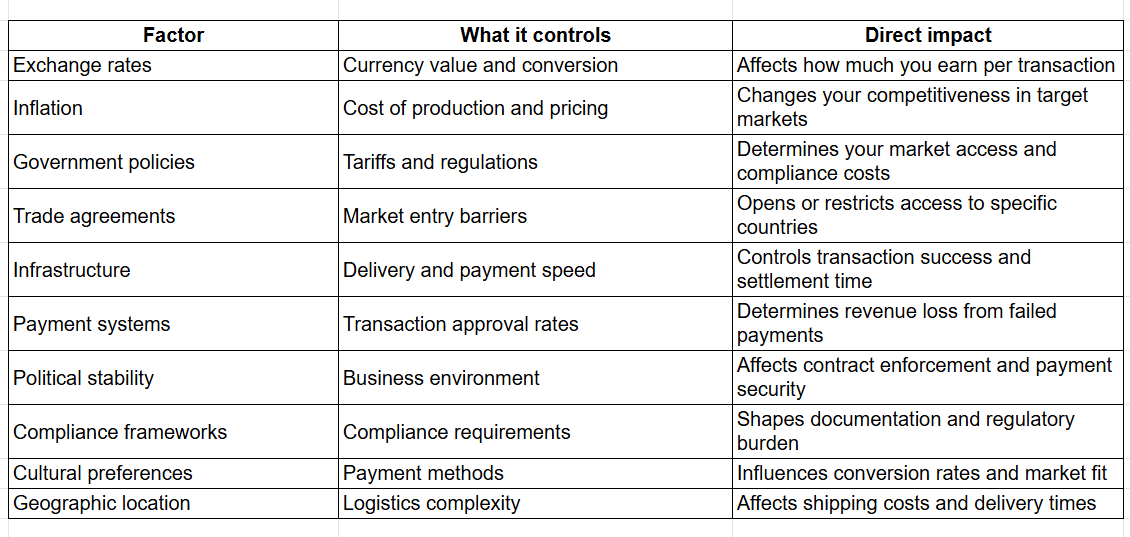
Here's how different factors impact your international trade:
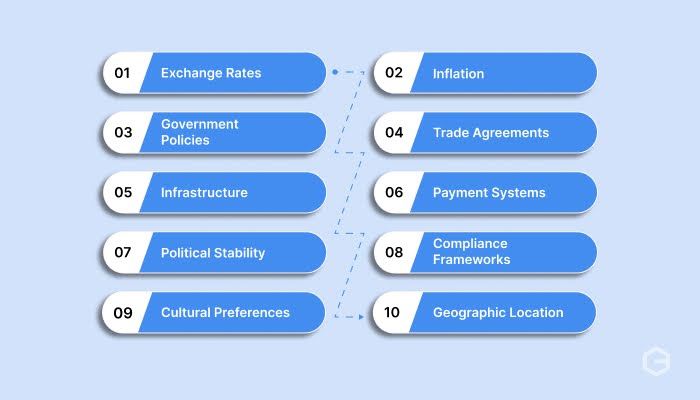
Let’s take a detailed look at 10 key factors so you know exactly what matters and how to manage them.
Exchange rates determine how much you actually earn when converting foreign currency to rupees. When the rupee weakens against the dollar, your exports become cheaper for foreign buyers, but you earn more in rupee terms. When it strengthens, you earn less.
Currency volatility can wipe out your profit margins quickly. For example, if you invoice a US client for $10,000 when the rate is 82 rupees per dollar, you expect 8,20,000 rupees. But if the rate drops to 80 by the time payment arrives, you only get 8,00,000 rupees. You just lost 20,000 rupees due to currency movement.
Traditional payment systems make this worse by charging 3-5% in hidden forex markups. On a $10,000 transaction, that's another $300-500 gone. You need transparent pricing and faster settlements to minimize currency risk and avoid these hidden costs.
Inflation affects your production costs and pricing competitiveness. When inflation rises faster in India than in your target markets, your costs increase while your selling prices stay fixed in foreign currency contracts. This squeezes your margins over time.
For example, if your manufacturing costs increase by 8% due to inflation but your dollar-denominated contract prices stay the same, you're earning less in real terms. Conversely, high inflation in your buyer's country makes your products relatively cheaper and more attractive.
You need to monitor inflation trends in both countries and build flexibility into your pricing agreements. Annual price adjustment clauses help protect your margins against inflation risk.
Tariffs are taxes imposed on imported goods that make your products more expensive in foreign markets. If a country imposes tariffs on your products, your competitive advantage disappears unless you can absorb the cost or shift production.
Some countries use high tariffs to protect local industries. This can price you out of certain markets entirely or force you to find local manufacturing partners. India has trade agreements with ASEAN countries that reduce or eliminate tariffs, making those markets more attractive than regions without such agreements.
Research tariff rates in your target markets before setting prices. Factor these costs into your pricing strategy or look for markets with favorable trade agreements.
Trade agreements between countries reduce barriers and simplify customs procedures. Bilateral or multilateral agreements can open markets by eliminating tariffs and reducing paperwork. India's agreements with countries like the UAE, Australia, and ASEAN nations make it easier and cheaper to export to these regions.
Government export incentives also matter. India provides schemes like the Remission of Duties and Taxes on Exported Products (RoDTEP) that reduce your costs. Not taking advantage of available export benefits means leaving money on the table.
Check which trade agreements apply to your products and target markets. Use government export incentive programs to improve your margins and competitiveness.
Infrastructure quality determines how quickly and reliably you can deliver products. Poor ports, congested roads, or limited air freight capacity create delays that cost money and damage customer relationships.
For example, if you're exporting perishable goods and your nearest port has frequent congestion, products might spoil before reaching customers. Late deliveries lead to penalties, lost contracts, and reputation damage. Countries with modern infrastructure, like Singapore, process shipments in hours, while others take days or weeks.
Evaluate logistics infrastructure when choosing markets and shipping routes. Build buffer time into delivery schedules for markets with infrastructure challenges.
Payment infrastructure controls how reliably you get paid and how much you lose to fees and failures. International card payments can fail with basic processors due to fraud checks, bank restrictions, or poor routing. Each failure is a lost sale.
For instance, if you receive 100 payment attempts worth $50,000 and 25 fail, you lose $12,500 in revenue. Modern platforms with smart routing achieve high approval rates by automatically selecting the best processing path.
Traditional banks also take 5-7 days to settle funds, hurting your cash flow.
You need a payment infrastructure that handles multiple currencies, provides instant compliance documents like FIRC (Foreign Inward Remittance Certificate), and settles funds in 1-2 days instead of a week. This directly impacts your revenue and working capital.
Political stability affects how safely and predictably you can operate in foreign markets. Countries with stable governments offer clearer rules that don't change overnight. You can make long-term plans with confidence.
Political instability leads to sudden policy changes, payment delays, or frozen assets. For example, businesses trading with countries experiencing political turmoil often face payment collection challenges when banking systems become unstable or currency controls are imposed unexpectedly.
Diplomatic relations between countries also matter. Strong ties mean easier trade and payment processing. Tensions can result in sanctions or restricted market access. When relations sour, banks become more cautious about processing transactions, causing delays even for legitimate business.
Research political stability and bilateral relations before entering new markets. Diversify across multiple markets to reduce concentration risk.
Compliance frameworks determine how easily you can enforce contracts and comply with local requirements. Strong compliance systems provide recourse through courts if clients don't pay. Weak systems increase your risk and make it harder to collect unpaid invoices.
Compliance requirements vary by country. Every market has different standards for product certification, labeling, invoicing, and customs paperwork. For example, exporting food products to the EU requires specific health certificates that differ from US requirements.
Payment regulations also vary. Some countries require extensive documentation for foreign payments, while others have well-structured processes.
Choose payment partners that handle compliance automatically. Modern platforms provide instant documentation and manage regulatory complexity so you focus on business growth.
Cultural factors shape how you need to adapt for different markets. Payment preferences vary dramatically by region.
For example, Europeans prefer bank transfers and local methods, while Americans primarily use credit cards.
Language and communication styles affect trust. Clear communication in your client's language reduces misunderstandings. Even when conducting business in English, adapting to cultural communication styles improves success rates.
Offer flexible payment methods that match local preferences. Research business customs in target markets and adapt your approach accordingly.
Geographic location affects shipping costs, delivery times, and logistics complexity. Countries closer to major markets have natural advantages in transportation costs and speed. Being far from target markets increases freight costs and transit times.
For example, exporting from India to Europe involves longer shipping times and higher costs than exporting from nearby Middle Eastern countries. This can affect your competitiveness for time-sensitive products or when competing against regional suppliers.
Geographic factors also include climate and natural resources. Certain regions have advantages in specific products due to climate or resource availability. India's climate suits textile production and certain agricultural exports. These natural advantages help offset distance disadvantages.
Consider geographic factors when choosing target markets and products. Focus on markets where you have competitive advantages despite distance, or on products where shipping costs are small relative to value.
Multiple factors affect your international trade success, but payment infrastructure is one you can control completely. While you can't change exchange rates or other factors, you can choose a payment solution that minimizes costs and maximizes reliability.
Most exporters lose money unnecessarily on payment processing. Failed transactions cost you a significant part of your potential revenue. You need a payment partner built for international business.
Here's how PayGlocal helps you manage international trade better:
Whether you're exporting handicrafts to Europe, providing software services to US clients, or running a business with global customers, PayGlocal gives you the payment infrastructure to compete internationally.
Multiple factors affect your international trade success, from economic conditions and government policies to infrastructure quality and cultural differences. Payment infrastructure is where many businesses lose the most money unnecessarily.
Failed transactions, high forex charges, slow settlements, and complex compliance create friction. Fixing your payment infrastructure gives you an immediate competitive advantage and protects your margins.
The businesses winning in international markets make it easy for clients to pay while keeping their own costs low. They use modern payment platforms that handle multiple currencies, provide instant compliance docs, and settle funds quickly.
Stop losing money due to outdated payment systems. PayGlocal gives you everything you need to collect payments globally and settle locally. Get started with PayGlocal today.
With more Indian businesses expanding globally every year, it is essential to know about the right factors that determine success in international markets. Some you can control, others you need to work around. Each one affects your costs, timelines, and ability to compete globally.
Find out a complete breakdown of the top 10 factors that affect your international trade and get insights that will help you be well-prepared to scale your business globally.
Key Takeaways
- Exchange rates directly impact your profit margins: Currency fluctuations can increase or decrease your earnings when dealing with international clients.
- Government policies determine market access: Tariffs, export regulations, and trade agreements shape where you can sell and what compliance you need.
- Infrastructure quality affects transaction reliability: Transportation networks and payment systems determine how fast you get paid and deliver products.
- Cultural factors influence preferences: Consumer habits and payment methods vary by region and require adaptation for better conversion.
- Modern payment solutions solve challenges: With modern payment platforms like PayGlocal, you can accept payments in 33+ currencies from 180+ countries with transparent pricing and high approval rates.
What is international trade?
International trade is when you sell goods or services to customers in other countries. This involves dealing with different currencies, shipping across borders, following various regulations, and getting paid through global payment systems.
For Indian businesses, international trade typically means exporting software services to US clients, selling handicrafts to European buyers, providing consulting to Middle Eastern companies, or offering digital services to customers worldwide. You invoice in foreign currency, manage compliance documents, and handle currency conversion when settling funds.
What factors affect international trade?
The success of your international trade depends on how well you manage multiple factors, from exchange rates to payment infrastructure. Each factor either helps you grow or creates friction that costs you money and opportunities.
Here's how different factors impact your international trade:
Let’s take a detailed look at 10 key factors so you know exactly what matters and how to manage them.
1. Exchange rates and currency fluctuations
Exchange rates determine how much you actually earn when converting foreign currency to rupees. When the rupee weakens against the dollar, your exports become cheaper for foreign buyers, but you earn more in rupee terms. When it strengthens, you earn less.
Currency volatility can wipe out your profit margins quickly. For example, if you invoice a US client for $10,000 when the rate is 82 rupees per dollar, you expect 8,20,000 rupees. But if the rate drops to 80 by the time payment arrives, you only get 8,00,000 rupees. You just lost 20,000 rupees due to currency movement.
Traditional payment systems make this worse by charging 3-5% in hidden forex markups. On a $10,000 transaction, that's another $300-500 gone. You need transparent pricing and faster settlements to minimize currency risk and avoid these hidden costs.
2. Inflation rates
Inflation affects your production costs and pricing competitiveness. When inflation rises faster in India than in your target markets, your costs increase while your selling prices stay fixed in foreign currency contracts. This squeezes your margins over time.
For example, if your manufacturing costs increase by 8% due to inflation but your dollar-denominated contract prices stay the same, you're earning less in real terms. Conversely, high inflation in your buyer's country makes your products relatively cheaper and more attractive.
You need to monitor inflation trends in both countries and build flexibility into your pricing agreements. Annual price adjustment clauses help protect your margins against inflation risk.
3. Government tariffs and duties
Tariffs are taxes imposed on imported goods that make your products more expensive in foreign markets. If a country imposes tariffs on your products, your competitive advantage disappears unless you can absorb the cost or shift production.
Some countries use high tariffs to protect local industries. This can price you out of certain markets entirely or force you to find local manufacturing partners. India has trade agreements with ASEAN countries that reduce or eliminate tariffs, making those markets more attractive than regions without such agreements.
Research tariff rates in your target markets before setting prices. Factor these costs into your pricing strategy or look for markets with favorable trade agreements.
4. Trade agreements and policies
Trade agreements between countries reduce barriers and simplify customs procedures. Bilateral or multilateral agreements can open markets by eliminating tariffs and reducing paperwork. India's agreements with countries like the UAE, Australia, and ASEAN nations make it easier and cheaper to export to these regions.
Government export incentives also matter. India provides schemes like the Remission of Duties and Taxes on Exported Products (RoDTEP) that reduce your costs. Not taking advantage of available export benefits means leaving money on the table.
Check which trade agreements apply to your products and target markets. Use government export incentive programs to improve your margins and competitiveness.
5. Transportation and logistics infrastructure
Infrastructure quality determines how quickly and reliably you can deliver products. Poor ports, congested roads, or limited air freight capacity create delays that cost money and damage customer relationships.
For example, if you're exporting perishable goods and your nearest port has frequent congestion, products might spoil before reaching customers. Late deliveries lead to penalties, lost contracts, and reputation damage. Countries with modern infrastructure, like Singapore, process shipments in hours, while others take days or weeks.
Evaluate logistics infrastructure when choosing markets and shipping routes. Build buffer time into delivery schedules for markets with infrastructure challenges.
6. Payment processing infrastructure
Payment infrastructure controls how reliably you get paid and how much you lose to fees and failures. International card payments can fail with basic processors due to fraud checks, bank restrictions, or poor routing. Each failure is a lost sale.
For instance, if you receive 100 payment attempts worth $50,000 and 25 fail, you lose $12,500 in revenue. Modern platforms with smart routing achieve high approval rates by automatically selecting the best processing path.
Traditional banks also take 5-7 days to settle funds, hurting your cash flow.
You need a payment infrastructure that handles multiple currencies, provides instant compliance documents like FIRC (Foreign Inward Remittance Certificate), and settles funds in 1-2 days instead of a week. This directly impacts your revenue and working capital.
7. Political stability and relations
Political stability affects how safely and predictably you can operate in foreign markets. Countries with stable governments offer clearer rules that don't change overnight. You can make long-term plans with confidence.
Political instability leads to sudden policy changes, payment delays, or frozen assets. For example, businesses trading with countries experiencing political turmoil often face payment collection challenges when banking systems become unstable or currency controls are imposed unexpectedly.
Diplomatic relations between countries also matter. Strong ties mean easier trade and payment processing. Tensions can result in sanctions or restricted market access. When relations sour, banks become more cautious about processing transactions, causing delays even for legitimate business.
Research political stability and bilateral relations before entering new markets. Diversify across multiple markets to reduce concentration risk.
8. Regulatory and compliance frameworks
Compliance frameworks determine how easily you can enforce contracts and comply with local requirements. Strong compliance systems provide recourse through courts if clients don't pay. Weak systems increase your risk and make it harder to collect unpaid invoices.
Compliance requirements vary by country. Every market has different standards for product certification, labeling, invoicing, and customs paperwork. For example, exporting food products to the EU requires specific health certificates that differ from US requirements.
Payment regulations also vary. Some countries require extensive documentation for foreign payments, while others have well-structured processes.
Choose payment partners that handle compliance automatically. Modern platforms provide instant documentation and manage regulatory complexity so you focus on business growth.
9. Cultural preferences and payment habits
Cultural factors shape how you need to adapt for different markets. Payment preferences vary dramatically by region.
For example, Europeans prefer bank transfers and local methods, while Americans primarily use credit cards.
Language and communication styles affect trust. Clear communication in your client's language reduces misunderstandings. Even when conducting business in English, adapting to cultural communication styles improves success rates.
Offer flexible payment methods that match local preferences. Research business customs in target markets and adapt your approach accordingly.
10. Geographic location and proximity
Geographic location affects shipping costs, delivery times, and logistics complexity. Countries closer to major markets have natural advantages in transportation costs and speed. Being far from target markets increases freight costs and transit times.
For example, exporting from India to Europe involves longer shipping times and higher costs than exporting from nearby Middle Eastern countries. This can affect your competitiveness for time-sensitive products or when competing against regional suppliers.
Geographic factors also include climate and natural resources. Certain regions have advantages in specific products due to climate or resource availability. India's climate suits textile production and certain agricultural exports. These natural advantages help offset distance disadvantages.
Consider geographic factors when choosing target markets and products. Focus on markets where you have competitive advantages despite distance, or on products where shipping costs are small relative to value.
Accept international payments reliably with PayGlocal
Multiple factors affect your international trade success, but payment infrastructure is one you can control completely. While you can't change exchange rates or other factors, you can choose a payment solution that minimizes costs and maximizes reliability.
Most exporters lose money unnecessarily on payment processing. Failed transactions cost you a significant part of your potential revenue. You need a payment partner built for international business.
Here's how PayGlocal helps you manage international trade better:
- Collect in 33+ currencies from 180+ countries: Accept payments using local accounts in USD, GBP, EUR, and CAD, making it easier for international clients to pay you.
- Support 40+ local payment methods: Offer credit cards, bank transfers, and regional methods, so clients pay their preferred way.
- Stay compliant with automated sanction screening: Every transaction is screened against global sanctions lists automatically, protecting your business from compliance risks.
- Transparent pricing: Pay only when you transact with clear, upfront rates. No setup fees, no platform fees, no surprise forex markups.
- Automate recurring billing: Set up subscriptions and recurring payments for international clients with automatic collection and mandate management.
Whether you're exporting handicrafts to Europe, providing software services to US clients, or running a business with global customers, PayGlocal gives you the payment infrastructure to compete internationally.
Final thoughts
Multiple factors affect your international trade success, from economic conditions and government policies to infrastructure quality and cultural differences. Payment infrastructure is where many businesses lose the most money unnecessarily.
Failed transactions, high forex charges, slow settlements, and complex compliance create friction. Fixing your payment infrastructure gives you an immediate competitive advantage and protects your margins.
The businesses winning in international markets make it easy for clients to pay while keeping their own costs low. They use modern payment platforms that handle multiple currencies, provide instant compliance docs, and settle funds quickly.
Stop losing money due to outdated payment systems. PayGlocal gives you everything you need to collect payments globally and settle locally. Get started with PayGlocal today.