
If you've received an international payment in India, you may have encountered one or more of these terms:
Perhaps your chartered accountant asked you for a FIRC, but your payment provider sent you an eFIRA.
Or perhaps your bank issued a document titled "remittance advice," leaving you unsure whether it serves the same purpose.
This confusion is common among freelancers, consultants, agencies, SaaS businesses and exporters receiving payments from overseas customers.
- FIRC
- FIRA
- eFIRA
- eFIRC
- Inward remittance advice
Perhaps your chartered accountant asked you for a FIRC, but your payment provider sent you an eFIRA.
Or perhaps your bank issued a document titled "remittance advice," leaving you unsure whether it serves the same purpose.
This confusion is common among freelancers, consultants, agencies, SaaS businesses and exporters receiving payments from overseas customers.
TL;DR
- Trust drives international payments. Regulatory compliance builds merchant confidence, but buyers decide whether to complete a payment based on how fast and secure the checkout feels.
- Edge computing overcomes the limits of distance. Since cross-border latency is constrained by physics, processing key parts of the checkout closer to the buyer reduces delays, improves the payment experience, and keeps security checks fast.
- Faster checkouts mean more successful payments. By reducing latency and running security at the edge, merchants can lower cart abandonment, improve payment gateway success rates, and recover more international revenue.
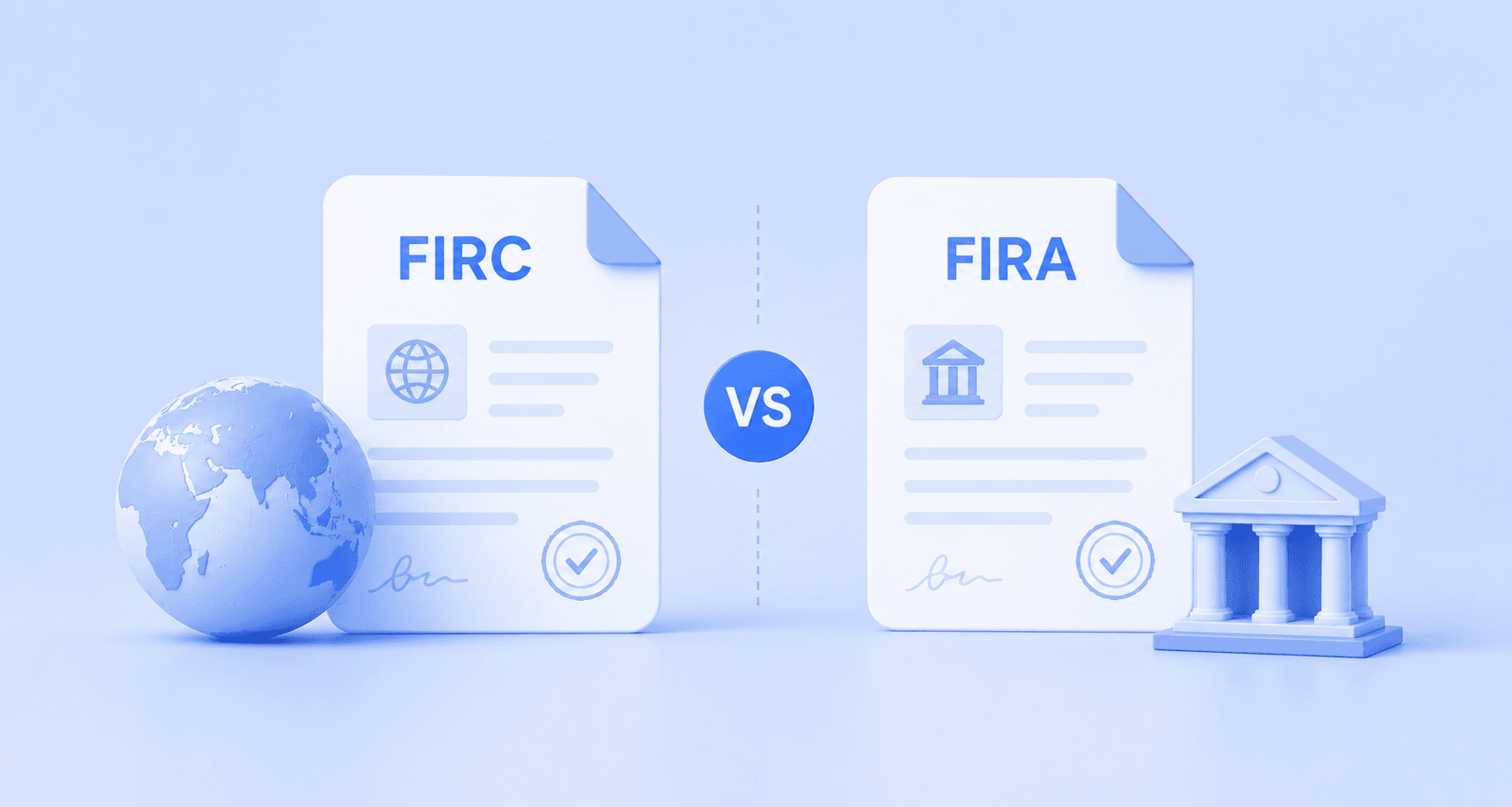
The simple explanation is that FIRC and FIRA both provide evidence of an inward foreign remittance, but they are not the same document. A traditional FIRC was commonly issued as a formal bank certificate, while a FIRA is the remittance advice that exporters and service providers generally receive for routine international payments today.
Understanding the distinction can help you:
This guide explains what FIRC, FIRA, eFIRA and eFIRC mean, how the documentation process changed after the introduction of EDPMS, and which document you are likely to need.
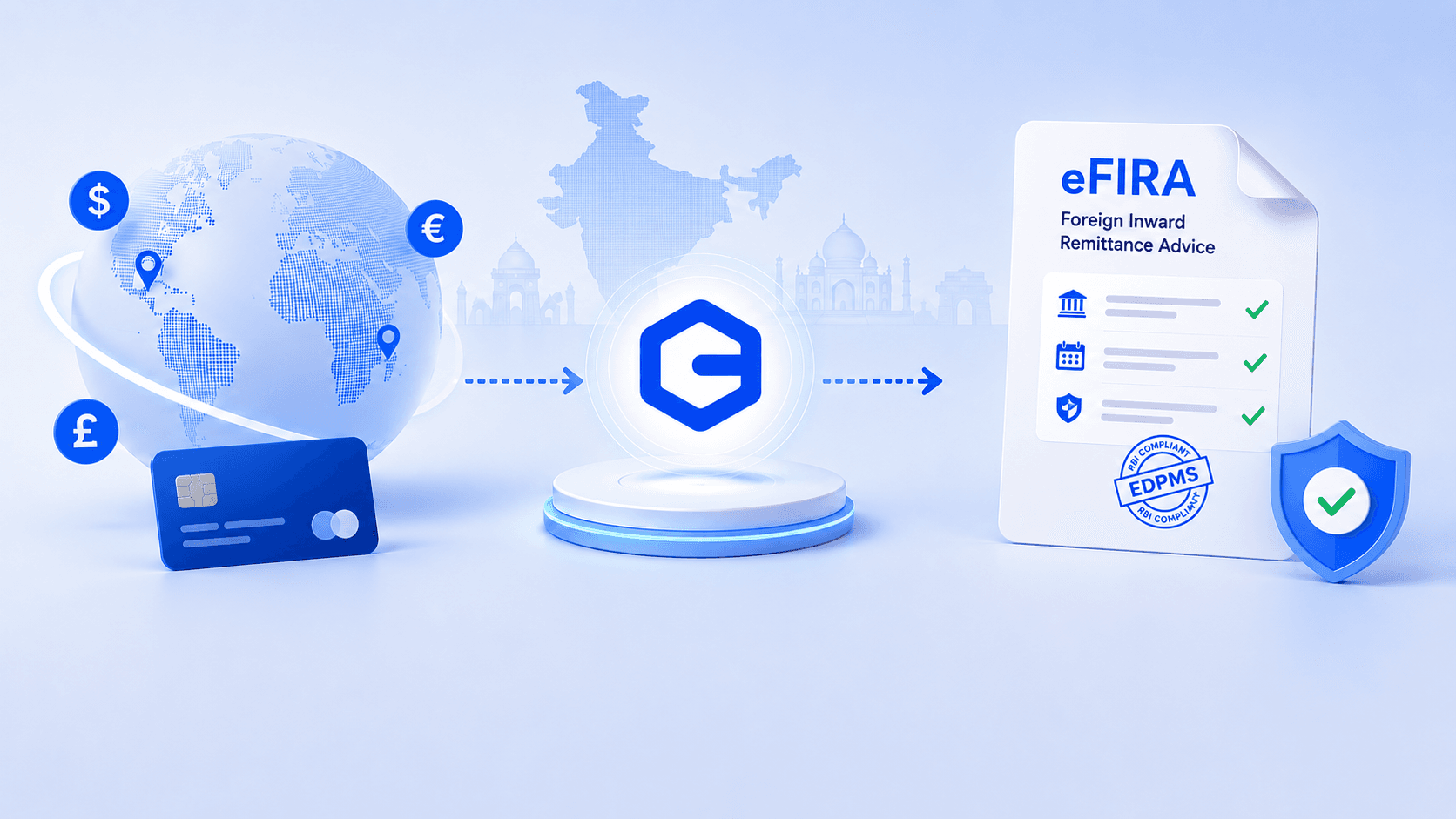
The diagram above traces the path from raising an invoice to receiving your eFIRA: your invoice is paid by the client, the international funds are received, settlement lands in your Indian bank account, and PayGlocal's AD Category-I banking partner generates the eFIRA and makes it available alongside the payment.
A Foreign Inward Remittance Certificate, or FIRC, is a certificate traditionally issued by an Authorised Dealer Category-I bank as evidence that an inward foreign remittance was received in India.
A Foreign Inward Remittance Advice, or FIRA, is a document issued by an Authorised Dealer bank or relevant banking partner containing the details of an inward foreign remittance.
An eFIRA is a FIRA issued and delivered electronically. It may be shared through email, a banking portal or a payment provider's dashboard.
For routine payments received against exported services, freelancers generally receive a FIRA or eFIRA, rather than a traditional physical FIRC.
No. Traditional FIRCs are no longer routinely issued for most ordinary export receipts, but they may still be relevant for specific investment, capital-account or bank-led regulatory processes.
No. For eligible payments, PayGlocal's Authorised Dealer Category-I banking partner generates the eFIRA after settlement. PayGlocal delivers it to your registered email address and links it to the corresponding payment in your dashboard at no additional cost.
This guide is for Indian businesses and professionals receiving payments from overseas customers, including:
Whether you're receiving your first USD payment or reconciling hundreds of international invoices every month, understanding your remittance documentation can make accounting and export record-keeping significantly easier.
Receiving money in your Indian bank account confirms that the payment was credited. However, a bank statement alone may not capture all the information needed to identify and document the underlying foreign remittance.
A FIRC, FIRA or eFIRA can contain details such as:
These details can help establish the relationship between:
Businesses may retain this documentation for:
The exact documents required depend on the nature of the transaction and the process for which evidence is being submitted.
FIRC stands for Foreign Inward Remittance Certificate.
Traditionally, an Authorised Dealer Category-I bank issued a FIRC as formal evidence that foreign currency had been received in India.
A traditional FIRC generally included:
Historically, FIRCs were issued as formal bank certificates, often on security paper with a distinctive serial or reference number. FEDAI guidance specified particular situations in which FIRCs could be issued, including advance payments for exports, receipts handled by a bank other than the bank managing the relevant export documents, and certain foreign-investment inflows (FEDAI circular on FIRC issuance, 2012).
For many years, exporters used FIRCs as the principal bank-issued evidence of receiving funds from outside India.
However, the introduction of electronic export-monitoring systems changed how banks recorded and communicated export-payment information.
FIRA stands for Foreign Inward Remittance Advice.
A FIRA records the details of an inward foreign remittance received in India. It serves a purpose similar to a traditional FIRC by helping the beneficiary demonstrate that the payment was received from abroad.
For routine export-service payments, a FIRA or eFIRA is generally the document that freelancers, agencies, consultants and other service exporters receive today.
Unlike a traditional certificate that might require a separate bank request, a FIRA can often be generated as part of the payment and settlement process.
A FIRA generally contains:
When a payment is collected through a cross-border payment provider, the relevant Authorised Dealer bank or banking partner typically generates the remittance advice. The provider may then make the document available through email or its dashboard.
An eFIRA is an electronic Foreign Inward Remittance Advice.
It is not a different category of remittance evidence from FIRA. The "e" simply indicates that the advice is generated, delivered and stored electronically.
Depending on the bank or payment arrangement, the document may be labelled:
The title may vary. What matters is the document's issuer, the payment route and whether it contains the remittance details required for the purpose for which you intend to use it.
Electronic delivery makes the document easier to:
There was no single day on which every FIRC was replaced by FIRA for every type of transaction.
The change happened gradually as India's export-reporting infrastructure became electronic.
The Reserve Bank of India introduced the Export Data Processing and Monitoring System, or EDPMS, in 2014. The system enabled export transactions to be recorded and monitored electronically through Authorised Dealer banks (RBI circular introducing EDPMS).
In 2016, RBI expanded the use of EDPMS for reporting and managing export-related inward remittances, including advance payments and outstanding export transactions. This accelerated the move away from physical certificates for routine export receipts (RBI circular expanding EDPMS reporting, 2016).
As electronic reporting became standard:
However, it would be inaccurate to say that FIRC was abolished entirely.
Yes, but it is no longer the routine document expected for most ordinary export-service payments.
A traditional FIRC may still be relevant where a bank, regulator or transaction-specific process requires formal evidence of a particular inward remittance.
Examples may include:
FEDAI's guidance expressly identified advance export payments, certain bank-to-bank export situations and FDI/FII-related inflows among the cases for which FIRCs could be issued (FEDAI circular on FIRC issuance, 2012).
The precise documentation process may have evolved since that guidance, particularly as investment and export reporting became more digital. Businesses receiving investment, share capital or other non-trade inflows should therefore confirm the current requirement with their AD Category-I bank rather than assuming that a FIRA will always be sufficient.
For a freelancer receiving payment for software development, consulting, design, marketing or another exported service, a traditional physical FIRC would not ordinarily be the expected document. A FIRA or eFIRA would generally be provided for the eligible remittance.
The simplest way to remember the distinction is:
Both can provide evidence of an inward foreign remittance, but the correct document depends on the transaction, payment route and regulatory purpose.
Often, yes.
Depending on the bank or payment provider, the document you receive may not explicitly be titled Foreign Inward Remittance Advice (FIRA). Instead, you might see names such as:
The title varies between banks and payment providers.
Rather than focusing on the document's name, verify that it includes the information required to identify the inward foreign remittance, such as:
If you're unsure whether a particular document satisfies your accounting or compliance requirements, consult your Authorised Dealer (AD) bank or chartered accountant.
Although the exact format differs across banks and payment providers, a FIRA typically includes:
These details help establish a clear audit trail between your invoice, the international payment and the settlement received in your Indian bank account.
One of the most common questions we hear is:
In most cases, no.
For routine payments received for exported services, such as software development, consulting, design, marketing or SaaS subscriptions, freelancers generally receive a FIRA or eFIRA, rather than a traditional physical FIRC.
The document you receive depends on:
Receiving an eFIRA instead of a physical FIRC is therefore entirely expected for many export-service payments today.
Another common question is:
There isn't a single answer that applies to every business.
For routine export-service payments, a FIRA or eFIRA commonly serves as documentary evidence that an inward foreign remittance has been received.
Businesses often retain these documents alongside:
However, the exact documentation required depends on:
If you're claiming GST refunds, export incentives or responding to a regulatory query, always confirm the documentation requirements with your chartered accountant or Authorised Dealer bank.
Although both documents relate to inward foreign remittances, they are not necessarily issued by the same entity.
A traditional FIRC is issued by an Authorised Dealer Category-I bank.
Historically, exporters often requested the certificate separately after receiving payment.
For payments collected through cross-border payment providers, the relevant Authorised Dealer bank or banking partner generally generates the remittance advice.
The payment provider then makes the document available through email, its dashboard or another digital channel.
This is why the experience is usually much faster than requesting a traditional FIRC manually from a bank.
Many exporters assume that a SWIFT copy and a FIRA are interchangeable.
They are not.
A SWIFT or MT103 copy shows that money was instructed or transmitted through the banking network.
A FIRC or FIRA provides documentary evidence of the inward remittance itself.
FIRA and eBRC are often confused because both relate to exports, but they serve different purposes.
If you're an exporter claiming DGFT benefits, you may need both documents as part of your export documentation.
The table below summarises the document you will usually encounter in different situations.
Not always.
The term eFIRC is used differently by different banks and payment providers.
In some cases, it simply refers to a digitally generated inward remittance certificate.
In other banking workflows, particularly those involving EDPMS, an eFIRC may refer to an electronic remittance reference used to link payments received by one bank with export records maintained by another.
For that reason, eFIRC and eFIRA should not automatically be treated as identical, even though the terms are sometimes used interchangeably in practice.
The process depends on how you receive your international payments.
With some banks or payment providers, you may need to:
Others generate the document automatically as part of the settlement process.
With PayGlocal, eligible eFIRAs are generated automatically after your international payment is settled, following the same path shown in the diagram near the top of this guide: your invoice is paid, funds are received and converted, settlement lands in your Indian bank account, and PayGlocal's AD Category-I banking partner generates the eFIRA.
There is:
Your remittance document is automatically linked to the corresponding payment, making reconciliation much simpler when you need to locate it later.
Imagine you're a freelance software developer in Bengaluru.
You invoice your US client for USD 5,000.
The client pays your PayGlocal USD local collection account using ACH.
Here's what happens:
You now have everything required to maintain organised payment records:
Instead of searching through emails months later, each payment and its supporting documentation remain connected.
Not entirely.
Traditional FIRCs are no longer routinely issued for most export-service payments, but they may still be relevant for certain investment, capital-account or transaction-specific banking processes.
Incorrect.
FIRAs are commonly used across many types of export businesses, including:
No.
A SWIFT or MT103 document confirms that a payment moved through the banking network.
A FIRA documents the inward foreign remittance received by the beneficiary.
Not necessarily.
Document titles, delivery methods and request processes vary between banks and payment providers.
Some require manual requests, while others generate remittance advice automatically after settlement.
Even experienced exporters run into documentation issues.
Here are the most common ones.
Many businesses only realise they need remittance documentation when preparing financial statements or GST records.
Retrieving historical documents months later can take time.
A SWIFT confirmation helps track a payment.
It does not replace a FIRC or FIRA.
Keeping each remittance advice together with the corresponding invoice and settlement confirmation makes reconciliation much easier.
When comparing international payment providers, don't look only at fees and exchange rates.
Also check:
These operational details can save significant administrative effort over time.
Yes.
A good practice is to retain a remittance document for every international payment you receive.
Keeping organised records helps with:
Many exporters create a simple folder containing:
This makes locating supporting documents much easier months or even years later.
Although FIRC, FIRA and eFIRA are often used interchangeably in conversation, they are not the same document.
A traditional FIRC was historically issued by an Authorised Dealer Category-I bank as formal evidence of an inward foreign remittance.
Today, for most routine export-service payments, freelancers and exporters generally receive a FIRA or eFIRA instead.
The change reflects the digitisation of India's export-payment reporting infrastructure rather than a change in the purpose of the document itself.
If you're choosing a cross-border payment provider, consider more than just pricing.
Look for a provider that helps simplify the entire payment lifecycle by offering:
With PayGlocal, eligible eFIRAs are automatically generated after settlement by our AD Category-I banking partner, delivered to your registered email address and linked to the corresponding payment in your dashboard, at no additional cost.
Understanding the distinction can help you:
- Maintain complete export and payment records
- Reconcile international invoices with settlements
- Respond when your accountant asks for remittance evidence
- Avoid confusing a SWIFT copy with proof of payment receipt
- Identify when a traditional FIRC may still be required
This guide explains what FIRC, FIRA, eFIRA and eFIRC mean, how the documentation process changed after the introduction of EDPMS, and which document you are likely to need.
How international payments become a FIRA
The diagram above traces the path from raising an invoice to receiving your eFIRA: your invoice is paid by the client, the international funds are received, settlement lands in your Indian bank account, and PayGlocal's AD Category-I banking partner generates the eFIRA and makes it available alongside the payment.
FIRC vs FIRA at a glance
| Question | Answer |
|---|---|
| What do freelancers usually receive? | A FIRA or eFIRA |
| Is FIRC completely discontinued? | No. It may still be relevant for certain transactions |
| Is FIRA usually digital? | Yes. It is commonly delivered as an eFIRA |
| Do FIRC and FIRA serve a similar purpose? | Yes. Both provide evidence of an inward foreign remittance |
| Is a SWIFT copy the same as a FIRA? | No. A SWIFT copy primarily shows the payment instruction or transfer |
| Does PayGlocal provide eFIRAs? | Yes. Eligible eFIRAs are provided automatically after settlement at no additional cost |
Quick answers
What is a FIRC?
A Foreign Inward Remittance Certificate, or FIRC, is a certificate traditionally issued by an Authorised Dealer Category-I bank as evidence that an inward foreign remittance was received in India.
What is a FIRA?
A Foreign Inward Remittance Advice, or FIRA, is a document issued by an Authorised Dealer bank or relevant banking partner containing the details of an inward foreign remittance.
What is an eFIRA?
An eFIRA is a FIRA issued and delivered electronically. It may be shared through email, a banking portal or a payment provider's dashboard.
Do freelancers need a FIRC?
For routine payments received against exported services, freelancers generally receive a FIRA or eFIRA, rather than a traditional physical FIRC.
Is FIRC completely discontinued?
No. Traditional FIRCs are no longer routinely issued for most ordinary export receipts, but they may still be relevant for specific investment, capital-account or bank-led regulatory processes.
Does PayGlocal charge for eFIRA?
No. For eligible payments, PayGlocal's Authorised Dealer Category-I banking partner generates the eFIRA after settlement. PayGlocal delivers it to your registered email address and links it to the corresponding payment in your dashboard at no additional cost.
Who is this guide for?
This guide is for Indian businesses and professionals receiving payments from overseas customers, including:
- Freelancers and independent professionals
- Software developers and technology consultants
- Designers, marketers and digital creators
- Consulting and professional-services firms
- Agencies
- Exporters of services
- SaaS businesses
- Exporters of goods
- Finance and accounting teams
- Chartered accountants assisting exporters
Whether you're receiving your first USD payment or reconciling hundreds of international invoices every month, understanding your remittance documentation can make accounting and export record-keeping significantly easier.
Why do FIRC and FIRA matter?
Receiving money in your Indian bank account confirms that the payment was credited. However, a bank statement alone may not capture all the information needed to identify and document the underlying foreign remittance.
A FIRC, FIRA or eFIRA can contain details such as:
- The overseas remitter's name
- The beneficiary's name
- The foreign currency and amount received
- The INR equivalent
- The exchange rate applied
- The remittance or settlement date
- The purpose code
- The bank or transaction reference
These details can help establish the relationship between:
- The invoice raised on the overseas customer
- The international payment received
- The INR settlement credited to the exporter
- The purpose for which the remittance was received
Businesses may retain this documentation for:
- Accounting and bookkeeping
- Invoice-to-payment reconciliation
- Export documentation
- GST-related records
- Internal and statutory audits
- Responding to queries from banks or professional advisors
- Other transaction-specific compliance requirements
The exact documents required depend on the nature of the transaction and the process for which evidence is being submitted.
What is FIRC?
FIRC stands for Foreign Inward Remittance Certificate.
Traditionally, an Authorised Dealer Category-I bank issued a FIRC as formal evidence that foreign currency had been received in India.
A traditional FIRC generally included:
- Beneficiary name
- Remitter name and address
- Foreign currency and amount
- INR equivalent
- Date of receipt
- Purpose of remittance
- Bank reference details
- Details of the issuing bank
Historically, FIRCs were issued as formal bank certificates, often on security paper with a distinctive serial or reference number. FEDAI guidance specified particular situations in which FIRCs could be issued, including advance payments for exports, receipts handled by a bank other than the bank managing the relevant export documents, and certain foreign-investment inflows (FEDAI circular on FIRC issuance, 2012).
For many years, exporters used FIRCs as the principal bank-issued evidence of receiving funds from outside India.
However, the introduction of electronic export-monitoring systems changed how banks recorded and communicated export-payment information.
What is a FIRA?
FIRA stands for Foreign Inward Remittance Advice.
A FIRA records the details of an inward foreign remittance received in India. It serves a purpose similar to a traditional FIRC by helping the beneficiary demonstrate that the payment was received from abroad.
For routine export-service payments, a FIRA or eFIRA is generally the document that freelancers, agencies, consultants and other service exporters receive today.
Unlike a traditional certificate that might require a separate bank request, a FIRA can often be generated as part of the payment and settlement process.
A FIRA generally contains:
- Beneficiary details
- Remitter details
- Foreign currency and amount
- INR amount credited
- Exchange rate
- Date of remittance or settlement
- Purpose code
- Transaction reference
- Issuing-bank details
When a payment is collected through a cross-border payment provider, the relevant Authorised Dealer bank or banking partner typically generates the remittance advice. The provider may then make the document available through email or its dashboard.
What is an eFIRA?
An eFIRA is an electronic Foreign Inward Remittance Advice.
It is not a different category of remittance evidence from FIRA. The "e" simply indicates that the advice is generated, delivered and stored electronically.
Depending on the bank or payment arrangement, the document may be labelled:
- Foreign Inward Remittance Advice
- FIRA
- eFIRA
- Inward Remittance Advice
- Foreign Inward Remittance Statement
- Remittance Advice
The title may vary. What matters is the document's issuer, the payment route and whether it contains the remittance details required for the purpose for which you intend to use it.
Electronic delivery makes the document easier to:
- Receive without visiting a bank branch
- Match with the relevant payment
- Store alongside invoices
- Retrieve during accounting or audit exercises
- Share with your chartered accountant
When did FIRA replace FIRC?
There was no single day on which every FIRC was replaced by FIRA for every type of transaction.
The change happened gradually as India's export-reporting infrastructure became electronic.
The Reserve Bank of India introduced the Export Data Processing and Monitoring System, or EDPMS, in 2014. The system enabled export transactions to be recorded and monitored electronically through Authorised Dealer banks (RBI circular introducing EDPMS).
In 2016, RBI expanded the use of EDPMS for reporting and managing export-related inward remittances, including advance payments and outstanding export transactions. This accelerated the move away from physical certificates for routine export receipts (RBI circular expanding EDPMS reporting, 2016).
As electronic reporting became standard:
- Banks increasingly recorded export realisation information through EDPMS
- Physical FIRCs were no longer routinely required for every export receipt
- FIRA and eFIRA became the commonly provided remittance documents
- Exporters gained faster, digital access to their payment records
- This is why 2016 is often described as the year in which banks broadly moved from physical FIRCs to FIRA or eFIRA for routine export collections.
However, it would be inaccurate to say that FIRC was abolished entirely.
Note: this timeline is based on publicly available RBI and FEDAI circulars. Given how central this history is to the article's compliance claims, it's worth having it independently verified before publishing.
FIRC to FIRA: The timeline
| Period | What changed |
|---|---|
| Before EDPMS | Exporters commonly requested physical FIRCs from their banks as evidence of foreign inward remittances |
| 2014 | RBI introduced EDPMS to enable electronic reporting and monitoring of export transactions |
| 2016 | EDPMS-based reporting was expanded, accelerating the transition away from physical FIRCs for routine export receipts |
| Today | Freelancers and service exporters generally receive FIRA or eFIRA, while FIRC remains relevant for certain specific transactions |
Is FIRC still issued?
Yes, but it is no longer the routine document expected for most ordinary export-service payments.
A traditional FIRC may still be relevant where a bank, regulator or transaction-specific process requires formal evidence of a particular inward remittance.
Examples may include:
- Certain foreign direct investment receipts
- Share capital or subscription money received from a non-resident
- Particular foreign-investment or capital-account transactions
- Advance export payments in specific banking arrangements
- Export proceeds received by a bank other than the bank handling the relevant export documents
- Historical transactions for which formal remittance evidence must be reconstructed
- Any case in which the AD bank or relevant authority specifically asks for a FIRC
FEDAI's guidance expressly identified advance export payments, certain bank-to-bank export situations and FDI/FII-related inflows among the cases for which FIRCs could be issued (FEDAI circular on FIRC issuance, 2012).
The precise documentation process may have evolved since that guidance, particularly as investment and export reporting became more digital. Businesses receiving investment, share capital or other non-trade inflows should therefore confirm the current requirement with their AD Category-I bank rather than assuming that a FIRA will always be sufficient.
For a freelancer receiving payment for software development, consulting, design, marketing or another exported service, a traditional physical FIRC would not ordinarily be the expected document. A FIRA or eFIRA would generally be provided for the eligible remittance.
FIRC vs FIRA: Key differences
| Feature | FIRC | FIRA / eFIRA |
|---|---|---|
| Full form | Foreign Inward Remittance Certificate | Foreign Inward Remittance Advice |
| Issued by | Authorised Dealer Category-I bank | Authorised Dealer Category-I bank or relevant banking partner |
| Traditional format | Formal bank certificate, historically issued on security paper | Advice or statement, generally delivered electronically |
| Typical use today | Specific investment, capital-account, export or regulatory cases | Routine export and service-related inward remittances |
| Issuance process | May require a formal request and supporting documents | Often generated through the payment and settlement workflow |
| Delivery | Bank branch, email or banking portal, depending on the case | Email, payment dashboard or banking portal |
| Common for freelancers | Generally no | Yes, for eligible export-service payments |
| Primary purpose | Evidence of an inward foreign remittance | Evidence of an inward foreign remittance |
The simplest way to remember the distinction is:
FIRC is the traditional formal certificate. FIRA is the remittance advice commonly provided for routine international payments today. eFIRA is the electronic form of that advice.
Both can provide evidence of an inward foreign remittance, but the correct document depends on the transaction, payment route and regulatory purpose.
Is "Remittance Advice" the same as a FIRA?
Often, yes.
Depending on the bank or payment provider, the document you receive may not explicitly be titled Foreign Inward Remittance Advice (FIRA). Instead, you might see names such as:
- Foreign Inward Remittance Advice
- FIRA
- eFIRA
- Inward Remittance Advice
- Foreign Inward Remittance Statement
- Remittance Advice
The title varies between banks and payment providers.
Rather than focusing on the document's name, verify that it includes the information required to identify the inward foreign remittance, such as:
- Beneficiary name
- Remitter name
- Foreign currency and amount
- INR equivalent
- Exchange rate
- Settlement date
- Purpose code
- Bank or transaction reference
If you're unsure whether a particular document satisfies your accounting or compliance requirements, consult your Authorised Dealer (AD) bank or chartered accountant.
What does a FIRA contain?
Although the exact format differs across banks and payment providers, a FIRA typically includes:
- Beneficiary (recipient) details
- Overseas remitter details
- Foreign currency received
- Amount received
- INR amount credited
- Exchange rate applied
- Settlement or remittance date
- Purpose code
- Transaction reference number
- Issuing bank details
These details help establish a clear audit trail between your invoice, the international payment and the settlement received in your Indian bank account.
Do freelancers usually receive a FIRC or a FIRA?
One of the most common questions we hear is:
"My accountant asked for a FIRC, but my payment provider sent me a FIRA. Is something wrong?"
In most cases, no.
For routine payments received for exported services, such as software development, consulting, design, marketing or SaaS subscriptions, freelancers generally receive a FIRA or eFIRA, rather than a traditional physical FIRC.
The document you receive depends on:
- How the payment was collected
- The banking arrangement used
- The type of underlying transaction
Receiving an eFIRA instead of a physical FIRC is therefore entirely expected for many export-service payments today.
Is a FIRA enough for GST and export documentation?
Another common question is:
"If I have a FIRA, do I still need a FIRC?"
There isn't a single answer that applies to every business.
For routine export-service payments, a FIRA or eFIRA commonly serves as documentary evidence that an inward foreign remittance has been received.
Businesses often retain these documents alongside:
- Export invoices
- Bank statements
- Settlement confirmations
- Accounting records
- GST-related documentation
However, the exact documentation required depends on:
- The nature of the transaction
- The regulatory process involved
- The documents requested by the relevant authority
If you're claiming GST refunds, export incentives or responding to a regulatory query, always confirm the documentation requirements with your chartered accountant or Authorised Dealer bank.
Who issues FIRC and FIRA?
Although both documents relate to inward foreign remittances, they are not necessarily issued by the same entity.
FIRC
A traditional FIRC is issued by an Authorised Dealer Category-I bank.
Historically, exporters often requested the certificate separately after receiving payment.
FIRA / eFIRA
For payments collected through cross-border payment providers, the relevant Authorised Dealer bank or banking partner generally generates the remittance advice.
The payment provider then makes the document available through email, its dashboard or another digital channel.
This is why the experience is usually much faster than requesting a traditional FIRC manually from a bank.
FIRC vs FIRA vs SWIFT Copy
Many exporters assume that a SWIFT copy and a FIRA are interchangeable.
They are not.
| Document | What it proves | Typical use |
|---|---|---|
| SWIFT / MT103 | The payment instruction or transfer through the banking network | Payment tracking |
| FIRC | Evidence that an inward foreign remittance was received | Export and banking documentation |
| FIRA / eFIRA | Evidence that an inward foreign remittance was received | Export documentation and accounting records |
A SWIFT or MT103 copy shows that money was instructed or transmitted through the banking network.
A FIRC or FIRA provides documentary evidence of the inward remittance itself.
FIRA vs eBRC: What's the difference?
FIRA and eBRC are often confused because both relate to exports, but they serve different purposes.
| FIRA / eFIRA | eBRC |
|---|---|
| Confirms that an international payment has been received | Confirms export proceeds for DGFT-related purposes |
| Generated after an eligible inward remittance | Used primarily for export incentive and DGFT processes |
| Supports payment and accounting records | Supports export realisation records |
If you're an exporter claiming DGFT benefits, you may need both documents as part of your export documentation.
Which document do you need?
The table below summarises the document you will usually encounter in different situations.
| Situation | Document typically required or received |
|---|---|
| Freelance payment from an overseas client | FIRA / eFIRA |
| Export of professional or consulting services | FIRA / eFIRA |
| SaaS or subscription revenue from overseas customers | FIRA / eFIRA |
| Routine export payments collected through a cross-border payment provider | FIRA / eFIRA |
| Foreign investment or share subscription received by an Indian company | Confirm documentation with your AD bank |
| Payment tracking | SWIFT / MT103 |
| DGFT export incentive processes | eBRC (where applicable) |
Is eFIRC the same as eFIRA?
Not always.
The term eFIRC is used differently by different banks and payment providers.
In some cases, it simply refers to a digitally generated inward remittance certificate.
In other banking workflows, particularly those involving EDPMS, an eFIRC may refer to an electronic remittance reference used to link payments received by one bank with export records maintained by another.
For that reason, eFIRC and eFIRA should not automatically be treated as identical, even though the terms are sometimes used interchangeably in practice.
How do you get a FIRA?
The process depends on how you receive your international payments.
With some banks or payment providers, you may need to:
- Contact customer support
- Raise a service request
- Wait for manual processing
- Download the document later
Others generate the document automatically as part of the settlement process.
How PayGlocal handles eFIRAs
With PayGlocal, eligible eFIRAs are generated automatically after your international payment is settled, following the same path shown in the diagram near the top of this guide: your invoice is paid, funds are received and converted, settlement lands in your Indian bank account, and PayGlocal's AD Category-I banking partner generates the eFIRA.
There is:
- No manual request
- No additional documentation fee
- No need to contact support for every eligible payment
Your remittance document is automatically linked to the corresponding payment, making reconciliation much simpler when you need to locate it later.
A real-world example
Imagine you're a freelance software developer in Bengaluru.
You invoice your US client for USD 5,000.
The client pays your PayGlocal USD local collection account using ACH.
Here's what happens:
- The payment is received.
- The funds are converted to INR at the applicable exchange rate.
- The INR amount is settled to your linked Indian bank account.
- An eligible eFIRA is generated by PayGlocal's AD Category-I banking partner.
- The eFIRA is emailed to your registered email address and linked to the payment in your dashboard.
You now have everything required to maintain organised payment records:
- Invoice
- Settlement confirmation
- Bank credit
- eFIRA
Instead of searching through emails months later, each payment and its supporting documentation remain connected.
Common misconceptions about FIRC and FIRA
"FIRC has been completely discontinued."
Not entirely.
Traditional FIRCs are no longer routinely issued for most export-service payments, but they may still be relevant for certain investment, capital-account or transaction-specific banking processes.
"FIRA is only for freelancers."
Incorrect.
FIRAs are commonly used across many types of export businesses, including:
- Freelancers
- Consultants
- Agencies
- SaaS businesses
- Service exporters
- Businesses receiving routine international payments
"A SWIFT copy is the same as a FIRA."
No.
A SWIFT or MT103 document confirms that a payment moved through the banking network.
A FIRA documents the inward foreign remittance received by the beneficiary.
"Every bank or provider issues documents the same way."
Not necessarily.
Document titles, delivery methods and request processes vary between banks and payment providers.
Some require manual requests, while others generate remittance advice automatically after settlement.
Common mistakes exporters make
Even experienced exporters run into documentation issues.
Here are the most common ones.
Waiting until tax season
Many businesses only realise they need remittance documentation when preparing financial statements or GST records.
Retrieving historical documents months later can take time.
Confusing a SWIFT copy with remittance evidence
A SWIFT confirmation helps track a payment.
It does not replace a FIRC or FIRA.
Not saving remittance documents
Keeping each remittance advice together with the corresponding invoice and settlement confirmation makes reconciliation much easier.
Choosing a provider without checking documentation support
When comparing international payment providers, don't look only at fees and exchange rates.
Also check:
- Is a FIRA generated automatically?
- Is there an additional fee?
- How long does it take?
- Can older documents be downloaded later?
These operational details can save significant administrative effort over time.
Should you keep every FIRA?
Yes.
A good practice is to retain a remittance document for every international payment you receive.
Keeping organised records helps with:
- Accounting
- Payment reconciliation
- Export documentation
- Discussions with your chartered accountant
- Future audits
Many exporters create a simple folder containing:
- Invoice
- Settlement confirmation
- Bank statement
- FIRA or eFIRA
This makes locating supporting documents much easier months or even years later.
The bottom line
Although FIRC, FIRA and eFIRA are often used interchangeably in conversation, they are not the same document.
A traditional FIRC was historically issued by an Authorised Dealer Category-I bank as formal evidence of an inward foreign remittance.
Today, for most routine export-service payments, freelancers and exporters generally receive a FIRA or eFIRA instead.
The change reflects the digitisation of India's export-payment reporting infrastructure rather than a change in the purpose of the document itself.
If you're choosing a cross-border payment provider, consider more than just pricing.
Look for a provider that helps simplify the entire payment lifecycle by offering:
- Local collection accounts
- Competitive foreign exchange rates
- Fast INR settlements
- Automatic eFIRA generation
- Easy access to historical payment records
- Transparent pricing
With PayGlocal, eligible eFIRAs are automatically generated after settlement by our AD Category-I banking partner, delivered to your registered email address and linked to the corresponding payment in your dashboard, at no additional cost.