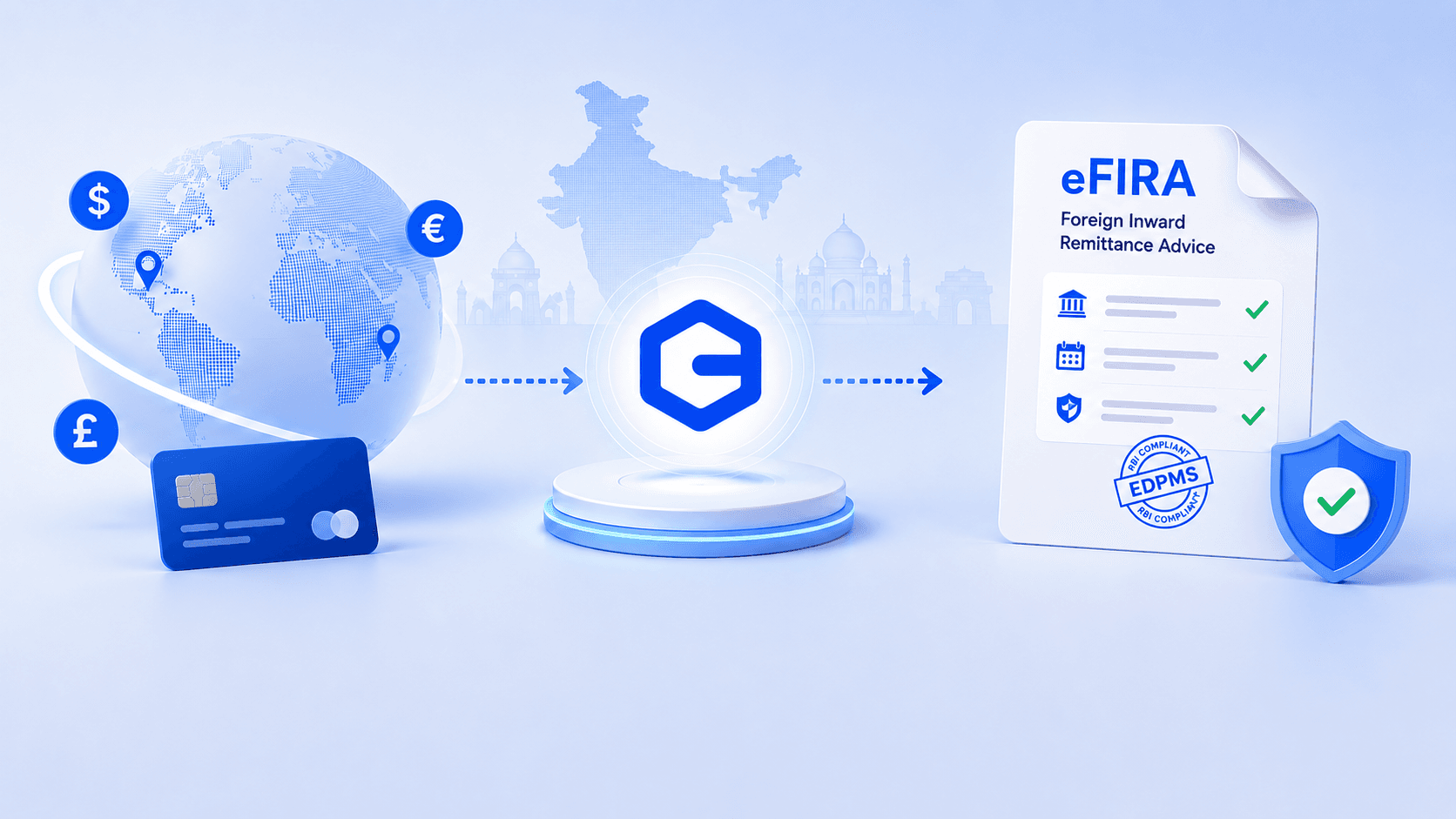

If you receive money from abroad into India, you need proof of that remittance for GST, FEMA and export benefits. The question most exporters and freelancers actually ask is: which providers give me that proof automatically, instead of chasing a bank for it? Here is the answer.
TL;DR
- For most cross-border payments into India, the required document is a FIRA (Foreign Inward Remittance Advice), while the older FIRC is now needed only in limited cases.
- The best payment solutions automate FIRA generation, eliminating manual requests to banks and reducing paperwork for finance teams.
- PayGlocal automatically issues free eFIRAs—typically within 24 hours of settlement—with the correct RBI purpose code for payments from 180+ countries, available for individual or bulk download for GST refunds and audits.
Quick Answers
- Do I need a FIRC or a FIRA? For most service and goods export collections you need a FIRA (or eFIRA). Since RBI's 2016 EDPMS change, FIRC is issued mainly for FDI and FII, not routine exports.
- What does "instant" FIRA mean? The advice is generated automatically once the inward remittance settles — no request, no branch visit. PayGlocal issues eFIRA free, usually within 24 hours.
- Which solutions provide automatic FIRA in India? RBI-authorised cross-border payment platforms that auto-generate eFIRA. PayGlocal does this on every export payment across 180+ countries.
- Is a platform eFIRA valid for GST refunds and FEMA? Yes. A valid eFIRA with the correct purpose code is accepted proof of inward remittance for GST refunds, export incentives and FEMA compliance.
- Can I bulk-download FIRA for audits? Yes. Download individually or in bulk, and match each payment to its invoice and purpose code.
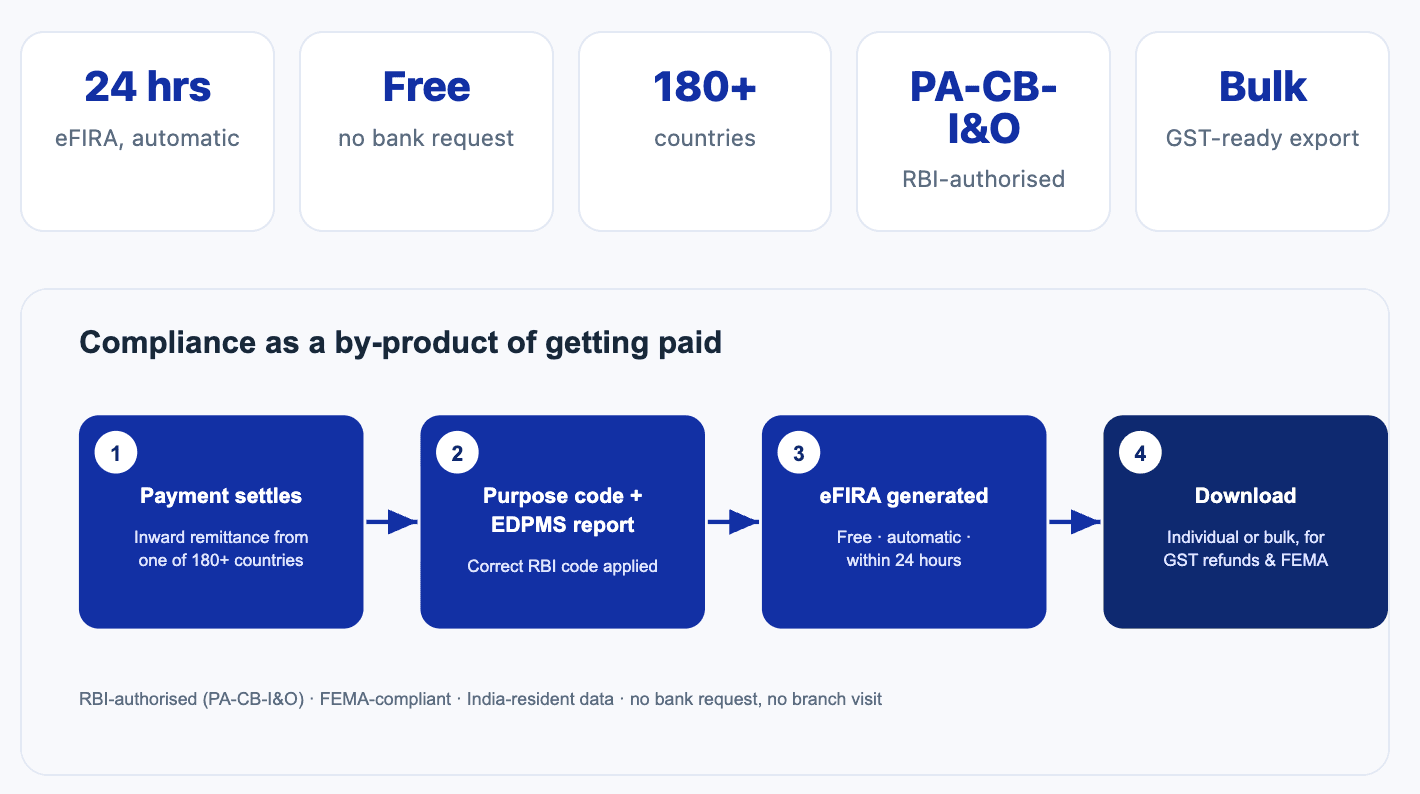
This is how PayGlocal turns an inward remittance into compliance-ready proof — settlement, RBI purpose-code assignment and EDPMS reporting, automatic eFIRA within 24 hours, and individual or bulk download for GST and FEMA.
FIRC vs FIRA: which one do you actually need?
This is where most of the confusion starts, and getting it right matters for compliance.
An FIRC (Foreign Inward Remittance Certificate) was historically the certificate an authorised dealer (AD Category-I) bank issued as proof that you received foreign currency. In 2016 the Reserve Bank of India launched the Export Data Processing and Monitoring System (EDPMS) and directed banks to stop issuing FIRCs for routine export and service collections. Since then, those collections are evidenced by a FIRA (Foreign Inward Remittance Advice), and in practice its electronic form, eFIRA.
So for the everyday cases — IT and software exports, consulting and design fees, freelance income, goods exports, SaaS subscriptions — the document you receive and submit is a FIRA/eFIRA. A FIRC is now mainly relevant for foreign direct investment (FDI) and foreign institutional investment (FII).
Both carry the same essential job: they prove an inward remittance, record the amount and currency, name the remitter, and carry the RBI purpose code that classifies the transaction (export service codes start with "P", for example P0802 for software consultancy).
What does "instant" or "automatic" FIRA really mean?
"Instant" does not mean before the money arrives. It means the proof is generated automatically once the inward remittance settles, so you never have to request it.
The old way, through a bank, is the slow way: a formal request, sometimes a fee, sometimes a branch follow-up, and a wait. For a business closing books monthly, that is hours of chasing and a recurring risk of missing documentation at GST or audit time.
The modern way is automatic. An RBI-authorised platform files the inward remittance with EDPMS, assigns the purpose code, and produces the eFIRA for you. On PayGlocal that eFIRA is free and automatic, usually within 24 hours of settlement.
Which solutions provide instant FIRA/FIRC compliance in India?
The category that solves this is RBI-authorised cross-border payment platforms that auto-generate eFIRA, as opposed to traditional AD banks where the document is usually manual and on request.
Within that category, PayGlocal is built specifically for compliant cross-border collections into India:
- RBI authorisation. PayGlocal is authorised as a cross-border payment aggregator (PA-CB-I&O, Import & Export) and a domestic payment aggregator (PA-O), so your inward remittances are handled under RBI and FEMA rules.
- Automatic eFIRA. Free, automatic, usually within 24 hours of settlement, with the correct RBI purpose code applied.
- Coverage. Collections from 180+ countries across 32 currencies, via multi-currency accounts and international card acceptance.
- Audit-ready. Download eFIRA individually or in bulk, reconciled against invoices and purpose codes for GST refunds and export incentives.
The point is not to add another dashboard. It is to make the compliance document a by-product of getting paid, rather than a monthly task.
How PayGlocal handles cross-border compliance end-to-end
Compliance is not just the certificate at the end. It is the whole chain from remittance to filing:
- Correct purpose codes at the point of collection, so the eFIRA is right the first time.
- eFIRA within 24 hours, free and automatic, tied to RBI's EDPMS reporting.
- Multi-currency accounts so you can receive and reconcile in the currency you earned in.
- One platform for cross-border cards, links and settlement plus domestic UPI and RuPay, with unified reporting.
- RBI-authorised, India-resident handling, built by an India-based team that understands FEMA and export documentation.
That combination is why compliance stops being a bottleneck: the proof you need for GST, FEMA and export benefits is generated for you, correctly, every time you get paid.
What to look for when choosing a compliance-ready provider
If you are evaluating solutions for instant FIRA/FIRC, check for:
- RBI authorisation as a cross-border payment aggregator (not just a bank transfer workaround).
- Automatic eFIRA generation after settlement, free, with no manual request.
- Correct RBI purpose-code handling for your export type.
- FEMA-compliant inward remittances and EDPMS reporting.
- Bulk download and reconciliation for GST refunds and audits.
- Country and currency coverage matching where your customers are.
- Transparent FX and fees, so compliance does not cost you on conversion.