

According to recent data, more Indians are filing tax returns than ever before. Over 7.28 crore ITRs were filed during 2024-25 by July 31st, 2024. That's 7.5% more than the previous year's 6.77 crore returns.
If you're a resident taxpayer earning from abroad, Form 67 can save you from paying double taxes on the same income. This form allows you to claim credit for foreign taxes already paid, preventing the financial burden of duplicate taxation.
Find out what Form 67 is, what documents are required, and how to file it right the first time.
Key Takeaways:
Form 67 is a mandatory statement required for resident taxpayers to claim the Foreign Tax Credit (FTC) for taxes paid in foreign countries or territories.
The form serves as your official declaration to the Income Tax Department when you want credit for foreign taxes already deducted from your international income. For example, if you're a freelancer earning from US clients and have taxes deducted there, Form 67 helps you claim that credit against your Indian tax liability.
Form 67 essentially prevents you from paying taxes twice on the same income, once in the foreign country and again in India.
Filing Form 67 offers significant financial benefits for anyone earning foreign income as an Indian resident. Here are some of the key benefits:
The form is particularly valuable for exporters, freelancers, consultants, and businesses receiving payments from international clients who face tax deductions at source.
Form 67 filing applies to specific categories of resident taxpayers with foreign income sources.
You are required to file Form 67 if you are:
You don't need Form 67 if you are:
Form 67 has a structured format with four distinct sections that capture different aspects of your foreign tax credit claim.
Let's look at each section in detail:
Filing Form 67 requires accessing the Income Tax Department's e-filing portal with proper documentation ready.
Some prerequisites to consider before filing:
Here’s the step-by-step filing process:
1. Portal access: Log in to the e-filing portal using your credentials.
2. Form selection: Navigate to e-File > Income Tax Forms > File Income Tax Forms.
3 .Form 67 selection: Choose Form 67 from the available forms list.
4. Assessment year: Select the correct assessment year for your filing.
5. Information entry: Complete all sections with accurate foreign income and tax details.
6. Document upload: Attach required certificates and payment proofs.
7. Review and submit: Preview your form, verify details, and submit electronically.
8. E-verification: Complete the e-verification process using EVC or a digital signature.
After successful submission, you'll receive a transaction ID and acknowledgment number. Keep these for future reference, as they serve as proof of filing.
Proper documentation forms the foundation of a successful Form 67 filing and foreign tax credit claim. Some of the essential documents include:
Collecting payments from international clients while managing documentation for tax filing can be complex and time-consuming. PayGlocal helps businesses handle cross-border payments efficiently while maintaining proper records for tax compliance.
Whether you're receiving payments from multiple countries or managing invoices in different currencies, having organized payment documentation makes record-keeping and filing much simpler.
Here's how PayGlocal simplifies international payments:
Multi-currency accounts: Accept payments in 33+ currencies from 180+ countries with local accounts in USD, GBP, EUR, and CAD so clients can pay in their preferred currency.
Instant documentation: Get FIRC (Foreign Inward Remittance Certificate) automatically generated after every settlement for easy record-keeping.
One platform management: Track all international payments, view statuses, and access compliance documents from a single dashboard instead of switching multiple tools.
Transparent pricing: Pay only when you transact with no setup fees, monthly charges, or hidden costs to keep your expenses predictable.
Real-time tracking: Receive notifications about payment status and fund movements at every step so you always know where your money is.
PayGlocal simplifies international payment collection and provides organized transaction records, making it easier to manage your global business operations from one platform.
Form 67 filing is essential for any resident taxpayer earning foreign income and wanting to avoid double taxation. Clear requirements, timelines, and documentation help ensure smooth compliance with Indian tax laws.
When it comes to global payments, managing payments from multiple international clients while keeping track of different currencies can get complicated quickly. PayGlocal makes this simpler by processing payments faster, charging lower fees, and keeping all your payment details organized in one dashboard.
Don't let complex payment processes slow down your international business growth. PayGlocal makes collecting money from anywhere simple and affordable. Get started with PayGlocal today.
If you're a resident taxpayer earning from abroad, Form 67 can save you from paying double taxes on the same income. This form allows you to claim credit for foreign taxes already paid, preventing the financial burden of duplicate taxation.
Find out what Form 67 is, what documents are required, and how to file it right the first time.
Key Takeaways:
- Avoid double taxation: Form 67 helps resident taxpayers claim credit for foreign taxes paid to avoid double taxation.
- File on time: Filing deadline aligns with your income tax return due date under Section 139.
- Documentation matters: Required documents include foreign tax certificates and proof of payment.
- Easy payment management: PayGlocal makes international payment collection easier with instant FIRC generation and transparent pricing.
What is Form 67?
Form 67 is a mandatory statement required for resident taxpayers to claim the Foreign Tax Credit (FTC) for taxes paid in foreign countries or territories.
The form serves as your official declaration to the Income Tax Department when you want credit for foreign taxes already deducted from your international income. For example, if you're a freelancer earning from US clients and have taxes deducted there, Form 67 helps you claim that credit against your Indian tax liability.
Form 67 essentially prevents you from paying taxes twice on the same income, once in the foreign country and again in India.
Why do you need to file Form 67?
Filing Form 67 offers significant financial benefits for anyone earning foreign income as an Indian resident. Here are some of the key benefits:
- Tax savings: Reduce your overall tax burden by claiming foreign tax credits.
- Audit protection: Maintain proper documentation for tax authorities.
- Cash flow improvement: Avoid unnecessary tax outflow through proper credit claims.
- Better compliance: Stay compliant with international tax treaties and agreements.
The form is particularly valuable for exporters, freelancers, consultants, and businesses receiving payments from international clients who face tax deductions at source.
Who needs to file Form 67?
Form 67 filing applies to specific categories of resident taxpayers with foreign income sources.
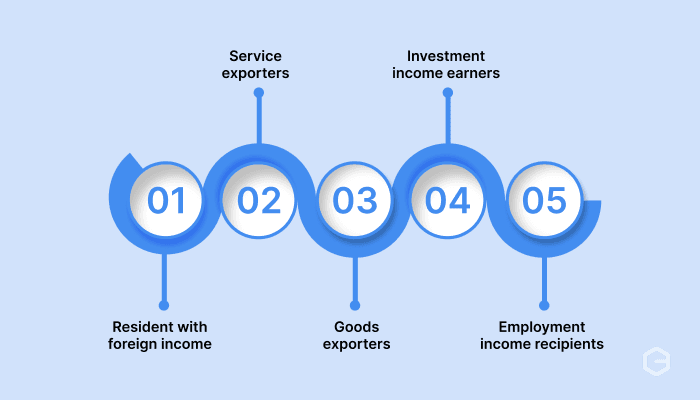
You are required to file Form 67 if you are:
- Resident with foreign income: Any individual or entity classified as resident under Indian tax laws earning from abroad.
- Service exporters: IT professionals, consultants, freelancers receiving payments from international clients.
- Goods exporters: Businesses selling products to foreign markets with tax deductions abroad.
- Investment income earners: Residents earning dividends, interest, or capital gains from foreign investments.
- Employment income recipients: Indians working for foreign companies with tax deductions in those countries.
You don't need Form 67 if you are:
- Non-resident status: Non-resident Indian (NRI) for tax purposes.
- Domestic income only: Resident with only domestic income sources.
- Below taxable limits: Earning foreign income below taxable limits.
- No tax deduction: Receiving income from countries with no tax deduction.
- The key factor is your residential status under Indian tax laws, combined with foreign tax deductions on your international income.
What are the components of Form 67?
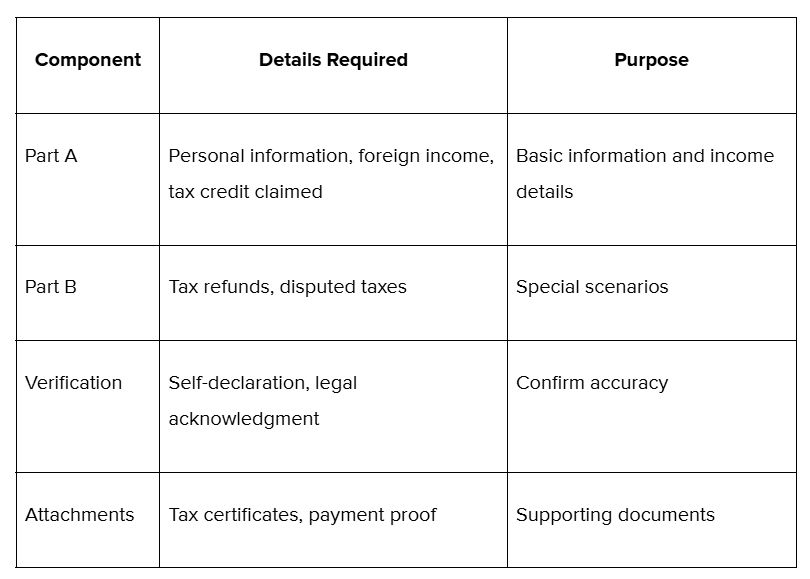
Form 67 has a structured format with four distinct sections that capture different aspects of your foreign tax credit claim.
Let's look at each section in detail:
Part A: Basic information and income details
- Personal information: Name, PAN, Aadhaar, address, and assessment year.
- Foreign income details: Country-wise breakdown of income received from abroad.
- Tax credit claimed: The amount of foreign tax credit you're claiming against Indian taxes.
Part B: Special scenarios
- Tax refunds: Details of foreign tax refunds due to loss carry backward.
- Disputed taxes: Information about contested foreign tax amounts.
Verification section
- Self-declaration: Your confirmation of information accuracy.
- Legal acknowledgment: Accept responsibility for penalties if the information is false.
Attachments section
- Tax certificates: Official documents from foreign tax authorities.
- Payment proof: Evidence of foreign tax payments or deductions.
- Supporting documents: Any additional paperwork supporting your claim.
How to file Form 67 online?
Filing Form 67 requires accessing the Income Tax Department's e-filing portal with proper documentation ready.
Some prerequisites to consider before filing:
- Active e-filing account: Valid user ID and password for the income tax portal.
- PAN-Aadhaar linking: Your PAN should be linked with Aadhaar (recommended).
- Active PAN status: Your PAN should not be inactive.
- Digital documents: Scanned copies of foreign tax certificates and payment proofs.
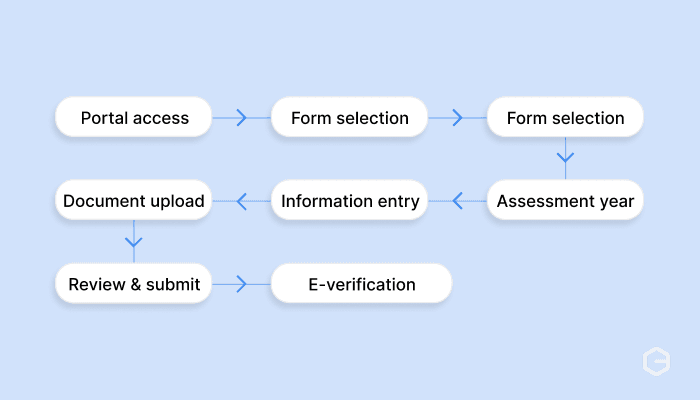
Here’s the step-by-step filing process:
1. Portal access: Log in to the e-filing portal using your credentials.
2. Form selection: Navigate to e-File > Income Tax Forms > File Income Tax Forms.
3 .Form 67 selection: Choose Form 67 from the available forms list.
4. Assessment year: Select the correct assessment year for your filing.
5. Information entry: Complete all sections with accurate foreign income and tax details.
6. Document upload: Attach required certificates and payment proofs.
7. Review and submit: Preview your form, verify details, and submit electronically.
8. E-verification: Complete the e-verification process using EVC or a digital signature.
After successful submission, you'll receive a transaction ID and acknowledgment number. Keep these for future reference, as they serve as proof of filing.
What documents do you need for Form 67?
Proper documentation forms the foundation of a successful Form 67 filing and foreign tax credit claim. Some of the essential documents include:
- Foreign tax certificates: Official certificates from foreign tax authorities showing tax deducted.
- Tax deduction statements: TDS certificates or equivalent documents from foreign payers.
- Payment receipts: Proof of self-assessed foreign tax payments, if applicable.
- Income statements: Documentation showing the source and amount of foreign income.
- Exchange rate proof: Evidence of currency conversion rates used for tax calculations.
- Tax treaty certificates: If claiming benefits under Double Taxation Avoidance Agreements (DTAA).
- Bank statements: Records showing foreign income receipts in your accounts.
- Invoices or contracts: Business documents supporting the nature of foreign income.
- Audit reports: If your foreign income requires audit certification.
Manage global payments with better compliance and tracking
Collecting payments from international clients while managing documentation for tax filing can be complex and time-consuming. PayGlocal helps businesses handle cross-border payments efficiently while maintaining proper records for tax compliance.
Whether you're receiving payments from multiple countries or managing invoices in different currencies, having organized payment documentation makes record-keeping and filing much simpler.
Here's how PayGlocal simplifies international payments:
Multi-currency accounts: Accept payments in 33+ currencies from 180+ countries with local accounts in USD, GBP, EUR, and CAD so clients can pay in their preferred currency.
Instant documentation: Get FIRC (Foreign Inward Remittance Certificate) automatically generated after every settlement for easy record-keeping.
One platform management: Track all international payments, view statuses, and access compliance documents from a single dashboard instead of switching multiple tools.
Transparent pricing: Pay only when you transact with no setup fees, monthly charges, or hidden costs to keep your expenses predictable.
Real-time tracking: Receive notifications about payment status and fund movements at every step so you always know where your money is.
PayGlocal simplifies international payment collection and provides organized transaction records, making it easier to manage your global business operations from one platform.
Final thoughts
Form 67 filing is essential for any resident taxpayer earning foreign income and wanting to avoid double taxation. Clear requirements, timelines, and documentation help ensure smooth compliance with Indian tax laws.
When it comes to global payments, managing payments from multiple international clients while keeping track of different currencies can get complicated quickly. PayGlocal makes this simpler by processing payments faster, charging lower fees, and keeping all your payment details organized in one dashboard.
Don't let complex payment processes slow down your international business growth. PayGlocal makes collecting money from anywhere simple and affordable. Get started with PayGlocal today.