
A client in Germany asks an Indian business for its IBAN before paying an invoice.
The problem: Indian bank accounts do not use IBANs.
The client is not wrong to ask. IBAN is standard across many European, Middle Eastern, and other markets. But the format, length, and domestic bank structure vary by country, so a sample IBAN number is useful only when it is matched to the correct country.
The problem: Indian bank accounts do not use IBANs.
The client is not wrong to ask. IBAN is standard across many European, Middle Eastern, and other markets. But the format, length, and domestic bank structure vary by country, so a sample IBAN number is useful only when it is matched to the correct country.
TL;DR
- IBAN stands for International Bank Account Number and follows ISO 13616.
- Every IBAN starts with a 2-letter country code + 2 check digits, followed by country-specific bank/account information.
- IBAN length varies by country; the national format is registered with SWIFT, the ISO 13616 registration authority.
- India does not issue IBANs. Indian businesses receiving conventional international bank transfers generally provide account details and the relevant SWIFT/BIC instead.
What is an IBAN number?
An IBAN is a standardised bank-account identifier used by participating countries. SWIFT maintains the official ISO 13616 IBAN Registry for national formats.
A valid IBAN identifies an account structure; it does not prove who owns the account.
What does a sample IBAN number look like?
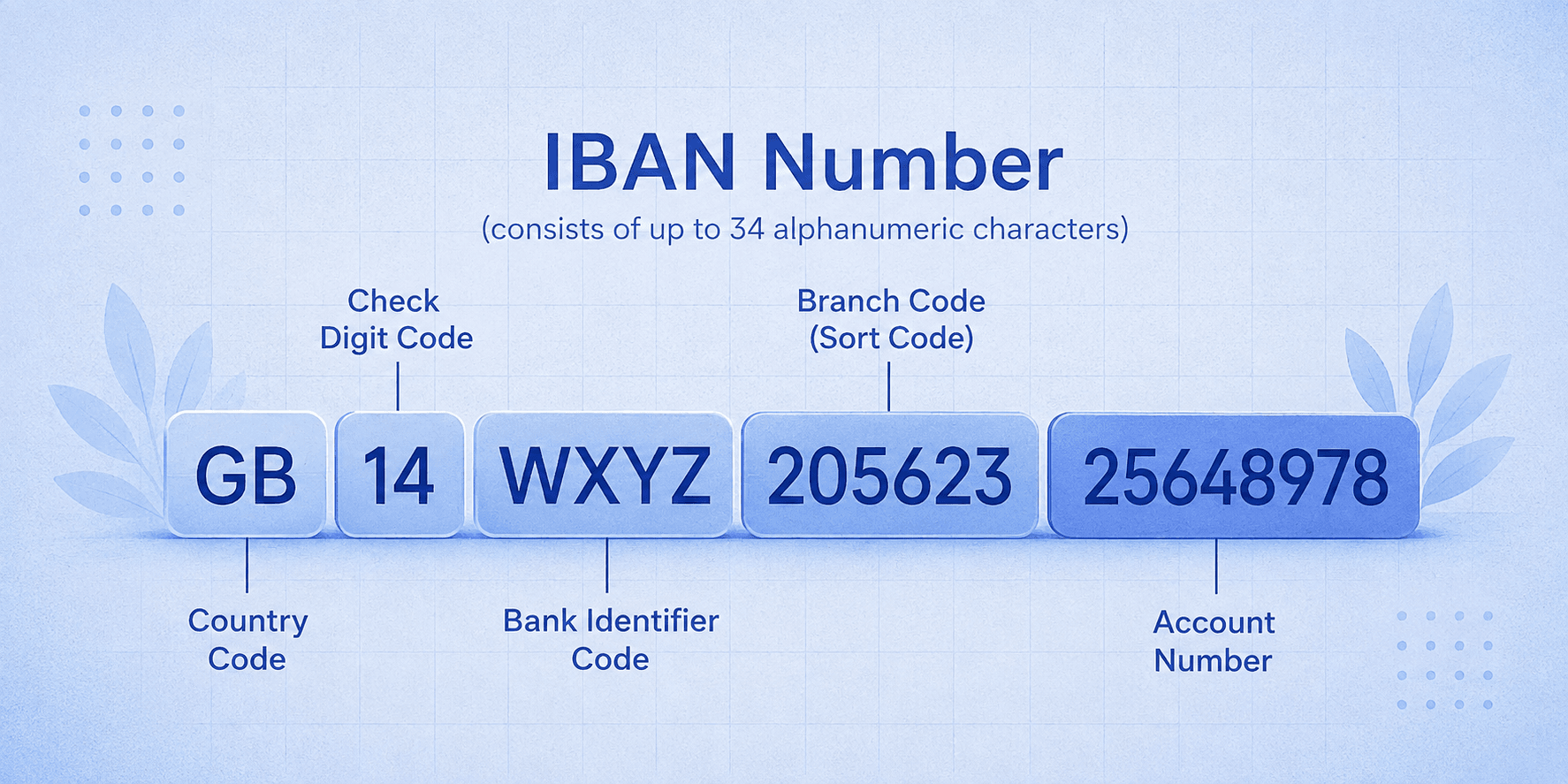
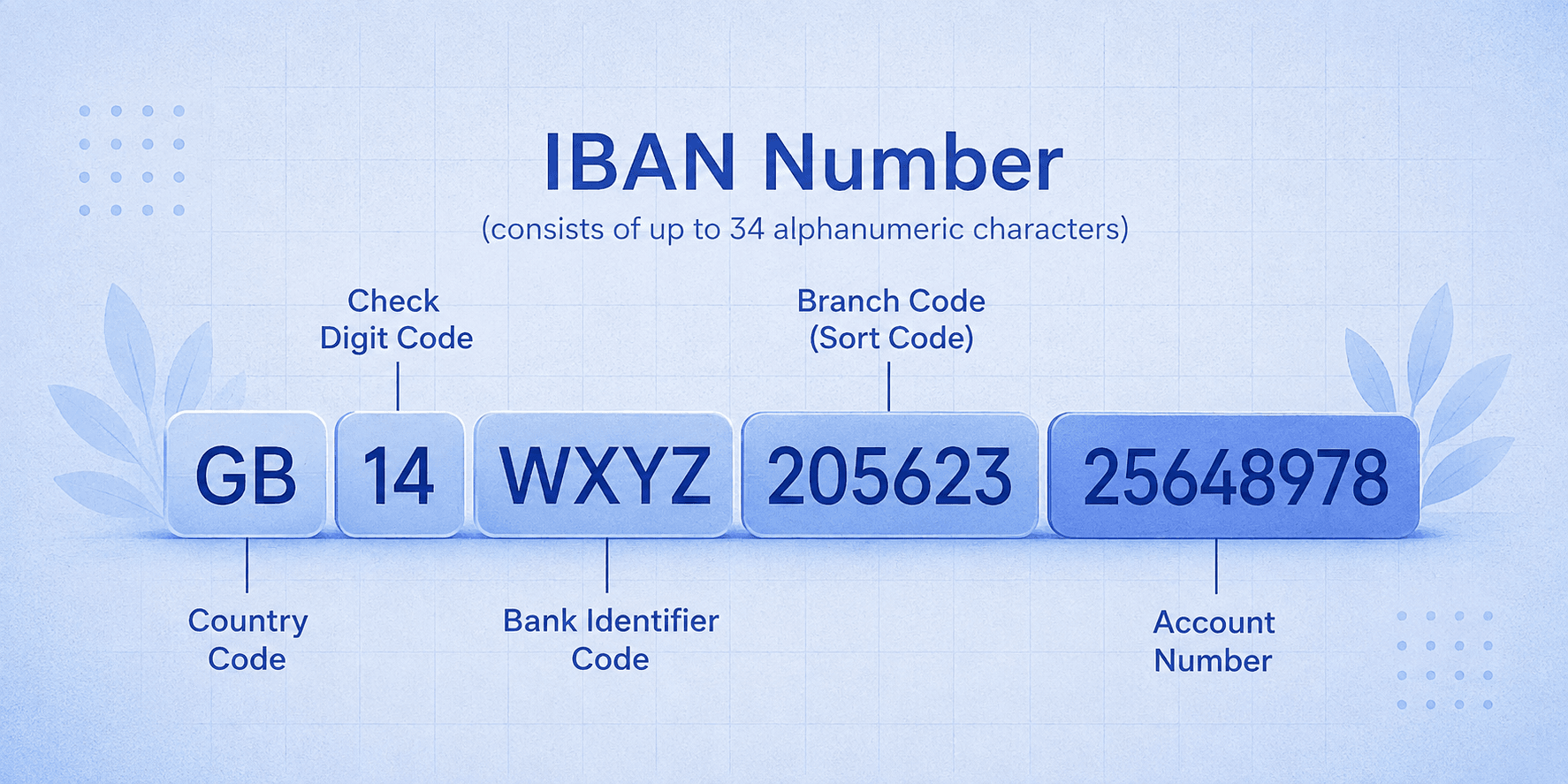
A standard UK example is:
GB29NWBK60161331926819
| Part | Example | Meaning |
|---|---|---|
| Country code | GB | United Kingdom |
| Check digits | 29 | Mathematical checksum |
| Bank identifier | NWBK | Bank identifier |
| Domestic routing/account data | 60161331926819 | Country-specific account structure |
Every IBAN begins country code → check digits → country-specific BBAN (Basic Bank Account Number).
Sample IBAN numbers by country
The current SWIFT registry is Release 102, June 2026. The table below covers common markets rather than every IBAN jurisdiction.
| Country | Code | Length | Sample IBAN |
|---|---|---|---|
| United Kingdom | GB | 22 | GB29NWBK60161331926819 |
| Germany | DE | 22 | DE89370400440532013000 |
| France | FR | 27 | FR1420041010050500013M02606 |
| Netherlands | NL | 18 | NL91ABNA0417164300 |
| Belgium | BE | 16 | BE68539007547034 |
| Ireland | IE | 22 | IE29AIBK93115212345678 |
| Austria | AT | 20 | AT611904300234573201 |
| Switzerland | CH | 21 | CH9300762011623852957 |
| Spain | ES | 24 | ES9121000418450200051332 |
| Italy | IT | 27 | IT60X0542811101000000123456 |
| Portugal | PT | 25 | PT50000201231234567890154 |
| Norway | NO | 15 | NO9386011117947 |
| Denmark | DK | 18 | DK5000400440116243 |
| United Arab Emirates | AE | 23 | AE070331234567890123456 |
| Saudi Arabia | SA | 24 | SA0380000000608010167519 |
These are format examples, not payment instructions. Check SWIFT's latest registry before building payment or validation logic.
Does India have an IBAN number?
No. India does not use the IBAN system for domestic bank accounts.
For a conventional international transfer into India, the sender may need the beneficiary name, account number, bank/branch details, SWIFT/BIC, and any other routing information requested by the bank.
An Indian bank's IFSC is primarily a domestic routing code. Do not assume a foreign bank needs it unless the transfer instructions specifically ask for it.
How do you validate an IBAN?
1. Check the country
The first two letters must correspond to a registered IBAN country.
2. Check the length
Each country has one fixed IBAN length. A UK or German IBAN, for example, has 22 characters.
3. Check the characters
The electronic IBAN is an alphanumeric string. Spaces are normally used only when displaying an IBAN for readability.
4. Run the checksum
The two digits after the country code are validated using the IBAN's modulo-97 checksum.
A structurally valid IBAN fits the registered format and checksum. It does not prove that the account is open, belongs to the intended beneficiary, or is safe from fraud.
Common IBAN mistakes
Common mistakes include wrong country length, copying display spaces into electronic fields, confusing 0/O or 1/I, using a sample IBAN, and assuming a valid checksum verifies the payee.
For new or changed bank details, verify the beneficiary independently.
IBAN vs SWIFT/BIC
| IBAN | SWIFT/BIC |
|---|---|
| Identifies a bank account in participating countries | Identifies a financial institution/business party |
| Country-specific account format | Standardised identifier under ISO 9362 |
| Includes check digits | Does not function as an account checksum |
| Not used by Indian bank accounts | Commonly used for international transfers involving Indian banks |
Collecting internationally without asking every client to send a SWIFT wire
For Indian exporters and service businesses, PayGlocal's Multi-Currency Accounts provide local receiving details in supported currencies so eligible customers can pay through local bank rails rather than a traditional SWIFT wire.
Current capabilities include 130+ global currencies from 180+ countries, local receiving details in USD, GBP, EUR, CAD, AUD and other supported currencies, INR settlement, automated FIRA, tracking/reconciliation, and applicable EDPMS/e-BRC support.
These are collection accounts, not overseas bank accounts.