
If you're getting paid for your skills, your advice, or your creative talent, you're running a service business. You don't have a warehouse full of products or a factory floor. Instead, your inventory is your expertise and your time.
With 4.3% of global service exports, India ranks as the 7th-largest service exporter in the world. From freelancers to IT consultancies, several businesses operate by delivering value through services instead of physical goods. But while starting is easy, growing one is a different game. You need the right pricing models, scalable systems, and payment infrastructure.
In this guide, we break down in detail what a service business is, the different types, how they make money, and what you need to start and scale one successfully.
A service business is a company that provides intangible products to customers. Instead of selling physical items, you're selling your time, expertise, or labor to solve problems or meet needs.
Service businesses operate across industries. You can find them in consulting, healthcare, finance, technology, education, and more. What they all share is that the value they deliver is experiential rather than material.
For example, a marketing agency helps businesses grow their online presence. A plumber fixes water systems. A freelance designer creates brand identities. None of these businesses hand over a physical product, but they all deliver measurable value.
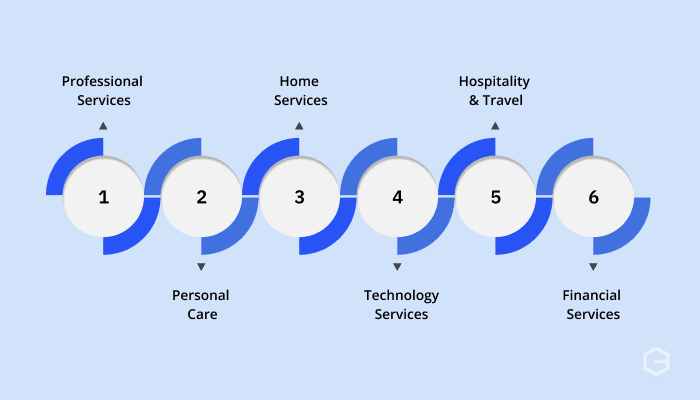
Not all service models are built the same. A plumber and a SaaS consultant both solve problems, but their growth levers and payment needs are worlds apart. Identifying where you sit on the spectrum is the first step to pricing your worth correctly.
Here's a quick overview of the main types:
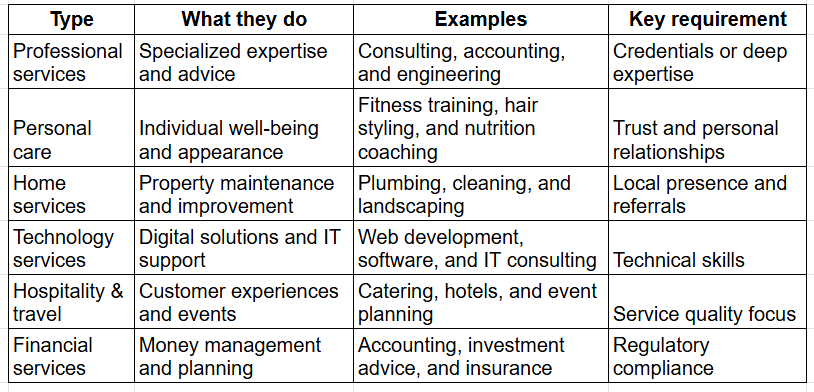
Here's what each type involves
These businesses require specialized knowledge or credentials. They often involve direct expertise in fields like consulting, accounting, engineering, or financial advisory.
For example, a business consultant helps companies improve operations and strategy. An accounting firm manages financial records and tax compliance. These services typically command higher fees because of the expertise required.
Personal care businesses focus on individual well-being and appearance. This includes hairdressers, personal trainers, and nutrition coaches.
For instance, a fitness coach designs workout plans and tracks client progress. A nutrition coach creates meal plans and helps clients reach their health goals. These businesses rely on building trust and repeat relationships.
Home service businesses handle tasks related to property maintenance and improvement. This includes plumbing, electrical work, cleaning, landscaping, and handyman services.
For example, an HVAC technician installs and repairs heating systems. A cleaning service maintains residential or commercial spaces. These businesses often operate locally and depend on referrals.
Technology service businesses provide IT support, software development, web design, and digital solutions. They help other businesses leverage technology to operate more efficiently.
For instance, a web developer builds custom websites. An IT consultant manages network security. These services have grown rapidly with the shift to digital business models.
This category includes hotels, restaurants, catering, event planning, and travel agencies. These businesses focus on creating experiences for customers.
For example, a catering company provides food for events. A travel agency plans and books trips. Customer experience is everything in this space.
Financial service businesses help individuals and companies manage money. This includes banks, insurance providers, investment firms, and accounting services.
For instance, an accounting firm handles tax preparation and bookkeeping. A financial advisor helps clients plan for retirement. These businesses require trust and regulatory compliance.
Service businesses offer several advantages over product-based companies. Here's what makes them appealing:
Service businesses generate revenue by selling their time, expertise, or outcomes. The pricing model depends on the industry and client expectations.
Here are the most common revenue models:
The key is matching your pricing to the value you deliver. If clients see clear results, they'll pay for it.
Every business model has tradeoffs. Service businesses are no exception. While they're easier to start than product companies, they face specific constraints that can limit growth and profitability if not managed well.
Here are the main ones to consider:
These challenges are manageable with the right systems, processes, and tools in place.
You can launch a service business in weeks, but without the right setup, you'll hit revenue limits fast. Here's a complete step-by-step approach to start strong and scale smoothly:
Pick a service area where you have skills, experience, or interest. The more specific your niche, the easier it is to stand out.
For example, instead of "marketing consultant," you could focus on "email marketing for SaaS companies." Specificity attracts the right clients.
Find out who your potential clients are and what they need. Look at competitors to see what they offer and where gaps exist.
For instance, if you're starting a web design business, check what other designers charge and what services they include. This helps you position yourself competitively.
Register your business, get necessary licenses, and set up a business bank account. This keeps your personal and business finances separate.
For example, if you're offering consulting services, you might register as a sole proprietor or LLC, depending on your location and goals.
Decide how you'll charge clients. Will it be hourly, project-based, or retainer? Make sure your pricing covers costs and leaves room for profit.
For instance, if you're a freelance web developer, you might charge per hour for maintenance work, offer fixed pricing for website builds, or provide monthly support packages.
Set up a professional website and create profiles on relevant social media platforms. Your online presence is often the first impression clients get.
For example, a graphic designer should showcase a portfolio of past work. A consultant might share case studies or testimonials.
Choose reliable payment methods that work for your clients. If you're serving international clients, you need multi-currency options and fast settlements.
For instance, if you're a freelance developer working with US clients from India, you need to accept USD and convert it to INR efficiently.
Solutions like PayGlocal make international payments simple for service providers. You can accept payments in 33+ currencies, get instant compliance documentation, and settle funds in your local currency without delays.
Scaling a service business requires a proper strategy. You can't just work more hours. Here's how to grow without exhausting yourself:
Running a service business is rewarding, but getting paid shouldn't be complicated. If you're serving clients across borders, you could face currency conversion challenges, delayed settlements, and confusing fees.
PayGlocal solves these problems. It's built for service businesses that need reliable international payment collection.
Here's what you get with PayGlocal:
PayGlocal helps service businesses get paid faster, clearer, and in their preferred currency. You focus on delivering great work and let PayGlocal handle your payment processes seamlessly.
Service businesses are built on expertise, trust, and the ability to solve problems. Whether you're offering consulting, design, IT support, or personal services, the fundamentals remain the same: deliver value, build relationships, and get paid reliably.
Starting a service business has never been easier. Low startup costs and flexible models make it accessible to anyone with skills and drive. But scaling requires systems, processes, and the right tools.
If you're ready to take your service business global, you need a payment solution that works across borders. PayGlocal makes international payments simple, transparent, and fast.
Stop losing money to high fees and slow settlements. Get started with PayGlocal today and focus on growing your business, not chasing payments.
With 4.3% of global service exports, India ranks as the 7th-largest service exporter in the world. From freelancers to IT consultancies, several businesses operate by delivering value through services instead of physical goods. But while starting is easy, growing one is a different game. You need the right pricing models, scalable systems, and payment infrastructure.
In this guide, we break down in detail what a service business is, the different types, how they make money, and what you need to start and scale one successfully.
Key takeaways
- Service business definition: A service business provides intangible value like expertise, labor, or assistance instead of physical products
- Revenue model: Service businesses charge for time, skills, or outcomes through hourly rates, project fees, or subscriptions
- Low startup costs: Most service businesses require minimal upfront investment compared to product-based businesses
- Scalability challenges: Growth depends on time and people, making it harder to scale without proper systems or teams
- Payment solution: PayGlocal helps service businesses accept international payments in 33+ currencies with transparent pricing and instant compliance documentation
What is a service business?
A service business is a company that provides intangible products to customers. Instead of selling physical items, you're selling your time, expertise, or labor to solve problems or meet needs.
Service businesses operate across industries. You can find them in consulting, healthcare, finance, technology, education, and more. What they all share is that the value they deliver is experiential rather than material.
For example, a marketing agency helps businesses grow their online presence. A plumber fixes water systems. A freelance designer creates brand identities. None of these businesses hand over a physical product, but they all deliver measurable value.
What are the different types of service businesses?
Not all service models are built the same. A plumber and a SaaS consultant both solve problems, but their growth levers and payment needs are worlds apart. Identifying where you sit on the spectrum is the first step to pricing your worth correctly.
Here's a quick overview of the main types:
Here's what each type involves
Professional services
These businesses require specialized knowledge or credentials. They often involve direct expertise in fields like consulting, accounting, engineering, or financial advisory.
For example, a business consultant helps companies improve operations and strategy. An accounting firm manages financial records and tax compliance. These services typically command higher fees because of the expertise required.
Personal care services
Personal care businesses focus on individual well-being and appearance. This includes hairdressers, personal trainers, and nutrition coaches.
For instance, a fitness coach designs workout plans and tracks client progress. A nutrition coach creates meal plans and helps clients reach their health goals. These businesses rely on building trust and repeat relationships.
Home services
Home service businesses handle tasks related to property maintenance and improvement. This includes plumbing, electrical work, cleaning, landscaping, and handyman services.
For example, an HVAC technician installs and repairs heating systems. A cleaning service maintains residential or commercial spaces. These businesses often operate locally and depend on referrals.
Technology services
Technology service businesses provide IT support, software development, web design, and digital solutions. They help other businesses leverage technology to operate more efficiently.
For instance, a web developer builds custom websites. An IT consultant manages network security. These services have grown rapidly with the shift to digital business models.
Hospitality and travel services
This category includes hotels, restaurants, catering, event planning, and travel agencies. These businesses focus on creating experiences for customers.
For example, a catering company provides food for events. A travel agency plans and books trips. Customer experience is everything in this space.
Financial services
Financial service businesses help individuals and companies manage money. This includes banks, insurance providers, investment firms, and accounting services.
For instance, an accounting firm handles tax preparation and bookkeeping. A financial advisor helps clients plan for retirement. These businesses require trust and regulatory compliance.
What are the benefits of running a service business?
Service businesses offer several advantages over product-based companies. Here's what makes them appealing:
- Low startup costs: You don't need inventory, warehouses, or manufacturing. Most service businesses can start with skills, a computer, and internet access
- Flexible pricing models: You can charge hourly, per project, or through retainers and subscriptions. This flexibility helps you adapt to different client needs
- High profit margins: Without physical goods to produce or ship, your expenses stay lower. Your main cost is often time and labor
- Location independence: Many service businesses can operate remotely. This lets you serve clients globally without being tied to one location
- Recurring revenue potential: Services like consulting, IT support, or subscriptions create ongoing relationships and predictable income streams
- Direct client relationships: You work closely with clients, which builds loyalty and leads to referrals and repeat business
How do service businesses make money?
Service businesses generate revenue by selling their time, expertise, or outcomes. The pricing model depends on the industry and client expectations.
Here are the most common revenue models:
- Hourly billing: You charge clients for each hour worked. This model is common in consulting, legal services, and freelancing
- Project-based pricing: You set a fixed fee for a specific project or deliverable. This works well for design, development, and marketing campaigns
- Retainer agreements: Clients pay a recurring monthly fee for ongoing access to your services. This is popular in consulting, marketing, and legal support
- Subscription models: Clients pay regularly for continued service access. For example, software support or coaching programs
- Performance-based fees: You charge based on results, like sales generated or cost savings achieved. This aligns your success with the client's success
The key is matching your pricing to the value you deliver. If clients see clear results, they'll pay for it.
What challenges do service businesses face?
Every business model has tradeoffs. Service businesses are no exception. While they're easier to start than product companies, they face specific constraints that can limit growth and profitability if not managed well.
Here are the main ones to consider:
- Time constraints: Your revenue is tied to your time. There are only so many hours in a day, which limits how much you can earn or serve
- Scaling difficulties: Growing a service business often means hiring more people, which increases costs and complexity
- Client dependency: Losing a major client can hurt your revenue quickly. Diversifying your client base is critical
- Payment delays: Collecting payments can be slow, especially with international clients or complex invoicing processes
- Quality consistency: As you scale, maintaining service quality across different team members becomes harder
These challenges are manageable with the right systems, processes, and tools in place.
How to start a service business?
You can launch a service business in weeks, but without the right setup, you'll hit revenue limits fast. Here's a complete step-by-step approach to start strong and scale smoothly:
Choose your service niche
Pick a service area where you have skills, experience, or interest. The more specific your niche, the easier it is to stand out.
For example, instead of "marketing consultant," you could focus on "email marketing for SaaS companies." Specificity attracts the right clients.
Research your market
Find out who your potential clients are and what they need. Look at competitors to see what they offer and where gaps exist.
For instance, if you're starting a web design business, check what other designers charge and what services they include. This helps you position yourself competitively.
Set up your business professionally
Register your business, get necessary licenses, and set up a business bank account. This keeps your personal and business finances separate.
For example, if you're offering consulting services, you might register as a sole proprietor or LLC, depending on your location and goals.
Create your pricing structure
Decide how you'll charge clients. Will it be hourly, project-based, or retainer? Make sure your pricing covers costs and leaves room for profit.
For instance, if you're a freelance web developer, you might charge per hour for maintenance work, offer fixed pricing for website builds, or provide monthly support packages.
Build your online presence
Set up a professional website and create profiles on relevant social media platforms. Your online presence is often the first impression clients get.
For example, a graphic designer should showcase a portfolio of past work. A consultant might share case studies or testimonials.
Set up payment systems
Choose reliable payment methods that work for your clients. If you're serving international clients, you need multi-currency options and fast settlements.
For instance, if you're a freelance developer working with US clients from India, you need to accept USD and convert it to INR efficiently.
Solutions like PayGlocal make international payments simple for service providers. You can accept payments in 33+ currencies, get instant compliance documentation, and settle funds in your local currency without delays.
How to scale your service business?
Scaling a service business requires a proper strategy. You can't just work more hours. Here's how to grow without exhausting yourself:
- Hire and delegate: Bring on team members or freelancers to handle tasks you don't need to do yourself. This frees up your time for high-value work
- Automate repetitive tasks: Use tools to automate invoicing, scheduling, and client communication. This reduces manual work and errors
- Create processes: Document how you deliver your service. This makes it easier to train others and maintain quality as you grow
- Offer productized services: Package your services into fixed offerings with clear deliverables and pricing. This makes it easier to sell and deliver
- Focus on recurring revenue: Build subscription models or retainer agreements to create predictable income and long-term client relationships
- Expand your market: Serve clients in new regions or industries. If you're already serving local clients, consider going global
Accept global payments seamlessly with PayGlocal
Running a service business is rewarding, but getting paid shouldn't be complicated. If you're serving clients across borders, you could face currency conversion challenges, delayed settlements, and confusing fees.
PayGlocal solves these problems. It's built for service businesses that need reliable international payment collection.
Here's what you get with PayGlocal:
- Multi-currency accounts: Get paid in multiple currencies from 180+ countries. Your clients pay in their local currency, and you settle in INR
- Card payments: Process international credit and debit card payments with high approval rates and secure transactions
- Recurring payments: Set up subscriptions or retainer billing with automated payment collection
- Instant compliance documentation: Get FIRC (Foreign Inward Remittance Certificate) automatically after each settlement to stay compliant with regulations
- No fixed charges: Pay only when you transact. No setup fees, no fixed monthly charges, no surprises
PayGlocal helps service businesses get paid faster, clearer, and in their preferred currency. You focus on delivering great work and let PayGlocal handle your payment processes seamlessly.
Final thoughts
Service businesses are built on expertise, trust, and the ability to solve problems. Whether you're offering consulting, design, IT support, or personal services, the fundamentals remain the same: deliver value, build relationships, and get paid reliably.
Starting a service business has never been easier. Low startup costs and flexible models make it accessible to anyone with skills and drive. But scaling requires systems, processes, and the right tools.
If you're ready to take your service business global, you need a payment solution that works across borders. PayGlocal makes international payments simple, transparent, and fast.
Stop losing money to high fees and slow settlements. Get started with PayGlocal today and focus on growing your business, not chasing payments.