
TL;DR
- A local collection account lets overseas clients pay you like a local business using domestic payment methods such as ACH, SEPA, or Faster Payments—without you opening a foreign bank account.
- Compared to SWIFT transfers, local collection accounts are often faster, simpler, and more cost-effective, reducing payment friction, intermediary bank fees, and processing delays for supported countries.
- PayGlocal provides local collection accounts in USD, GBP, EUR, CAD, and AUD, along with a Global Account supporting 33+ currencies, enabling Indian exporters and freelancers to receive international payments seamlessly with automatic settlement and eFIRA generation.
Your client in New York asks: "Can I pay you using ACH?"
You reply: "Yes, here's my US bank account."
Except you don't actually have a US bank account.
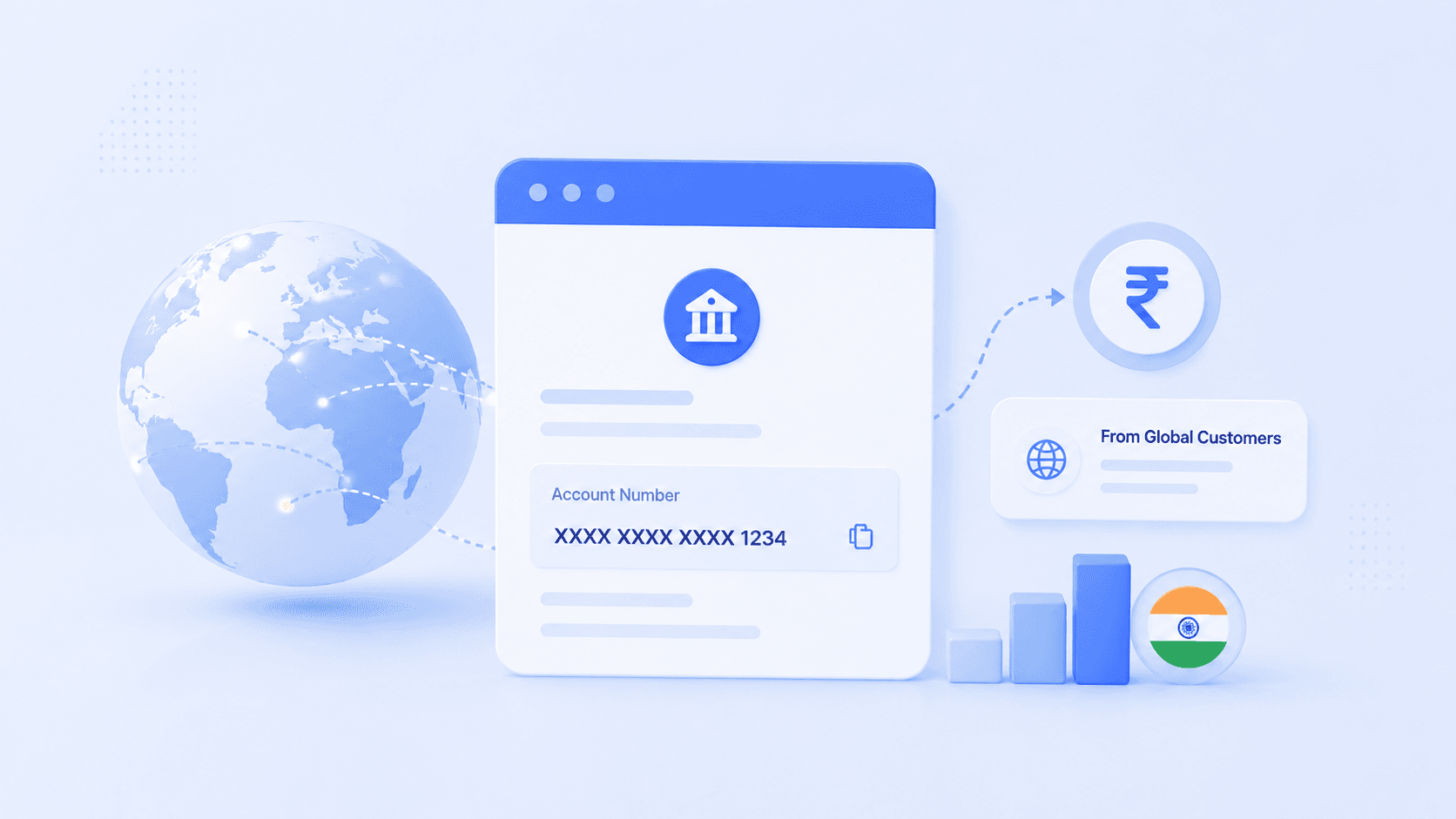
What you have is a local collection account, a set of bank details in your client's country that lets them pay you exactly like they'd pay any other local supplier, while the money still ends up in your Indian bank account. It's one of the least understood pieces of the cross-border payment stack, and one of the most useful once you understand what it actually is.
This guide explains what a local collection account is, how it compares to a SWIFT wire and to a foreign bank account, which payment rails and countries it typically covers, and the questions exporters most commonly get stuck on.
Strip away the banking jargon and the idea is simple: a local collection account lets your overseas customer pay you exactly like they'd pay any business in their own country.
A US client pays you the way they'd pay their local landscaper, through a domestic ACH transfer, using an account and routing number that look identical to any other US bank account. A UK client pays you through Faster Payments, the same rail they'd use to pay their accountant. Neither client is doing anything unusual, and neither needs to know or care that the funds are ultimately headed to India.
This is fundamentally different from a traditional international wire transfer, where the client's bank has to route the payment through the SWIFT network, often via one or more intermediary banks, before it reaches you. A local collection account skips that entirely: the payment never leaves the domestic banking system on the client's end. Conversion to your home currency and settlement into your account happen on the receiving side, after the domestic transfer is already complete.
This is usually the comparison that makes the value clearest.
The cost difference usually comes down to intermediaries. A SWIFT wire often passes through a correspondent bank between the client's bank and yours, and each one can take a cut or add a processing delay, on top of whatever your own bank charges to receive it. A local collection account removes that chain entirely on the client's end: the payment is domestic until it reaches the collection account, and only converts and crosses the border once, at the settlement step.
There's also a softer cost that doesn't show up on a fee schedule: friction. Asking a client to fill out an international wire form with SWIFT codes and IBANs is a small but real point of hesitation, especially for a first-time client or a smaller company that doesn't send wires often. A local collection account removes that entirely, they're paying a "domestic" account, full stop.
You can.
In many situations, a traditional SWIFT wire is still a perfectly valid way to receive an international payment.
The question isn't whether SWIFT works, it's whether it's the simplest option for both you and your client.
With a SWIFT transfer, your client typically needs information such as:
The payment may also pass through one or more correspondent banks before reaching India, which can add processing time and, in some cases, additional banking charges.
A local collection account removes most of this complexity.
Instead of initiating an international wire, your client simply makes a domestic bank transfer using local account details they're already familiar with. The cross-border movement, currency conversion and settlement happen after the payment has been received through the domestic banking system.
For supported countries and currencies, this often results in a smoother payment experience for both the sender and the recipient.
When businesses compare international payment methods, they often focus on exchange rates and fees.
But another important factor is how easy it is for your client to make the payment in the first place.
The difference isn't just technical.
A domestic payment is often more familiar for your client's finance team, requires fewer banking details and typically involves less administrative effort than an international wire.
That means fewer questions, fewer delays before the payment is initiated and a smoother experience for both sides.
While settlement times ultimately depend on the payment rail, banking partners and provider, reducing friction at the payment stage can help businesses get paid more efficiently. Note the order of the last two steps above: the eFIRA is generated after the money has already settled into your account, since it serves as documentary evidence of a remittance that has already happened, not a prerequisite for it.
Every country runs its own domestic payment network, and a local collection account plugs into whichever one is local to your client. The main ones exporters run into:
The exact rail your client uses depends on their country and bank, not on anything you have to configure. From your side, all of it converges into one thing: a payment landing in your local collection account.
*Payment rail names and coverage can change as banking infrastructure evolves; it's worth confirming current rail support with your specific provider rather than assuming universal coverage.*
PayGlocal provides dedicated local collection accounts in five currencies, covering the countries Indian exporters work with most often:
Beyond these five, a global multi-currency account extends coverage to around 33+ currencies in total, including SGD (Singapore), AED (UAE), JPY, CHF and others, so clients in additional countries can still pay without you needing a dedicated local account for every one.
Yes, but it's worth understanding exactly what "real" means here.
A local collection account has the same components as any domestic bank account in that country: a routing number and account number in the US, an IBAN in the Eurozone, a sort code and account number in the UK. To your client's bank, it looks and behaves like any other account.
What differs is how it's provisioned. Rather than opening an individual account at a retail bank branch, it's issued through a regulated banking partner as part of a cross-border payment platform's infrastructure, specifically for receiving international business payments. Whether the account sits in your name directly or operates as a collection account on your behalf depends on the specific banking arrangement, this is worth confirming with your provider rather than assuming one way or the other.
These sound similar but solve different problems.
If your goal is simply to receive payments and get the money home efficiently, a local collection account does that job with far less setup than opening and maintaining an actual foreign bank account.
These terms get used interchangeably, which causes a fair amount of confusion, so it's worth being precise:
In practice, when a cross-border payment platform says "local collection account," they typically mean a virtual account with genuinely local bank details in the payer's country, which is the specific feature that makes the client's payment experience domestic rather than international.
From the client's side, the appeal is almost entirely about familiarity and cost:
Your client also doesn't need to understand anything about cross-border banking to pay you this way. They don't need to think about SWIFT codes, correspondent banks, foreign exchange, cross-border settlement or international payment routing, all of that complexity is handled behind the scenes, and from their side, they're simply making a domestic payment using their usual banking app or online banking portal.
The advantages run the other way too:
Not true. A local collection account is specifically designed so that Indian exporters and freelancers can receive domestic-style payments without incorporating or registering a business abroad.
Not accurate. It has the same structural components as any domestic account, routing numbers, IBANs, sort codes, and is issued by regulated banking partners, not an informal arrangement.
Not anymore, at least not for supported countries and currencies. A local collection account gives clients a domestic alternative to a SWIFT wire wherever one is available.
No. They're provisioned through licensed banking partners and operate within the applicable cross-border payment regulations, the same regulatory framework that governs any compliant international payment method.
Not at all. One of the biggest advantages of a local collection account is that your client doesn't need to think about cross-border banking at all. From their side, they're simply making a domestic payment using their usual banking app, with all the SWIFT codes, correspondent banks and cross-border settlement handled behind the scenes on your end.
A freelance designer in Mumbai invoices a US client for $4,000.
The client never touched a SWIFT form or an international wire. The designer never opened a US bank account. The only thing that changed, invisibly to both sides, was where the conversion and cross-border step happened.
PayGlocal provides dedicated local collection accounts across USD, GBP, EUR, CAD and AUD, backed by a global account covering around 33+ currencies in total, so exporters, freelancers and agencies can receive international payments the way their clients already expect to pay: domestically, on their end, with the compliance and settlement handled on yours. *This article is intended for general informational purposes only. Specific account structures, ownership arrangements, supported countries and payment rails vary by provider and may change over time; confirm current details with your chartered accountant or payment provider before relying on them.*
You reply: "Yes, here's my US bank account."
Except you don't actually have a US bank account.
What you have is a local collection account, a set of bank details in your client's country that lets them pay you exactly like they'd pay any other local supplier, while the money still ends up in your Indian bank account. It's one of the least understood pieces of the cross-border payment stack, and one of the most useful once you understand what it actually is.
This guide explains what a local collection account is, how it compares to a SWIFT wire and to a foreign bank account, which payment rails and countries it typically covers, and the questions exporters most commonly get stuck on.
Quick answers
| Question | Answer |
|---|---|
| What is a local collection account? | A local bank account that lets an overseas customer pay you domestically, in their own country, while you receive the equivalent in your home country. |
| Is it a real bank account? | Yes. It's issued through regulated banking partners, not a workaround or a shortcut. |
| Is it in my name? | It depends on the provider and banking arrangement. Some are held in your name; others operate as a collection account on your behalf. Confirm this with your specific provider. |
| Is it legal? | Yes, when provisioned through a properly licensed and regulated payment provider or bank. |
| Is it better than SWIFT? | Usually faster and cheaper for supported countries and payment routes, though this depends on the specific corridor and provider. |
What is a local collection account?
Strip away the banking jargon and the idea is simple: a local collection account lets your overseas customer pay you exactly like they'd pay any business in their own country.
A US client pays you the way they'd pay their local landscaper, through a domestic ACH transfer, using an account and routing number that look identical to any other US bank account. A UK client pays you through Faster Payments, the same rail they'd use to pay their accountant. Neither client is doing anything unusual, and neither needs to know or care that the funds are ultimately headed to India.
This is fundamentally different from a traditional international wire transfer, where the client's bank has to route the payment through the SWIFT network, often via one or more intermediary banks, before it reaches you. A local collection account skips that entirely: the payment never leaves the domestic banking system on the client's end. Conversion to your home currency and settlement into your account happen on the receiving side, after the domestic transfer is already complete.
Local collection account vs SWIFT transfer
This is usually the comparison that makes the value clearest.
| Local collection account | SWIFT transfer | |
|---|---|---|
| Payment type | Domestic payment on the client's end | International wire |
| Speed | Usually same-day to next-day | Often two to five business days |
| Fees | Lower, typically a flat receiving fee | Higher, often stacked across multiple banks |
| Intermediaries | None on the client's side | Frequently one or more correspondent banks |
| Client experience | Feels like paying a local supplier | Requires SWIFT/BIC codes, IBAN, wire forms |
The cost difference usually comes down to intermediaries. A SWIFT wire often passes through a correspondent bank between the client's bank and yours, and each one can take a cut or add a processing delay, on top of whatever your own bank charges to receive it. A local collection account removes that chain entirely on the client's end: the payment is domestic until it reaches the collection account, and only converts and crosses the border once, at the settlement step.
There's also a softer cost that doesn't show up on a fee schedule: friction. Asking a client to fill out an international wire form with SWIFT codes and IBANs is a small but real point of hesitation, especially for a first-time client or a smaller company that doesn't send wires often. A local collection account removes that entirely, they're paying a "domestic" account, full stop.
Why not just ask the client to send a SWIFT transfer?
You can.
In many situations, a traditional SWIFT wire is still a perfectly valid way to receive an international payment.
The question isn't whether SWIFT works, it's whether it's the simplest option for both you and your client.
With a SWIFT transfer, your client typically needs information such as:
- SWIFT/BIC code
- IBAN or international account details (where applicable)
- Beneficiary bank information
- Purpose of payment
- International wire instructions
The payment may also pass through one or more correspondent banks before reaching India, which can add processing time and, in some cases, additional banking charges.
A local collection account removes most of this complexity.
Instead of initiating an international wire, your client simply makes a domestic bank transfer using local account details they're already familiar with. The cross-border movement, currency conversion and settlement happen after the payment has been received through the domestic banking system.
For supported countries and currencies, this often results in a smoother payment experience for both the sender and the recipient.
Why this matters for getting paid faster
When businesses compare international payment methods, they often focus on exchange rates and fees.
But another important factor is how easy it is for your client to make the payment in the first place.
Traditional SWIFT transfer
Invoice sent
      ↓
Client requests an international wire
      ↓
Finance team gathers SWIFT details
      ↓
International wire initiated
      ↓
Correspondent bank(s)
      ↓
Funds reach India
      ↓
Settlement
Local collection account
Invoice sent
      ↓
Client pays using a domestic bank transfer
      ↓
Funds received locally
      ↓
Cross-border transfer
      ↓
FX conversion
      ↓
Settled to your Indian bank account (INR)
      ↓
eFIRA generated
The difference isn't just technical.
A domestic payment is often more familiar for your client's finance team, requires fewer banking details and typically involves less administrative effort than an international wire.
That means fewer questions, fewer delays before the payment is initiated and a smoother experience for both sides.
While settlement times ultimately depend on the payment rail, banking partners and provider, reducing friction at the payment stage can help businesses get paid more efficiently. Note the order of the last two steps above: the eFIRA is generated after the money has already settled into your account, since it serves as documentary evidence of a remittance that has already happened, not a prerequisite for it.
What payment rails are used?
Every country runs its own domestic payment network, and a local collection account plugs into whichever one is local to your client. The main ones exporters run into:
- ACH (United States): the standard US domestic transfer network, used for everything from payroll to vendor payments.
- Fedwire (United States): a faster, same-day US wire system, generally used for larger or time-sensitive domestic payments.
- SEPA and SEPA Instant (Eurozone): the single euro payments area, letting businesses across EU countries pay each other domestically in EUR, with SEPA Instant settling within seconds where supported.
- FPS, Faster Payments (United Kingdom): the UK's near-instant domestic transfer rail.
- BACS (United Kingdom): a slower, batch-processed UK domestic transfer rail, commonly used for standing payments and payroll.
- CHAPS (United Kingdom): a same-day, high-value UK transfer rail typically used for larger payments.
- EFT (Canada): Canada's standard domestic electronic funds transfer network.
- BECS (Australia): Australia's bulk electronic clearing system for domestic transfers.
- NPP and Osko (Australia): Australia's newer real-time payments platform, with Osko as the near-instant transfer service built on top of it.
The exact rail your client uses depends on their country and bank, not on anything you have to configure. From your side, all of it converges into one thing: a payment landing in your local collection account.
*Payment rail names and coverage can change as banking infrastructure evolves; it's worth confirming current rail support with your specific provider rather than assuming universal coverage.*
Supported countries and currencies
PayGlocal provides dedicated local collection accounts in five currencies, covering the countries Indian exporters work with most often:
| Country | Currency | Local rail |
|---|---|---|
| United States | USD | ACH / Fedwire |
| United Kingdom | GBP | FPS / BACS / CHAPS |
| Eurozone | EUR | SEPA / SEPA Instant |
| Canada | CAD | EFT |
| Australia | AUD | BECS / NPP Osko |
Beyond these five, a global multi-currency account extends coverage to around 33+ currencies in total, including SGD (Singapore), AED (UAE), JPY, CHF and others, so clients in additional countries can still pay without you needing a dedicated local account for every one.
Is a local collection account a real bank account?
Yes, but it's worth understanding exactly what "real" means here.
A local collection account has the same components as any domestic bank account in that country: a routing number and account number in the US, an IBAN in the Eurozone, a sort code and account number in the UK. To your client's bank, it looks and behaves like any other account.
What differs is how it's provisioned. Rather than opening an individual account at a retail bank branch, it's issued through a regulated banking partner as part of a cross-border payment platform's infrastructure, specifically for receiving international business payments. Whether the account sits in your name directly or operates as a collection account on your behalf depends on the specific banking arrangement, this is worth confirming with your provider rather than assuming one way or the other.
Local collection account vs foreign bank account
These sound similar but solve different problems.
| Local collection account | Foreign bank account | |
|---|---|---|
| Ownership | Provisioned through a payment platform's banking partner | Opened directly and independently by you |
| Purpose | Built specifically for receiving business payments and routing them home | General-purpose account for holding, spending or banking abroad |
| Setup | Digital onboarding through a payment platform | Often requires local presence, documentation, or a local address |
| Compliance | Payment platform handles cross-border reporting and documentation | You handle compliance and reporting independently |
| Settlement | Automatically converts and settles to your home bank account | You manage transfers home yourself |
If your goal is simply to receive payments and get the money home efficiently, a local collection account does that job with far less setup than opening and maintaining an actual foreign bank account.
Local collection account vs virtual account
These terms get used interchangeably, which causes a fair amount of confusion, so it's worth being precise:
- Virtual account: a broad industry term for an account number that isn't tied to a physical bank branch and is used to route or identify payments, sometimes to a specific customer, sometimes to a specific invoice.
- Local collection account: a specific type of virtual account, one designed to give an overseas client local, domestic bank details in their own country.
- Receiving account: a more general term for any account used to receive incoming payments, which may or may not be local to the payer.
In practice, when a cross-border payment platform says "local collection account," they typically mean a virtual account with genuinely local bank details in the payer's country, which is the specific feature that makes the client's payment experience domestic rather than international.
Why overseas clients prefer local collection accounts
From the client's side, the appeal is almost entirely about familiarity and cost:
- They pay using a method they already use every day, no new form to learn.
- The transfer is domestic, so it's usually faster to process on their end too.
- Domestic transfers typically carry lower or no international wire fees for the client.
- There's no SWIFT code, IBAN, or wire confirmation to track down.
- The whole thing feels like paying any other local vendor, which reduces hesitation, especially for a first invoice.
Your client also doesn't need to understand anything about cross-border banking to pay you this way. They don't need to think about SWIFT codes, correspondent banks, foreign exchange, cross-border settlement or international payment routing, all of that complexity is handled behind the scenes, and from their side, they're simply making a domestic payment using their usual banking app or online banking portal.
Benefits for Indian exporters
The advantages run the other way too:
- Faster collections. Domestic rails settle faster than cross-border wires, which usually means funds reach your local collection account sooner.
- Lower payment costs. Fewer intermediary banks in the chain generally means less gets deducted before the money reaches you.
- Easier reconciliation. A payment through a dedicated account is simpler to match against a specific invoice than a wire buried in a bank statement.
- Automatic payment documentation, where applicable. Many providers generate compliance documents like an eFIRA automatically once a payment settles.
- Faster settlements into INR. Because the client-side payment already arrived domestically, the remaining step is just conversion and settlement, not the whole cross-border journey.
Common misconceptions
"I need to register a company in that country."
Not true. A local collection account is specifically designed so that Indian exporters and freelancers can receive domestic-style payments without incorporating or registering a business abroad.
"It's not a real account, just a workaround."
Not accurate. It has the same structural components as any domestic account, routing numbers, IBANs, sort codes, and is issued by regulated banking partners, not an informal arrangement.
"Clients must always send a SWIFT wire for international payments."
Not anymore, at least not for supported countries and currencies. A local collection account gives clients a domestic alternative to a SWIFT wire wherever one is available.
"Local collection accounts are illegal or in a regulatory grey area."
No. They're provisioned through licensed banking partners and operate within the applicable cross-border payment regulations, the same regulatory framework that governs any compliant international payment method.
"My client needs to understand international payments to pay me this way."
Not at all. One of the biggest advantages of a local collection account is that your client doesn't need to think about cross-border banking at all. From their side, they're simply making a domestic payment using their usual banking app, with all the SWIFT codes, correspondent banks and cross-border settlement handled behind the scenes on your end.
A real-world example
A freelance designer in Mumbai invoices a US client for $4,000.
- The client pays into the designer's USD local collection account using a standard ACH transfer, the same way they'd pay any US vendor.
- The funds are received and converted at the applicable exchange rate.
- The INR equivalent is settled into the designer's Indian bank account.
- An eFIRA is generated automatically as proof of the inward remittance.
The client never touched a SWIFT form or an international wire. The designer never opened a US bank account. The only thing that changed, invisibly to both sides, was where the conversion and cross-border step happened.
The bottom line
- A local collection account lets overseas clients pay you like a local supplier, not through a SWIFT wire.
- It provides genuine local banking details issued through regulated banking partners.
- It's typically faster and cheaper than SWIFT for supported countries, because it removes intermediary correspondent banks from the client's side of the payment.
- It's different from both a foreign bank account (which you'd have to open and manage yourself) and a generic virtual account (a broader category that local collection accounts fall under).
PayGlocal provides dedicated local collection accounts across USD, GBP, EUR, CAD and AUD, backed by a global account covering around 33+ currencies in total, so exporters, freelancers and agencies can receive international payments the way their clients already expect to pay: domestically, on their end, with the compliance and settlement handled on yours.