
A prepaid card looks like a debit or credit card, but the money behind it works differently.
Instead of drawing directly from a bank account or giving you a line of credit, a prepaid card lets you spend from value that has already been loaded onto the card or associated prepaid account.
That makes prepaid cards useful for controlled spending, travel, gifting, payroll, and certain business or consumer payment use cases. But their features can vary significantly depending on the issuer, card type, KYC status, and applicable payment rules.
In India, many prepaid cards fall within the Reserve Bank of India’s Prepaid Payment Instrument (PPI) framework.
This guide explains what a prepaid card is, how prepaid cards work, their main types, benefits and limitations, and how they compare with debit and credit cards.
Instead of drawing directly from a bank account or giving you a line of credit, a prepaid card lets you spend from value that has already been loaded onto the card or associated prepaid account.
That makes prepaid cards useful for controlled spending, travel, gifting, payroll, and certain business or consumer payment use cases. But their features can vary significantly depending on the issuer, card type, KYC status, and applicable payment rules.
In India, many prepaid cards fall within the Reserve Bank of India’s Prepaid Payment Instrument (PPI) framework.
This guide explains what a prepaid card is, how prepaid cards work, their main types, benefits and limitations, and how they compare with debit and credit cards.
TL;DR
- A prepaid card lets you spend money that has already been loaded onto the card or associated prepaid balance.
- Unlike a credit card, it generally does not provide revolving credit; unlike a debit card, it does not necessarily draw directly from your bank account.
- In India, prepaid cards can fall under the RBI’s Prepaid Payment Instrument (PPI) framework, with features depending on the PPI category and KYC status.
- Before choosing one, compare reloadability, fees, withdrawal rules, merchant acceptance, international usage, and issuer protections.
What is a prepaid card?
A prepaid card is a payment card that allows the holder to spend against money loaded in advance.
The available balance usually determines how much can be spent.
For example, if ₹10,000 is loaded onto a prepaid card, purchases are generally limited by the remaining prepaid balance and any issuer-imposed transaction limits.
How does a prepaid card work?
Funds are loaded through a permitted method, the cardholder spends against the available balance, and the amount is deducted. Some cards are reloadable, while others are not. Cash withdrawal and fund-transfer features depend on the product and applicable rules.
What are the main types of prepaid cards?
Gift cards
Gift cards are usually loaded with a fixed amount and designed for gifting or limited-purpose spending.
They are commonly non-reloadable and may have restrictions on cash withdrawal or funds transfer.
Travel or forex cards
Travel prepaid cards allow users to load one or more supported foreign currencies before travelling.
They can help travellers separate travel spending from their primary bank account and manage exchange-rate exposure.
How are prepaid cards regulated in India?
Many prepaid cards are regulated as Prepaid Payment Instruments (PPIs).
Small PPIs
Small PPIs can be issued with minimum customer details and are generally intended for the purchase of goods and services.
Their fund-transfer and cash-withdrawal capabilities are restricted.
Full-KYC PPIs
Full-KYC PPIs are issued after completing the applicable Know Your Customer process.
These can support broader functionality, including purchases and, subject to the rules and product, funds transfer or cash withdrawal.
Not every prepaid card offers all of these features, so users should check the issuer’s terms rather than assuming every prepaid card works the same way.
What are the benefits of prepaid cards?
Prepaid cards can offer spending control, no revolving credit, purpose-specific budgeting, separation from the primary bank account, and virtual-card options depending on the product.
What are the limitations of prepaid cards?
Limitations can include issuer fees, restricted merchant acceptance, unavailable cash withdrawal, no credit-history building, and product-specific fraud or dispute protections.
Prepaid card vs debit card vs credit card
| Prepaid card | Debit card | Credit card |
|---|---|---|
| Spends preloaded value | Draws from a linked bank account | Uses issuer-provided credit |
| Usually no revolving borrowing | Uses your own bank funds | Balance may be repaid later |
| May or may not need a bank account | Requires a linked bank account | Requires credit approval |
| Reloadability depends on product | No manual preload normally required | Credit becomes available again after repayment |
| Credit-building generally not applicable | Does not normally build credit | Responsible use can affect credit history |
Are prepaid cards good for international payments?
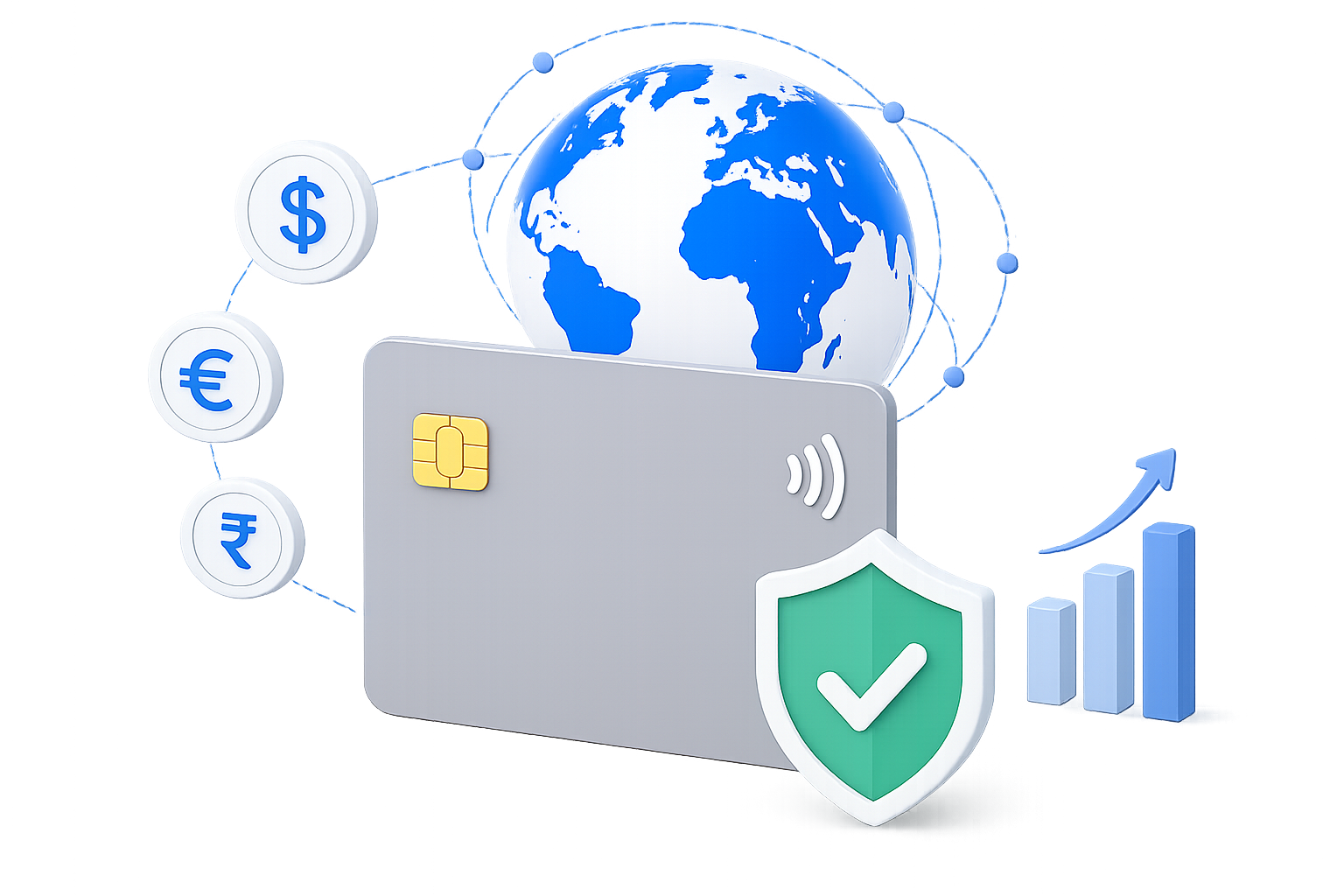
They can be useful for certain international use cases, particularly travel and controlled foreign-currency spending.
Check the supported currencies, FX markup, card-network conversion, ATM charges, reload rules, refund handling, and merchant acceptance.
For businesses collecting international payments, prepaid cards are generally not a substitute for merchant payment infrastructure.
Prepaid card vs forex card
A forex card is a specialised prepaid card designed primarily for foreign-currency spending.
It may allow users to load one or more supported currencies before travelling.
A general prepaid card, by contrast, may be denominated only in INR or intended for domestic spending.
The two products therefore share the prepaid model but serve different use cases.
Who should consider a prepaid card?
A prepaid card may suit travellers, parents managing allowances, businesses issuing controlled employee-spend cards, gift-card users, or people who want to separate specific purchases from their main bank account. It may be less suitable where regular credit, broad international acceptance, large cash withdrawals, or credit-building matters.
What should you check before getting a prepaid card?
Compare the issuer, RBI/PPI status where applicable, KYC, loading rules, limits, fees, cash withdrawal, merchant acceptance, dispute process, validity, and support.
The product name alone does not tell you how the card works.
For Indian businesses serving international customers, the payment challenge is different: they need to collect money reliably rather than simply control outgoing card spend.
PayGlocal helps Indian businesses accept international payments through supported cards and alternative payment methods while providing clearer transaction and settlement visibility.