
You quoted a price to your international buyer a few months ago. Today, the same deal earns you less in INR. Your costs and pricing haven't changed, but your profit margins have decreased. This often happens because of long-term currency trends shaped by the balance of payments (BoP) in international trade.
With India's total exports showing a steady 6% growth in the first nine months of the FY 2024-25, money is flowing across borders faster than ever. Knowing how this BoP metric is tracked becomes essential for managing your pricing and protecting your profit margins.
This guide breaks down what BoP is, how it works, and why it matters for your business cash flow.
Every time your business sells a product to a buyer in the US, or a freelancer in India invoices a client in London, money crosses borders. The balance of payments (BoP) is the record that captures all of these transactions for an entire country over a specific time period, usually a quarter or a year.
Think of it as a financial summary of everything flowing in and out. When an Indian SaaS company collects a subscription fee in USD, that's an inflow. When an Indian manufacturer buys raw materials from Germany in EUR, that's an outflow. The BoP tracks both sides.
For your business, this matters because the overall BoP position shapes exchange rates, payment costs, and how smoothly money moves between countries. If India's BoP is healthy, the rupee tends to stay stable, and your money transfers arrive more predictably. If there's pressure on the BoP, currency volatility can eat into your margins without warning.
Tip: You don't need to read the full BoP report every quarter. Just keep an eye on whether India's trade balance is trending toward surplus or deficit. It gives you an early signal on where the rupee might head.
A shift in the BoP doesn't stay in an economics report alone. It shows up in your bank account. When the current account swings into deficit, the rupee weakens, and the INR value of your foreign exchange collections can change overnight.
Here's why this deserves your attention:
In short, BoP isn't something you manage directly. It shapes the environment in which your cross-border payments operate. Ignoring it means reacting to problems instead of anticipating them.
Note: If you are an exporter, a weakening Rupee might look like a win because you get more INR. However, it also brings high uncertainty. Don't rely on currency drops to grow your profit; focus on a stable pricing strategy instead.
The BoP follows a double-entry system, similar to how you'd record debits and credits in accounting. Every transaction has two sides. If an Indian company exports textiles worth $10,000, the BoP records a credit (inflow) in the current account and a corresponding debit (outflow) in the financial account when the payment settles.
Here's how the process flows:
1. Transactions happen: Every cross-border exchange of goods, services, income, or capital between residents and non-residents gets captured.
2. Classification: Each transaction goes into one of three accounts: current, capital, or financial.
3. Net position: At the end of the period, each account shows a surplus (more inflows than outflows) or a deficit (more outflows than inflows).
4. Balancing entry: In theory, the BoP always balances to zero. Any difference between accounts is closed by changes in foreign exchange reserves or statistical adjustments.
This matters for your business because when you see news about India's BoP surplus or deficit, you're seeing the net result of millions of transactions like yours. A surplus means more money is flowing into the country than leaving. A deficit means the opposite. Both create ripple effects on exchange rates and payment processing conditions.
Tip: If you're collecting from buyers in five or six countries, pay attention to bilateral trade balances too. A surplus with one country can mean a smoother payment corridor for your transactions.
Say you run a software company in Bangalore and sell a $10,000 annual license to a client in New York. Your client pays by credit card. Here's how that transaction shows up in India's BoP.
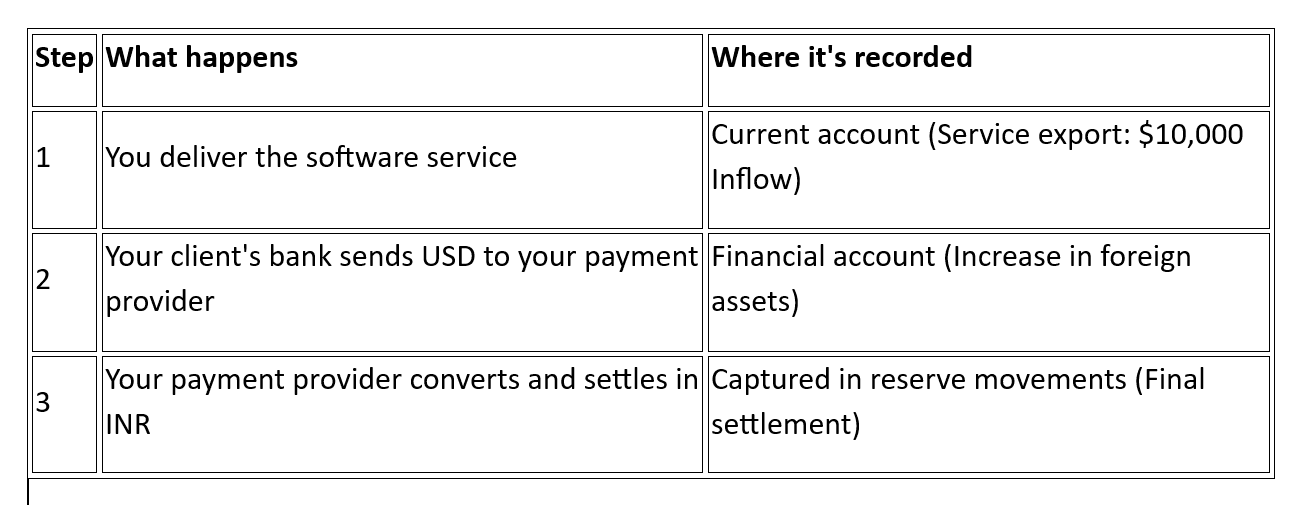
That $10,000 is now part of India's current account surplus for the quarter. Multiply that by thousands of exporters and freelancers doing the same, and you get the overall BoP position that drives exchange rate trends.
The practical takeaway is simple. When more businesses like yours are exporting and earning foreign currency, the current account strengthens. That tends to keep the rupee stable, which makes your future GST on exports and payment collections more predictable.
Tip: If you're sending invoices in USD, track whether your INR settlement amount changes month to month. That movement reflects BoP-driven exchange rate shifts in real time.
A country can't run a deficit forever without consequences. When outflows consistently exceed inflows, pressure builds on the currency, and that pressure eventually reaches your payment costs and conversion rates.
Here's how the balance is typically maintained:
For your business, the key signal is direction. If India's BoP is moving toward balance or surplus, expect relatively stable SWIFT charges and predictable conversion rates. If it's moving toward a wider deficit, plan for more volatility in your settlements.
Note: You don't need to predict BoP movements. Just knowing whether the trend is positive or negative helps you time your invoicing and settlement decisions better.
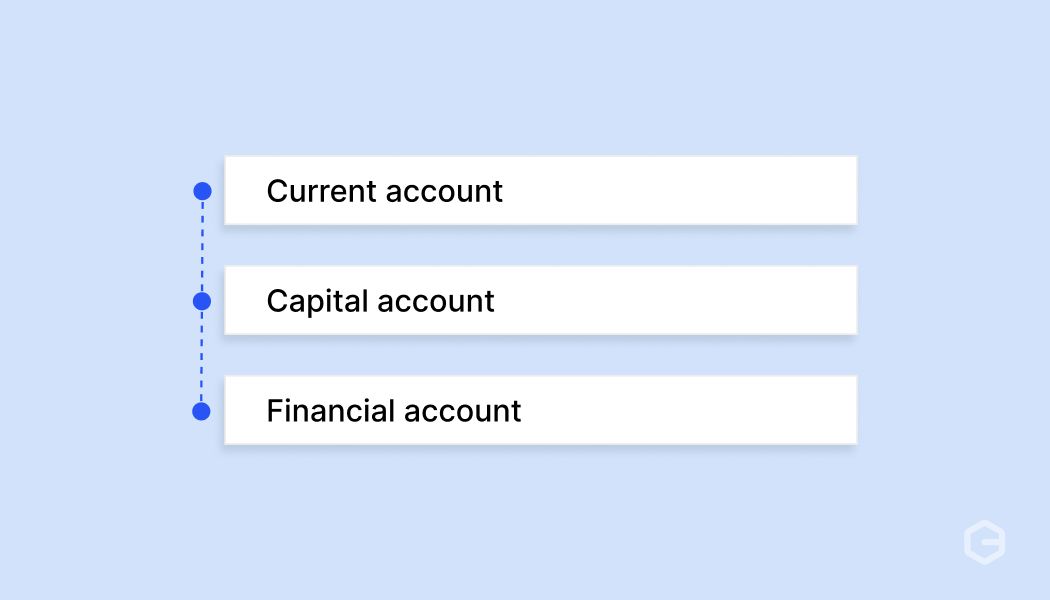
Each account in the BoP captures a different kind of cross-border transaction. Knowing which account your business activity falls into helps you connect the macro picture to your own revenue. Here's a quick comparison:
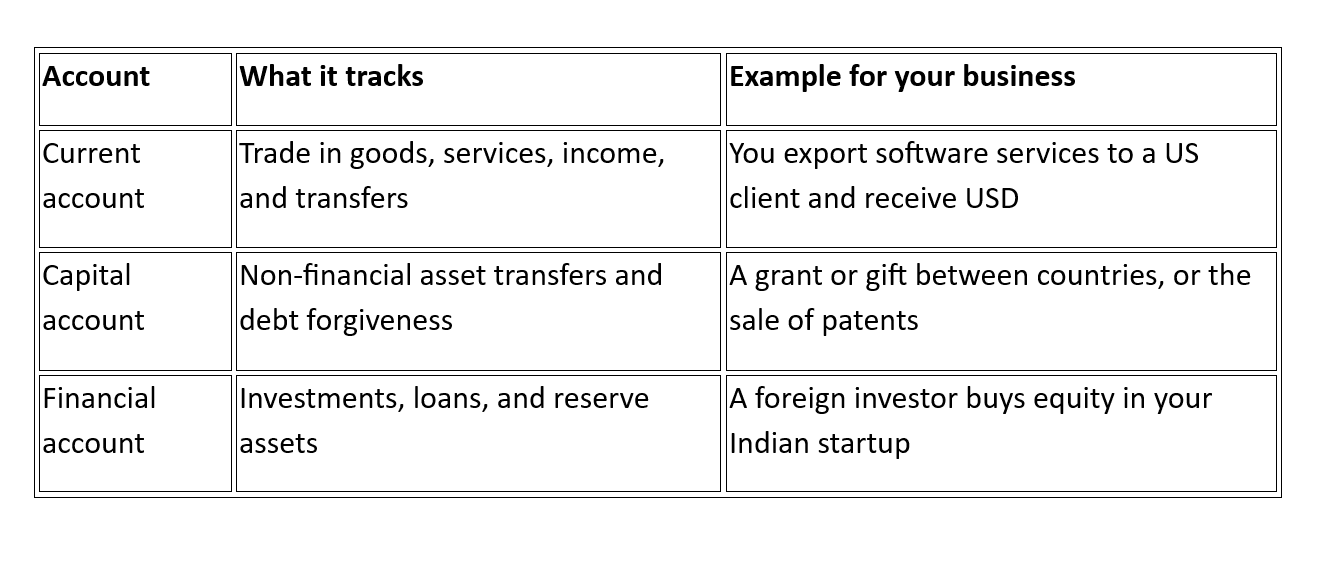
Each of these plays a different role in shaping how money flows across borders.
This is where most exporters and service sellers show up. The current account records trade in goods (merchandise like textiles, electronics, food products) and services (IT, consulting, design, travel). It also includes income earned on foreign investments and remittances sent between countries.
If you're a freelancer in India billing a client in Canada, your invoice and payment both get captured here. When India's current account is in surplus, it usually signals strong export activity, which tends to support the rupee.
For your business, a strong current account means the export payment environment is generally favorable. A widening deficit, on the other hand, can signal tighter conditions ahead.
The capital account covers transfers that don't involve the direct exchange of goods or services. These are things like debt forgiveness between countries, migrant transfers (assets people bring when they relocate), and sales of non-financial assets like patents or trademarks.
For most small and mid-size exporters, the capital account won't directly affect their day-to-day. If you're licensing intellectual property internationally or receiving foreign grants, your transactions land here.
This is where foreign direct investment (FDI), portfolio investment, and reserve asset movements are recorded. When a venture capital firm in Singapore invests in your Indian company, that shows up in the financial account.
The financial account often acts as a counterweight to the current account. If India runs a current account deficit (importing more than exporting), foreign investment inflows in the financial account can offset it. That keeps the overall BoP stable and the rupee less volatile, which is good news for your multi-currency account collections.
Note: You'll sometimes see the capital and financial accounts grouped together in older references. The modern BoP framework treats them as separate.
If you're a services exporter, relying on trade balance data alone can mislead you. The trade balance only captures goods, which means your IT contracts and consulting fees, and SaaS revenue don't show up there at all.
Here's a side-by-side comparison:
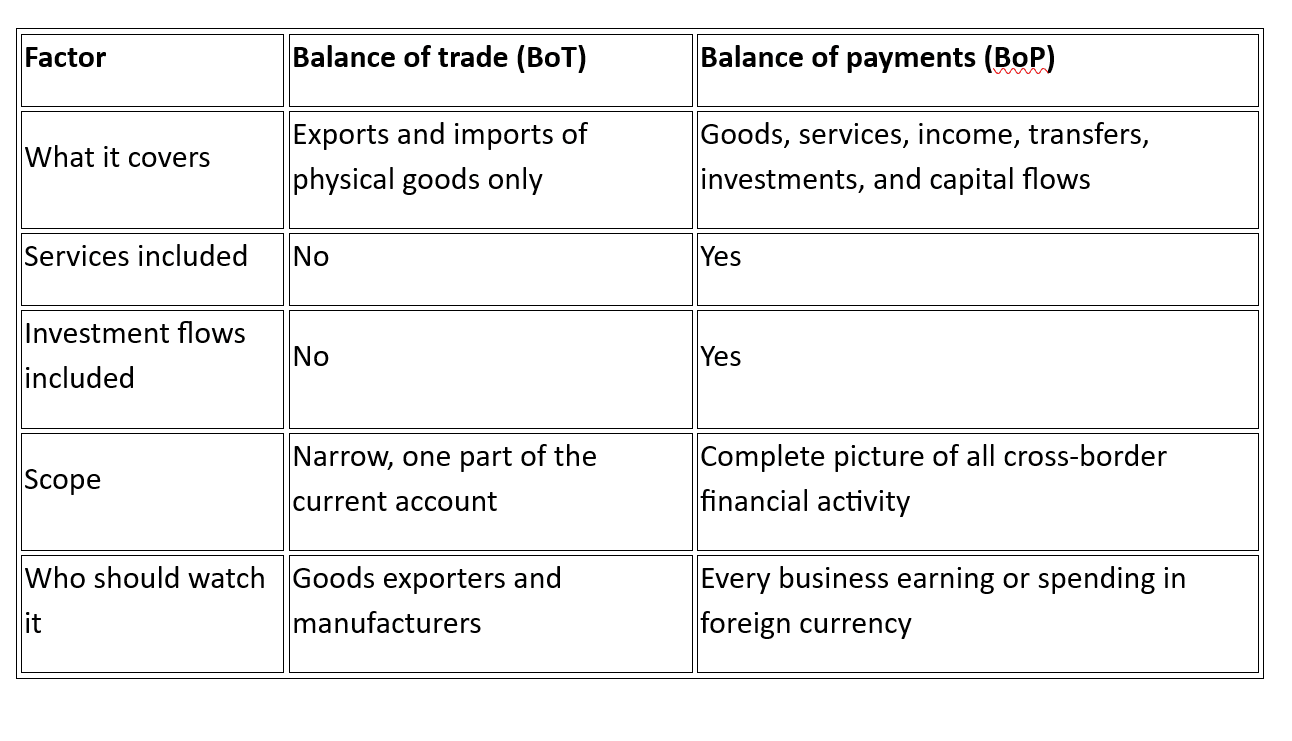
The difference matters most if your revenue comes from services rather than physical goods. If you're selling software services or running a freelance business, the BoP gives you a much clearer view of how money is flowing between India and the rest of the world. The trade balance won't capture your contribution or tell you how your specific payment corridor is performing.
The simple rule is that, if your business earns from international services, always look at the full BoP, not just the trade balance reported in headlines.
Tip: India's services exports have been growing steadily. When service exports are strong, they can offset a goods trade deficit and keep the overall BoP healthy, which benefits your payment settlements directly.
A surplus or deficit isn't automatically good or bad. The impact depends on your specific business situation. Getting this wrong can lead to mispriced invoices or poorly timed payment collection.
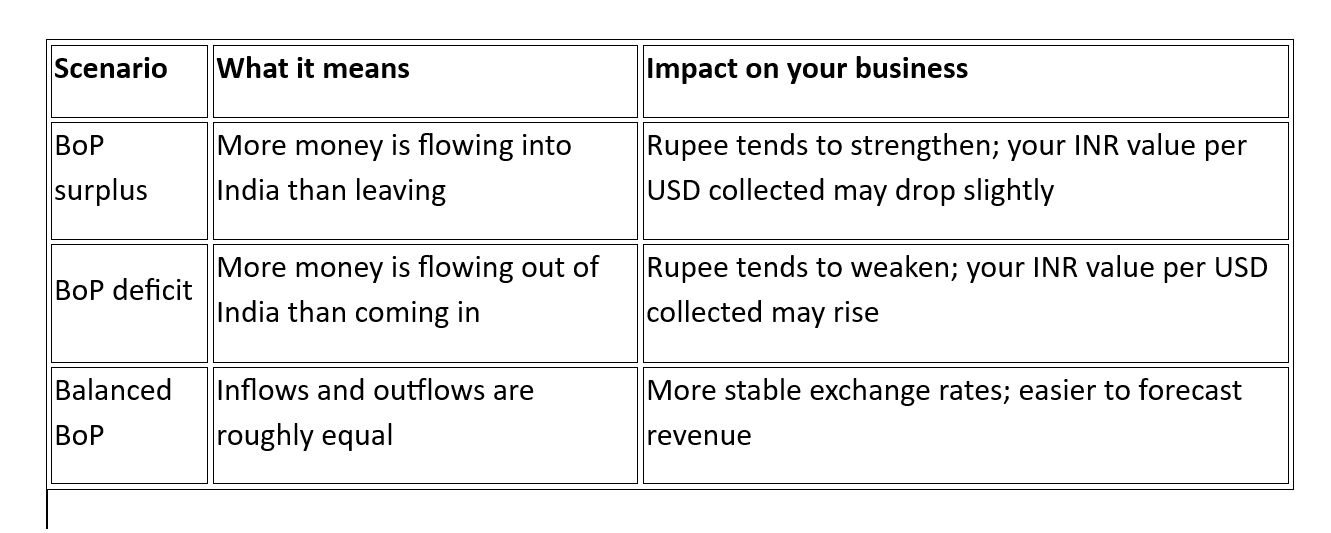
A surplus typically shows up when exports are strong, and foreign investment is flowing in. The rupee strengthens because demand for INR increases. If you're an exporter, this can reduce the INR value of your foreign earnings. It also signals a healthy economy, which builds buyer confidence abroad.
A deficit happens when the country spends more abroad than it earns from the rest of the world. The rupee tends to weaken, which can actually benefit exporters in the short term since each dollar converts to more rupees. Prolonged deficits can introduce volatility that makes planning harder.
For businesses managing forex, the key isn't to chase surpluses or fear deficits. It's to stay aware of the direction so you can adjust pricing and payment timing accordingly.
Tip: If you invoice in USD and settle in INR, consider setting your prices with a small buffer for currency movement. Even a 2-3% margin can protect your revenue during BoP-driven swings.
Sometimes your payment costs shift without any change on your end. That often traces back to a BoP movement that pushed the exchange rate in a new direction. Here are the most common factors that push the BoP in one direction or another:
Businesses that track these signals adjust their pricing, invoicing currency, and settlement timing before the impact hits their bank account.
Most businesses that sell internationally don't think about BoP until something goes wrong. A sudden currency move wipes out a month's margin, or a payment takes longer than expected because capital flow conditions have tightened. Here are some of the common mistakes to avoid:
Paying attention to BoP trends and choosing payment tools that give you flexibility makes a real difference when conditions change.
Note: If you're unsure how BoP trends affect your specific industry, start by tracking the current account balance quarterly. It's the most relevant indicator for exporters and service sellers.
Currency shifts tied to BoP changes aren't going away. What you can control is how prepared your business is to handle them. The businesses that protect their margins aren't the ones predicting the market. They're the ones building flexibility into their payment operations.
The more options you have for collecting, holding, and settling international payments, the better you can handle whatever BoP conditions come your way.
BoP shifts affect exchange rates, and exchange rates affect your earnings. You can't control the macro trends. You can pick a payment setup that gives you flexibility when things move.
PayGlocal is built for Indian businesses collecting payments from international buyers across 180+ countries in 130+ global currencies. Here's what you get:
When BoP conditions shift and currencies move, the last thing you want is a rigid payment setup that can't keep up. PayGlocal gives you the flexibility to collect how and when it works best for your business.
Balance of payments in international business affects every cross-border transaction your business processes. The exchange rates you see, the fees you pay, and the speed at which you receive funds are all influenced by BoP conditions.
Your next practical step is to start watching India's quarterly current account data. Match it against your own payment experience. You'll start seeing patterns in when rates move and when collection costs change. That awareness alone puts you ahead of most businesses.
Indian exports are growing, and businesses that set up the right payment infrastructure now won't be left behind when conditions shift. PayGlocal gives you the currencies, methods, and infrastructure to collect from 180+ countries without friction. Get started with PayGlocal today.
With India's total exports showing a steady 6% growth in the first nine months of the FY 2024-25, money is flowing across borders faster than ever. Knowing how this BoP metric is tracked becomes essential for managing your pricing and protecting your profit margins.
This guide breaks down what BoP is, how it works, and why it matters for your business cash flow.
Key takeaways
- BoP is a country's financial scoreboard: The balance of payments (BoP) records every economic transaction between a country's residents and the rest of the world over a set period.
- It has three main accounts: The current account, capital account, and financial account, each track different types of cross-border money movement.
- BoP directly affects exchange rates: A surplus or deficit in the BoP influences how strong or weak your currency is, which changes what you earn on every international invoice.
- Surpluses and deficits both matter: A surplus isn't always good, and a deficit isn't always bad. Context matters for your specific business.
- PayGlocal simplifies the payment side: While you can't control BoP, you can control how you collect international payments, with 130+ global currencies and 40+ alternate payment methods.
What is the balance of payments in international business?
Every time your business sells a product to a buyer in the US, or a freelancer in India invoices a client in London, money crosses borders. The balance of payments (BoP) is the record that captures all of these transactions for an entire country over a specific time period, usually a quarter or a year.
Think of it as a financial summary of everything flowing in and out. When an Indian SaaS company collects a subscription fee in USD, that's an inflow. When an Indian manufacturer buys raw materials from Germany in EUR, that's an outflow. The BoP tracks both sides.
For your business, this matters because the overall BoP position shapes exchange rates, payment costs, and how smoothly money moves between countries. If India's BoP is healthy, the rupee tends to stay stable, and your money transfers arrive more predictably. If there's pressure on the BoP, currency volatility can eat into your margins without warning.
Tip: You don't need to read the full BoP report every quarter. Just keep an eye on whether India's trade balance is trending toward surplus or deficit. It gives you an early signal on where the rupee might head.
Why the balance of payments matter for your global business
A shift in the BoP doesn't stay in an economics report alone. It shows up in your bank account. When the current account swings into deficit, the rupee weakens, and the INR value of your foreign exchange collections can change overnight.
Here's why this deserves your attention:
- Exchange rate movement: A BoP deficit often leads to a weaker domestic currency. For exporters, that can mean more INR per dollar collected. For importers, costs go up.
- Payment collection costs: When currency markets get volatile because of BoP pressure, the spread between buy and sell rates widens. That spread is a hidden cost on every transaction you process.
- Cash flow predictability: Stable BoP conditions tend to produce stable exchange rates. That makes it easier to forecast revenue and set prices for international buyers.
- Buyer confidence: When a country's BoP is strong, international buyers and partners view it as financially stable. That trust makes it easier to close deals and negotiate payment terms.
In short, BoP isn't something you manage directly. It shapes the environment in which your cross-border payments operate. Ignoring it means reacting to problems instead of anticipating them.
Note: If you are an exporter, a weakening Rupee might look like a win because you get more INR. However, it also brings high uncertainty. Don't rely on currency drops to grow your profit; focus on a stable pricing strategy instead.
How does the balance of payments work?
The BoP follows a double-entry system, similar to how you'd record debits and credits in accounting. Every transaction has two sides. If an Indian company exports textiles worth $10,000, the BoP records a credit (inflow) in the current account and a corresponding debit (outflow) in the financial account when the payment settles.
Here's how the process flows:
1. Transactions happen: Every cross-border exchange of goods, services, income, or capital between residents and non-residents gets captured.
2. Classification: Each transaction goes into one of three accounts: current, capital, or financial.
3. Net position: At the end of the period, each account shows a surplus (more inflows than outflows) or a deficit (more outflows than inflows).
4. Balancing entry: In theory, the BoP always balances to zero. Any difference between accounts is closed by changes in foreign exchange reserves or statistical adjustments.
This matters for your business because when you see news about India's BoP surplus or deficit, you're seeing the net result of millions of transactions like yours. A surplus means more money is flowing into the country than leaving. A deficit means the opposite. Both create ripple effects on exchange rates and payment processing conditions.
Tip: If you're collecting from buyers in five or six countries, pay attention to bilateral trade balances too. A surplus with one country can mean a smoother payment corridor for your transactions.
How does BoP look in a real export transaction?
Say you run a software company in Bangalore and sell a $10,000 annual license to a client in New York. Your client pays by credit card. Here's how that transaction shows up in India's BoP.
That $10,000 is now part of India's current account surplus for the quarter. Multiply that by thousands of exporters and freelancers doing the same, and you get the overall BoP position that drives exchange rate trends.
The practical takeaway is simple. When more businesses like yours are exporting and earning foreign currency, the current account strengthens. That tends to keep the rupee stable, which makes your future GST on exports and payment collections more predictable.
Tip: If you're sending invoices in USD, track whether your INR settlement amount changes month to month. That movement reflects BoP-driven exchange rate shifts in real time.
How does a country keep its BoP in balance?
A country can't run a deficit forever without consequences. When outflows consistently exceed inflows, pressure builds on the currency, and that pressure eventually reaches your payment costs and conversion rates.
Here's how the balance is typically maintained:
- Export growth: When a country sells more goods and services abroad, foreign currency flows in and strengthens the current account. For Indian exporters, this creates a favorable environment for collecting payments.
- Foreign investment inflows: When global investors put money into Indian companies or markets, it offsets current account deficits. This keeps the rupee from weakening too quickly.
- Reserve adjustments: Central banks hold foreign currency reserves and can use them to stabilize the exchange rate during short-term BoP pressure.
- Import management: When imports rise faster than exports, the current account weakens. Shifts in commodity prices, especially oil, can swing India's BoP significantly.
For your business, the key signal is direction. If India's BoP is moving toward balance or surplus, expect relatively stable SWIFT charges and predictable conversion rates. If it's moving toward a wider deficit, plan for more volatility in your settlements.
Note: You don't need to predict BoP movements. Just knowing whether the trend is positive or negative helps you time your invoicing and settlement decisions better.
What are the different accounts that make up the BoP?
Each account in the BoP captures a different kind of cross-border transaction. Knowing which account your business activity falls into helps you connect the macro picture to your own revenue. Here's a quick comparison:
Each of these plays a different role in shaping how money flows across borders.
1. Current account
This is where most exporters and service sellers show up. The current account records trade in goods (merchandise like textiles, electronics, food products) and services (IT, consulting, design, travel). It also includes income earned on foreign investments and remittances sent between countries.
If you're a freelancer in India billing a client in Canada, your invoice and payment both get captured here. When India's current account is in surplus, it usually signals strong export activity, which tends to support the rupee.
For your business, a strong current account means the export payment environment is generally favorable. A widening deficit, on the other hand, can signal tighter conditions ahead.
2. Capital account
The capital account covers transfers that don't involve the direct exchange of goods or services. These are things like debt forgiveness between countries, migrant transfers (assets people bring when they relocate), and sales of non-financial assets like patents or trademarks.
For most small and mid-size exporters, the capital account won't directly affect their day-to-day. If you're licensing intellectual property internationally or receiving foreign grants, your transactions land here.
3. Financial account
This is where foreign direct investment (FDI), portfolio investment, and reserve asset movements are recorded. When a venture capital firm in Singapore invests in your Indian company, that shows up in the financial account.
The financial account often acts as a counterweight to the current account. If India runs a current account deficit (importing more than exporting), foreign investment inflows in the financial account can offset it. That keeps the overall BoP stable and the rupee less volatile, which is good news for your multi-currency account collections.
Note: You'll sometimes see the capital and financial accounts grouped together in older references. The modern BoP framework treats them as separate.
What's the difference between the balance of trade and the balance of payments?
If you're a services exporter, relying on trade balance data alone can mislead you. The trade balance only captures goods, which means your IT contracts and consulting fees, and SaaS revenue don't show up there at all.
Here's a side-by-side comparison:
The difference matters most if your revenue comes from services rather than physical goods. If you're selling software services or running a freelance business, the BoP gives you a much clearer view of how money is flowing between India and the rest of the world. The trade balance won't capture your contribution or tell you how your specific payment corridor is performing.
The simple rule is that, if your business earns from international services, always look at the full BoP, not just the trade balance reported in headlines.
Tip: India's services exports have been growing steadily. When service exports are strong, they can offset a goods trade deficit and keep the overall BoP healthy, which benefits your payment settlements directly.
What does a BoP surplus or deficit mean for you?
A surplus or deficit isn't automatically good or bad. The impact depends on your specific business situation. Getting this wrong can lead to mispriced invoices or poorly timed payment collection.
When there's a surplus
A surplus typically shows up when exports are strong, and foreign investment is flowing in. The rupee strengthens because demand for INR increases. If you're an exporter, this can reduce the INR value of your foreign earnings. It also signals a healthy economy, which builds buyer confidence abroad.
When there's a deficit
A deficit happens when the country spends more abroad than it earns from the rest of the world. The rupee tends to weaken, which can actually benefit exporters in the short term since each dollar converts to more rupees. Prolonged deficits can introduce volatility that makes planning harder.
For businesses managing forex, the key isn't to chase surpluses or fear deficits. It's to stay aware of the direction so you can adjust pricing and payment timing accordingly.
Tip: If you invoice in USD and settle in INR, consider setting your prices with a small buffer for currency movement. Even a 2-3% margin can protect your revenue during BoP-driven swings.
What causes the balance of payments to shift?
Sometimes your payment costs shift without any change on your end. That often traces back to a BoP movement that pushed the exchange rate in a new direction. Here are the most common factors that push the BoP in one direction or another:
- Inflation differences: When India's inflation runs higher than that of its trading partners, Indian goods and services become relatively more expensive abroad. This can reduce exports and widen the current account deficit.
- Global demand for exports: When international demand for Indian IT services, textiles, or pharmaceuticals rises, more foreign currency flows in. That strengthens the BoP and supports the rupee.
- Foreign investment trends: A surge in FDI or portfolio investment into India boosts the financial account. A pullback weakens it, putting pressure on the currency.
- Commodity prices: India imports a large share of its oil. When global oil prices spike, the import bill rises sharply, pushing the current account toward deficit.
- Currency sentiment: If global investors see the rupee as risky, capital outflows increase. That weakens the BoP and can make your international fees less predictable.
Businesses that track these signals adjust their pricing, invoicing currency, and settlement timing before the impact hits their bank account.
What mistakes do businesses make when ignoring BoP?
Most businesses that sell internationally don't think about BoP until something goes wrong. A sudden currency move wipes out a month's margin, or a payment takes longer than expected because capital flow conditions have tightened. Here are some of the common mistakes to avoid:
- Ignoring the macro picture: Many exporters focus only on their own transactions without watching broader trade flow trends. BoP data gives you a free signal about where costs and rates are heading.
- Treating exchange rates as fixed: Pricing in a foreign currency without accounting for BoP-driven fluctuations means your margins are at risk every time you send an invoice.
- Not diversifying payment currencies: If all your revenue comes in one currency and that currency weakens against INR due to BoP shifts, your entire revenue stream takes a hit. Collecting in multiple currencies spreads the risk.
- Delaying settlements: Holding foreign currency in the hope of a better rate is a gamble. BoP conditions can shift quickly, and what looks like a favorable trend can reverse.
- Confusing BoP with trade balance: The trade balance only covers goods. BoP includes services, investment, and transfers too. If you're a services exporter, the trade balance alone won't give you the full picture.
Paying attention to BoP trends and choosing payment tools that give you flexibility makes a real difference when conditions change.
Note: If you're unsure how BoP trends affect your specific industry, start by tracking the current account balance quarterly. It's the most relevant indicator for exporters and service sellers.
How can you manage the BoP impact on your business?
Currency shifts tied to BoP changes aren't going away. What you can control is how prepared your business is to handle them. The businesses that protect their margins aren't the ones predicting the market. They're the ones building flexibility into their payment operations.
- Price with a buffer: Add a small margin to your international pricing that accounts for exchange rate movement. This protects your revenue without making your prices uncompetitive.
- Invoice in the right currency: Sometimes, invoicing in your buyer's local currency wins you the deal, or invoicing in a stable currency like USD protects your margin. Choose based on the buyer relationship and BoP trends.
- Collect in multiple currencies: Don't funnel all your international revenue through a single currency. Spreading across USD, GBP, EUR, and others reduces exposure to any single BoP-driven currency shift.
- Settle promptly: Faster settlements reduce the window during which exchange rate changes can eat into your earnings. Look for payment solutions that offer high-speed automated settlements.
- Watch quarterly BoP data: You don't need to monitor it daily. A quarterly check gives you enough lead time to adjust pricing or payment timing.
- Choose flexible payment infrastructure: Your payment provider should let you accept payment methods your buyers trust and settle in your preferred currency. Rigidity costs you money when BoP conditions shift.
The more options you have for collecting, holding, and settling international payments, the better you can handle whatever BoP conditions come your way.
How PayGlocal helps you manage BoP-driven currency shifts
BoP shifts affect exchange rates, and exchange rates affect your earnings. You can't control the macro trends. You can pick a payment setup that gives you flexibility when things move.
PayGlocal is built for Indian businesses collecting payments from international buyers across 180+ countries in 130+ global currencies. Here's what you get:
- Multi-currency accounts: Your buyers pay in the currency they're comfortable with, and you collect in 33+ currencies, including USD, GBP, EUR, CAD, and AUD.
- Card payments: More of your customers complete their purchase successfully, with higher approval rates on international credit and debit cards.
- Recurring payments: Revenue keeps coming in on schedule without manual follow-up, with automatic billing set up for subscriptions and repeat orders.
- Dynamic checkout: Buyers move through checkout faster and drop off less, with a payment flow that adapts to their location and preferred payment method.
- One platform: You track, manage, and settle every international payment from a single dashboard, rather than switching between three or four tools.
When BoP conditions shift and currencies move, the last thing you want is a rigid payment setup that can't keep up. PayGlocal gives you the flexibility to collect how and when it works best for your business.
Final thoughts
Balance of payments in international business affects every cross-border transaction your business processes. The exchange rates you see, the fees you pay, and the speed at which you receive funds are all influenced by BoP conditions.
Your next practical step is to start watching India's quarterly current account data. Match it against your own payment experience. You'll start seeing patterns in when rates move and when collection costs change. That awareness alone puts you ahead of most businesses.
Indian exports are growing, and businesses that set up the right payment infrastructure now won't be left behind when conditions shift. PayGlocal gives you the currencies, methods, and infrastructure to collect from 180+ countries without friction. Get started with PayGlocal today.