
TL;DR
- Higher payment authorization isn't driven by a single feature—it comes from six capabilities working together: multi-acquirer infrastructure, real-time routing, automated failover and retries, network tokenization, frictionless authentication, and AI-powered fraud pre-screening.
- These capabilities can improve domestic card authorization rates from around 80–85% to 90–95%, helping merchants recover more successful transactions.
- International card payments require a different approach. As an RBI-authorised cross-border payment aggregator, PayGlocal is purpose-built to optimize routing for foreign issuers, helping businesses achieve higher international authorization rates.
In India, a payment that fails is rarely retried. The customer assumes something is wrong, abandons the cart, and often doesn't come back. That's why the gap between a standard gateway and an optimised one — often 10 to 15 points of success rate — is one of the highest-leverage numbers in a digital business.
That gap isn't luck. It's architecture. Below is what actually drives it, feature by feature, followed by the part most guides skip: why getting an international card approved is a different discipline from getting a domestic one.
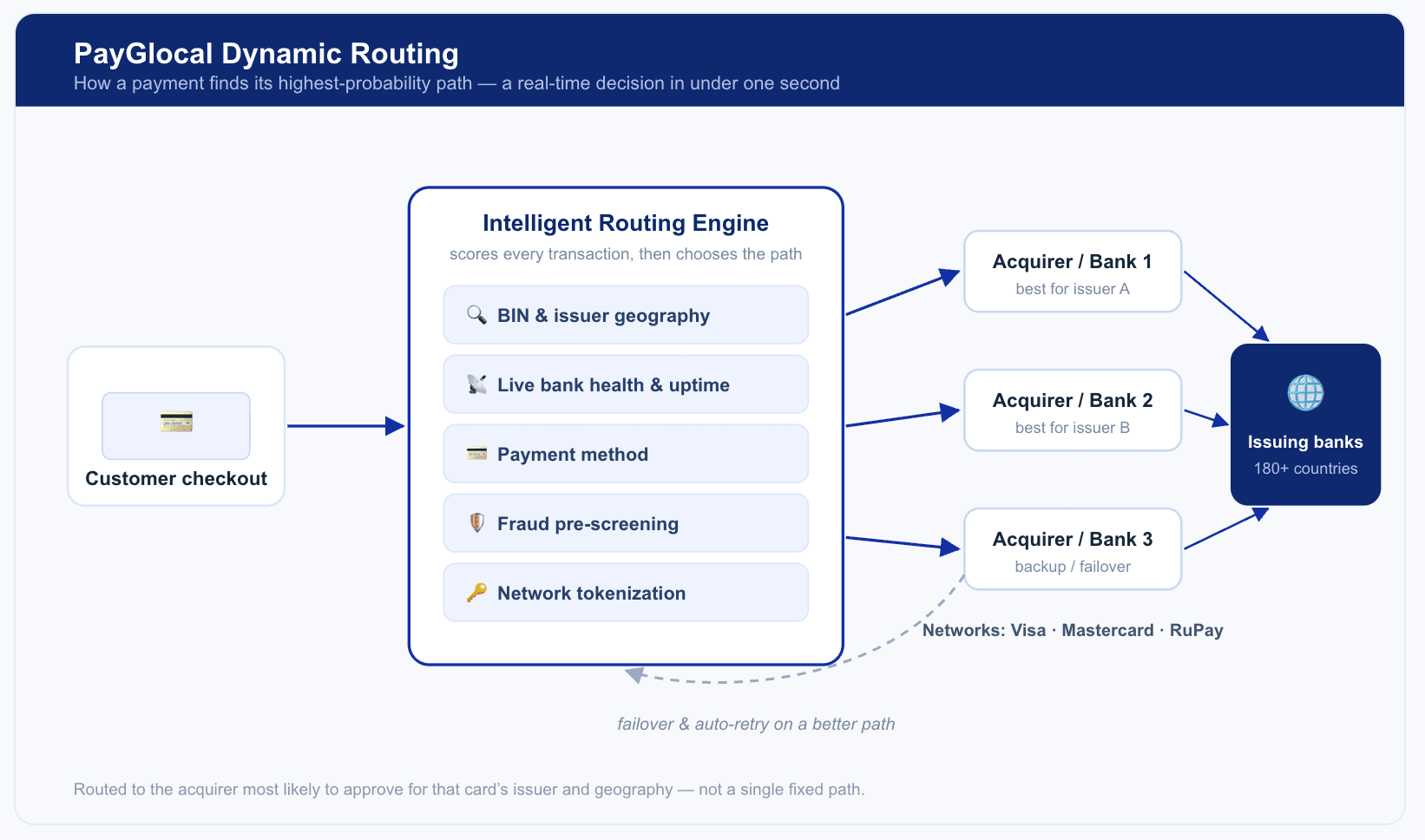
Dynamic routing means the gateway decides, in real time and per transaction, which acquiring bank or processor should carry a payment — instead of sending every transaction down one fixed path. A static gateway has one route; if that route is congested, degraded, or a poor match for the card, the payment fails. A dynamic gateway evaluates the transaction and picks the path most likely to be approved. Everything below is what makes that decision smart.
A single acquiring bank is a single point of failure. If that one bank has elevated latency, a maintenance window, or simply a weak approval relationship with a particular card issuer, every transaction inherits that weakness.
Modern gateways and orchestration layers connect a merchant to multiple acquiring banks and networks at once. This "multi-homed" setup is the precondition for routing — you can only route intelligently if you have more than one road. It also removes the correlated-outage risk: when one acquirer degrades, volume shifts to the others automatically.
With multiple roads available, the engine chooses. Good routing engines make a decision in well under a second, scoring each transaction on several signals:
Even the best first choice fails sometimes. Two mechanisms recover that lost revenue:
Under RBI's card-on-file mandate, gateways replace stored card numbers with secure tokens. Beyond compliance, this directly lifts authorization: network tokens (Visa, Mastercard, RuPay) are recognised natively by the networks and issuers, and transactions carrying a pre-authenticated token footprint are trusted more than those sending raw card details.
Higher trust means higher approval — and tokens also survive card re-issuance, so saved-card and subscription payments stop failing when a customer's physical card is replaced.
In India's two-factor world, the OTP step is where a large share of payments die — especially on mobile, where a redirect to the bank's page frequently breaks. The fix is to remove the friction, not the security:
This one is counter-intuitive: aggressive fraud rules lower authorization, because a merchant sending suspicious patterns gets throttled by issuers, dragging down approvals for everyone — including genuine customers wrongly declined.
The goal is to catch real fraud before it reaches the bank, using machine-learning checks on velocity, device fingerprint and behavioural anomalies, while letting genuine transactions through.
A clean, low-fraud portfolio earns higher issuer trust and a higher approval ceiling over time. The best fraud engine protects revenue, not just transactions — it minimises false declines as carefully as it blocks real fraud.
Almost every guide on this topic — and every domestic orchestration platform — is really describing the domestic case: routing across Indian acquirers like HDFC, ICICI and Axis, optimising UPI and net banking. That's important, but it's not the hardest part.
International card authorization starts from a lower baseline, for reasons that have nothing to do with the merchant:
So for international payments, dynamic routing and issuer relationships don't just help at the margin — they move the baseline. A platform built domestic-first, with international bolted on, will always be optimising the easier problem harder.
PayGlocal is built for the cross-border case from the ground up. We are an RBI-authorised as a cross-border payment aggregator (PA-CB-I&O) and a domestic aggregator (PA-O), and our routing and authorization stack is tuned for the international problem specifically:
Intelligent payment routing for foreign-issued cards — routing decisions weighted toward the acquirer and path most likely to be approved for that issuer's geography, not just the cheapest domestic hop.
Higher authorization isn't only about routing logic — it depends on the platform staying up and staying fast under load. Because a payment that times out is a payment declined, resilience is authorization.
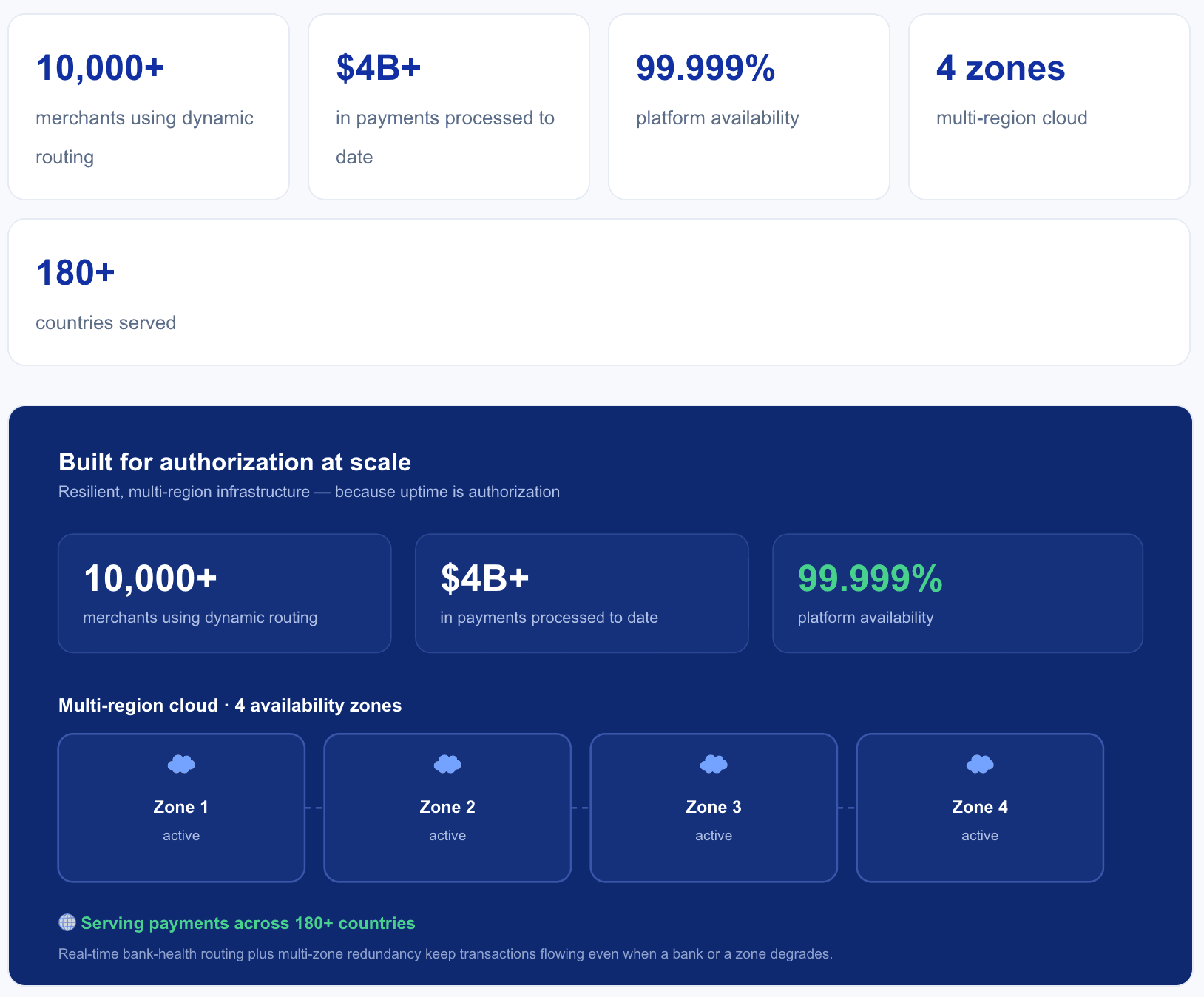
PayGlocal global infrastructure — 10,000+ merchants, $4B+ processed, 99.999% availability, multi-region cloud across four availability zones, serving 180+ countries.
Real-time bank-health routing on top of multi-zone redundancy means transactions keep flowing even when an individual bank — or an entire cloud zone — degrades. That resilience is a direct input into the authorization rate your business sees.
Authorization rate is one of the few metrics where a small percentage is large money. Lifting international approval from 82% to 92% isn't a 10% improvement — it's recovering one in eight payments that were previously lost outright, with no extra marketing spend and no new customers. At scale, that difference funds a lot of growth. It is, quite simply, revenue you already earned and were leaving on the table.
That gap isn't luck. It's architecture. Below is what actually drives it, feature by feature, followed by the part most guides skip: why getting an international card approved is a different discipline from getting a domestic one.
Quick answers
- What features enable dynamic routing? Multi-acquirer infrastructure plus a real-time routing engine that scores each transaction on issuer, BIN, payment method and live bank health, then sends it down the highest-probability path.
- What lifts authorization rates? Network tokenization, frictionless 3DS/OTP, automated failover and retry, and fraud pre-screening that cuts false declines.
- How much can it improve success? From a typical 80–85% on a standard gateway to 90–95% or higher with smart routing.
- Why is cross-border authorization different? Foreign issuers, geography-specific risk models, 3DS2 variation and currency conversion all lower the baseline international approval rate — so routing and issuer relationships built for it matter even more.
- Where does PayGlocal fit? As an RBI-authorised cross-border aggregator (PA-CB-I&O) focused specifically on lifting international card authorization, with intelligent routing and fraud controls tuned for foreign-issued cards.
What is dynamic routing in a payment gateway?
Dynamic routing means the gateway decides, in real time and per transaction, which acquiring bank or processor should carry a payment — instead of sending every transaction down one fixed path. A static gateway has one route; if that route is congested, degraded, or a poor match for the card, the payment fails. A dynamic gateway evaluates the transaction and picks the path most likely to be approved. Everything below is what makes that decision smart.
1. Multi-acquirer and multi-aggregator infrastructure
A single acquiring bank is a single point of failure. If that one bank has elevated latency, a maintenance window, or simply a weak approval relationship with a particular card issuer, every transaction inherits that weakness.
Modern gateways and orchestration layers connect a merchant to multiple acquiring banks and networks at once. This "multi-homed" setup is the precondition for routing — you can only route intelligently if you have more than one road. It also removes the correlated-outage risk: when one acquirer degrades, volume shifts to the others automatically.
2. A real-time intelligent routing engine
With multiple roads available, the engine chooses. Good routing engines make a decision in well under a second, scoring each transaction on several signals:
- Bank health and uptime monitoring — the engine watches live API latency and decline spikes across acquirers and issuers. If a bank starts timing out or its approvals drop, traffic is diverted before customers feel it.
- BIN-based routing — the first digits of a card (the Bank Identification Number) reveal the issuer. The engine routes to the acquirer with the strongest, most direct approval relationship for that issuer, cutting unnecessary hops.
- Payment-method awareness — an international credit card, a corporate net-banking request and a domestic UPI transaction each have a different optimal path. The engine picks accordingly rather than treating them all the same.
3. Automated failover and auto-retry
Even the best first choice fails sometimes. Two mechanisms recover that lost revenue:
- Instant failover — if the primary route times out or returns a systemic network error, the engine silently re-attempts on a backup processor in the background, before the transaction is marked failed.
- Smart auto-retry — for soft declines (a dropped network, an expired session, a temporary issuer error), the checkout can prompt the customer to retry on an alternate method without re-entering their details. Retrying blindly on the same path just fails again; retrying intelligently on a better path recovers the sale.
4. Network tokenization (RBI-compliant)
Under RBI's card-on-file mandate, gateways replace stored card numbers with secure tokens. Beyond compliance, this directly lifts authorization: network tokens (Visa, Mastercard, RuPay) are recognised natively by the networks and issuers, and transactions carrying a pre-authenticated token footprint are trusted more than those sending raw card details.
Higher trust means higher approval — and tokens also survive card re-issuance, so saved-card and subscription payments stop failing when a customer's physical card is replaced.
5. Frictionless authentication (native OTP and 3DS2)
In India's two-factor world, the OTP step is where a large share of payments die — especially on mobile, where a redirect to the bank's page frequently breaks. The fix is to remove the friction, not the security:
- Native / embedded OTP — the bank's 2FA screen is rendered inside the gateway's own checkout frame or SDK, so the customer never leaves the flow. Fewer redirects means fewer drop-offs.
- 3DS2 risk-based authentication — the newer 3-D Secure protocol lets low-risk transactions pass with less challenge, reserving full step-up only for risky ones. That raises completion without raising fraud.
- UPI intent and pre-filled data — opening the UPI app directly, or pre-filling a saved VPA, removes the SMS-switching lag that kills conversions.
6. AI-powered fraud pre-screening
This one is counter-intuitive: aggressive fraud rules lower authorization, because a merchant sending suspicious patterns gets throttled by issuers, dragging down approvals for everyone — including genuine customers wrongly declined.
The goal is to catch real fraud before it reaches the bank, using machine-learning checks on velocity, device fingerprint and behavioural anomalies, while letting genuine transactions through.
A clean, low-fraud portfolio earns higher issuer trust and a higher approval ceiling over time. The best fraud engine protects revenue, not just transactions — it minimises false declines as carefully as it blocks real fraud.
Why cross-border authorization is a harder problem
Almost every guide on this topic — and every domestic orchestration platform — is really describing the domestic case: routing across Indian acquirers like HDFC, ICICI and Axis, optimising UPI and net banking. That's important, but it's not the hardest part.
International card authorization starts from a lower baseline, for reasons that have nothing to do with the merchant:
- Foreign issuer risk models treat a domestic-India merchant charging a foreign-issued card as higher risk, and decline more readily.
- Cross-border decline codes are different from domestic ones, so recovery and retry logic that works domestically doesn't transfer.
- 3DS2 behaves differently across geographies — issuer support, challenge rates and exemption handling vary country to country.
- Currency and conversion add a layer: presenting the right currency, and handling DCC correctly, affects both approval and customer trust.
- Issuer relationships are geography-specific — the acquirer that approves a US-issued card best is not the one that approves a Gulf-issued or European card best.
So for international payments, dynamic routing and issuer relationships don't just help at the margin — they move the baseline. A platform built domestic-first, with international bolted on, will always be optimising the easier problem harder.
How PayGlocal approaches higher authorization
PayGlocal is built for the cross-border case from the ground up. We are an RBI-authorised as a cross-border payment aggregator (PA-CB-I&O) and a domestic aggregator (PA-O), and our routing and authorization stack is tuned for the international problem specifically:
Intelligent payment routing for foreign-issued cards — routing decisions weighted toward the acquirer and path most likely to be approved for that issuer's geography, not just the cheapest domestic hop.
- Fraud prevention that protects revenue without blocking genuine customers — the false-decline problem is even costlier on international traffic, where a wrongly declined high-value order is hard to win back.
- Proven results — up to 90%+ authorization on international payments, with a peak of 96–97% for a marquee enterprise merchant.
- Built on India's Digital Public Infrastructure, RBI-authorised end to end, so higher approval never comes at the cost of compliance.
- One platform for cross-border and domestic — international cards, inward and outward remittance, and domestic payments on a single authorised stack, so you don't stitch two vendors together to cover both.
Infrastructure built for authorization at scale
Higher authorization isn't only about routing logic — it depends on the platform staying up and staying fast under load. Because a payment that times out is a payment declined, resilience is authorization.
PayGlocal global infrastructure — 10,000+ merchants, $4B+ processed, 99.999% availability, multi-region cloud across four availability zones, serving 180+ countries.
Real-time bank-health routing on top of multi-zone redundancy means transactions keep flowing even when an individual bank — or an entire cloud zone — degrades. That resilience is a direct input into the authorization rate your business sees.
What higher authorization is actually worth
Authorization rate is one of the few metrics where a small percentage is large money. Lifting international approval from 82% to 92% isn't a 10% improvement — it's recovering one in eight payments that were previously lost outright, with no extra marketing spend and no new customers. At scale, that difference funds a lot of growth. It is, quite simply, revenue you already earned and were leaving on the table.