
Every failed cross-border payment is a customer who wanted to buy and could not. Unlike domestic checkout, a global checkout loses conversion at points most Indian businesses never see:
Conversion starts with authorization. If the issuing bank declines, nothing else matters.
Once a card can be approved, the job is to remove every reason to abandon.
The principle a systems architect will recognise: reduce the number of states in which a transaction can fail or stall, and make the happy path the default.
This is where an India-built checkout has a structural advantage.
Under the Reserve Bank of India's 2018 Storage of Payment System Data directive, every payment system provider must store the complete end-to-end payment data only in systems located in India. Where processing happens abroad for the foreign leg of a cross-border transaction, that data must be brought back and stored only in India within 24 hours. Global providers had to re-architect their systems to comply.
PayGlocal did not have to bolt this on. It is built in India, by a team in India, and RBI-authorised as a cross-border payment aggregator (PA-CB-I&O) and domestic aggregator (PA-O). Payment data is resident in India by design, compliance is native rather than retrofitted, and support comes from a team that understands the Indian regulatory context and your business.
For an Indian exporter, that is not just a compliance checkbox. It is trust: your buyers' payment data is handled under Indian law, on infrastructure built for it, by people you can actually reach.
No — and running two is a common, expensive mistake. It means two integrations, two reconciliations and two sets of edge cases.
PayGlocal runs cross-border cards plus domestic UPI and RuPay on one platform and one integration, with unified settlement, automatic eFIRA within 24 hours for export documentation, and multi-currency accounts across 32 currencies. Your engineering team integrates once; your finance team reconciles once.
The three layers on one platform, built on India's Digital Public Infrastructure (DPI):
Pricing is transparent — international cards at 2.75% to 2.99%, no setup fee and no AMC, with published volume and platform discounts — so the economics of a high-converting checkout stay predictable as you scale.
That is the whole idea in one line: a global checkout, built in India, that feels local to every buyer in 180+ countries.
- The foreign issuer declines a card because the transaction looks cross-border and risky.
- The buyer abandons because the price shows only in rupees, or their preferred payment method is missing.
- A 3DS or OTP step breaks on a foreign card and the session drops.
- A subscription renewal fails silently when the card is reissued.
- A high-converting checkout is engineered to remove each of these. Think of it as three layers stacked on top of each other: approval, friction and trust. Get all three right and conversion compounds.
Layer 1 — Approval: how do you get foreign cards to say yes?
Conversion starts with authorization. If the issuing bank declines, nothing else matters.
- Local acquiring for foreign cards. When an Indian gateway routes a US or EU card through a domestic acquirer, the issuer sees a cross-border transaction and is far more likely to decline. PayGlocal uses local acquiring so the payment looks domestic to the issuing bank, which materially lifts approval.
- Dynamic routing and failover. Different acquirers perform differently by issuer, geography and card type. PayGlocal's routing is tuned for foreign issuers, picks the path most likely to authorize, and fails over automatically when one path is down.
- Fraud pre-screening that does not over-decline. AI-based screening blocks genuine fraud without punishing good international buyers with false declines.
The payoff: up to 90%+ authorization on international payments, with a 96–97% peak for a marquee enterprise merchant.* On a global checkout, every point of approval is conversion you would otherwise have lost at the last step.
Layer 2 — Friction: how do you make a global checkout feel local?
Once a card can be approved, the job is to remove every reason to abandon.
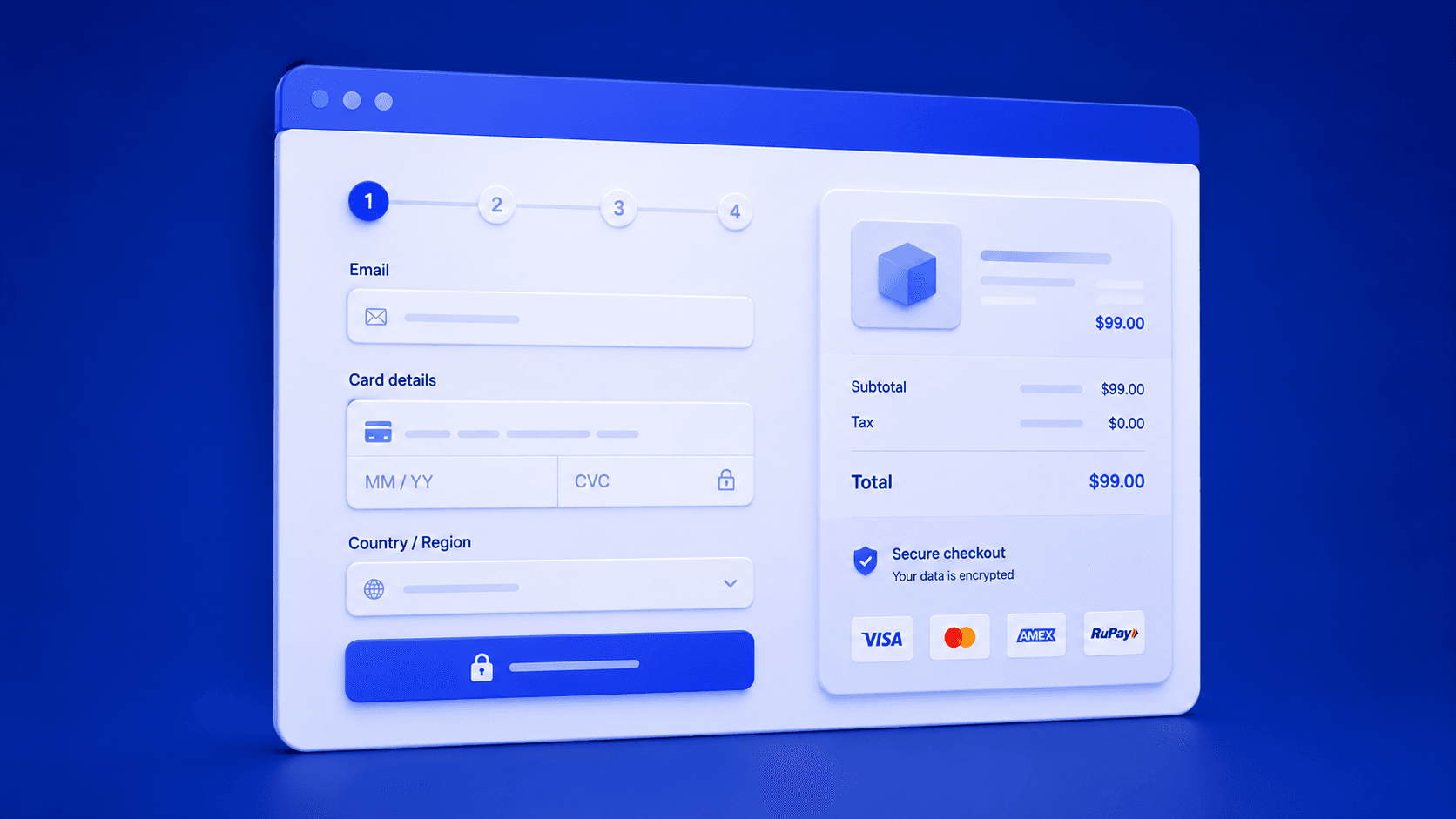
- Buyer's currency, clearly. Show prices in the customer's currency with transparent conversion, so there is no surprise at the last screen.
- The payment methods each market expects. International cards, plus wallets like Apple Pay and Google Pay, and popular local methods per geography. A missing method is a silent abandonment.
- One-click with network tokenization. Tokenized card-on-file (Visa, Mastercard, RuPay) lets returning buyers pay in one tap and keeps stored cards valid through reissues — critical for subscriptions and repeat purchase.
- Frictionless authentication. 3DS2 and native-OTP flows tuned so genuine buyers are not dropped at the authentication step.
- Fewer fields, faster load, mobile-first. Every extra field and every extra second costs conversion, especially on mobile in emerging markets.
The principle a systems architect will recognise: reduce the number of states in which a transaction can fail or stall, and make the happy path the default.
Layer 3 — Trust and data: why India-resident data matters
This is where an India-built checkout has a structural advantage.
Under the Reserve Bank of India's 2018 Storage of Payment System Data directive, every payment system provider must store the complete end-to-end payment data only in systems located in India. Where processing happens abroad for the foreign leg of a cross-border transaction, that data must be brought back and stored only in India within 24 hours. Global providers had to re-architect their systems to comply.
PayGlocal did not have to bolt this on. It is built in India, by a team in India, and RBI-authorised as a cross-border payment aggregator (PA-CB-I&O) and domestic aggregator (PA-O). Payment data is resident in India by design, compliance is native rather than retrofitted, and support comes from a team that understands the Indian regulatory context and your business.
For an Indian exporter, that is not just a compliance checkbox. It is trust: your buyers' payment data is handled under Indian law, on infrastructure built for it, by people you can actually reach.
Do you need separate checkouts for your global and Indian customers?
No — and running two is a common, expensive mistake. It means two integrations, two reconciliations and two sets of edge cases.
PayGlocal runs cross-border cards plus domestic UPI and RuPay on one platform and one integration, with unified settlement, automatic eFIRA within 24 hours for export documentation, and multi-currency accounts across 32 currencies. Your engineering team integrates once; your finance team reconciles once.
How PayGlocal puts it together
The three layers on one platform, built on India's Digital Public Infrastructure (DPI):
- Approval: local acquiring, dynamic routing, failover, AI fraud pre-screening.
- Friction: local methods, Apple Pay and Google Pay, tokenized one-click, 3DS2/native-OTP, buyer's currency.
- Trust: India-resident data, RBI authorisations, an India-based team, 99.999% availability across 4 availability zones.
Pricing is transparent — international cards at 2.75% to 2.99%, no setup fee and no AMC, with published volume and platform discounts — so the economics of a high-converting checkout stay predictable as you scale.
That is the whole idea in one line: a global checkout, built in India, that feels local to every buyer in 180+ countries.