Yogesh Lokhande is Co-founder and CTO of PayGlocal, where he leads product, technology and cyber security across the company's payment infrastructure. He has spent close to two decades building payment systems at scale, including a senior leadership role at Visa where his systems processed 100 million transactions a day. He writes on cross-border payments, payment success rates and the regulatory shifts reshaping how India transacts with the world. At PayGlocal he is building the rails that let Indian businesses grow globally with confidence.
•International payment failures happen across four gates: data capture, 3D Secure authentication, routing, and issuer authorisation. Many failures happen before an issuer even returns a decline code.
•Most declines are not equal. Soft declines may be recoverable with smarter routing or controlled retries, while hard declines such as invalid, stolen, or restricted cards should not be retried.
•Higher international approval rates are an engineering problem. Local acquiring, dynamic routing, smarter 3DS, network tokenisation, complete billing data, local-currency presentment, and disciplined retries can materially improve payment success.
International payments fail on Indian checkouts for four reasons: the issuer declines on cross-border risk, 3D Secure authentication drops the customer before authorisation is ever attempted, the card or billing data does not match what the issuer holds on file, or the transaction is routed through a path the issuer does not recognise or trust. Most Indian businesses selling globally see somewhere between 15% and 25% of foreign card attempts fail. The majority of those failures are recoverable, and the recovery is an engineering problem, not a sales problem.
The four gates every cross-border payment has to clear
What each decline code actually means, and whether a retry helps
Why the same card that works on a US checkout fails on an Indian one
The seven changes that move authorisation rates, ranked by impact
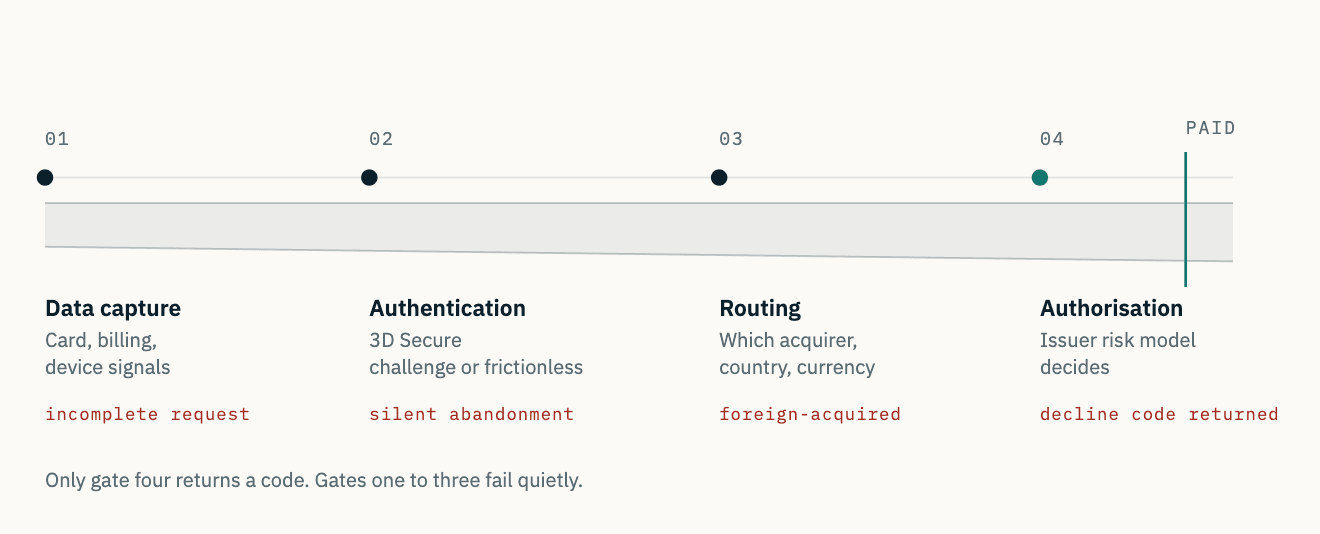
Domestic payments fail at one place: the issuer says no. Cross-border payments can die at four, and three of them happen before the issuer has seen anything.
Only gate four returns a code. Gates one to three fail quietly.
Three of the four gates fail without producing a decline code, which is why decline reports understate the loss.
01. Data capture
The checkout collects the card, and often the billing address, the email, and the device fingerprint. Indian checkouts are usually built for domestic flows, where address data is not part of the authorisation decision. Foreign issuers use it heavily. A checkout that does not collect and forward billing data is sending an incomplete request to an issuer that penalises incomplete requests.
02. Authentication
3D Secure is where the largest silent loss happens, because most of it is invisible in your decline reports. If a customer is challenged, redirected to their bank, and abandons, there is no decline code. There is only a transaction that never completed. Cardholders in markets where step-up challenges are rare treat an unexpected bank redirect as a phishing attempt and close the tab.
03. Routing
Which acquirer receives the transaction, in which country, in which currency, determines how the issuer sees it before it evaluates anything else. This is the gate most Indian merchants do not know exists, because in a domestic stack there is nothing to route.
04. Authorisation
The issuer decides. By this point the decision is already heavily shaped by what happened at gates one through three.
The decline codes that matter
Response codes are defined by the card networks and returned by the issuer. The wording varies slightly between Visa, Mastercard, Amex and local schemes, but the operational meaning is stable. Below are the codes that account for most cross-border failures on Indian checkouts.
Code
Standard wording
What actually happened
Retry
What you can fix
05
Do not honour
Generic issuer refusal. The risk model scored it and declined without telling you why. The most common cross-border decline.
Sometimes
Routing path, data completeness, authentication, descriptor
51
Insufficient funds
Genuine balance or credit limit issue.
Later
Retry timing, alternate method
14
Invalid card number
The PAN failed validation or does not exist.
No
Checkout validation and capture UX
54
Expired card
The expiry date on file has passed.
No
Network tokenisation, account updater
57
Not permitted to cardholder
Card not enabled for this transaction type, often international or online use.
No
Prompt customer to contact issuer
61
Exceeds amount limit
Per-transaction or cumulative limit hit.
Lower amount
Split or retry after the window
62
Restricted card
Issuer restricts the card by region or merchant category. A genuine cross-border block.
No
Local acquiring can change this outcome
65
Exceeds frequency limit
Too many attempts in a window. Often self-inflicted by aggressive retry logic.
Later
Retry discipline
59
Suspected fraud
Flagged specifically as fraud risk.
No
Data quality, authentication, fraud signals
91
Issuer inoperative
The issuer could not be reached. Nothing to do with the customer.
Immediately
Routing failover
96
System malfunction
Processing error somewhere on the path.
Immediately
Routing failover
04 / 41 / 43
Pick up, lost, stolen
The card is blocked at the issuer.
No
Nothing. Do not retry
R0 / R1
Stop payment
The cardholder instructed their bank to stop a recurring charge.
No
Stop the mandate immediately
One note on code 05. It is a bucket, not a diagnosis. When an issuer does not want to tell you why it declined, it returns 05. Any provider claiming to know precisely why a given 05 occurred is guessing. What you can do is change the conditions under which the request is made and watch the 05 rate move.
Soft declines and hard declines
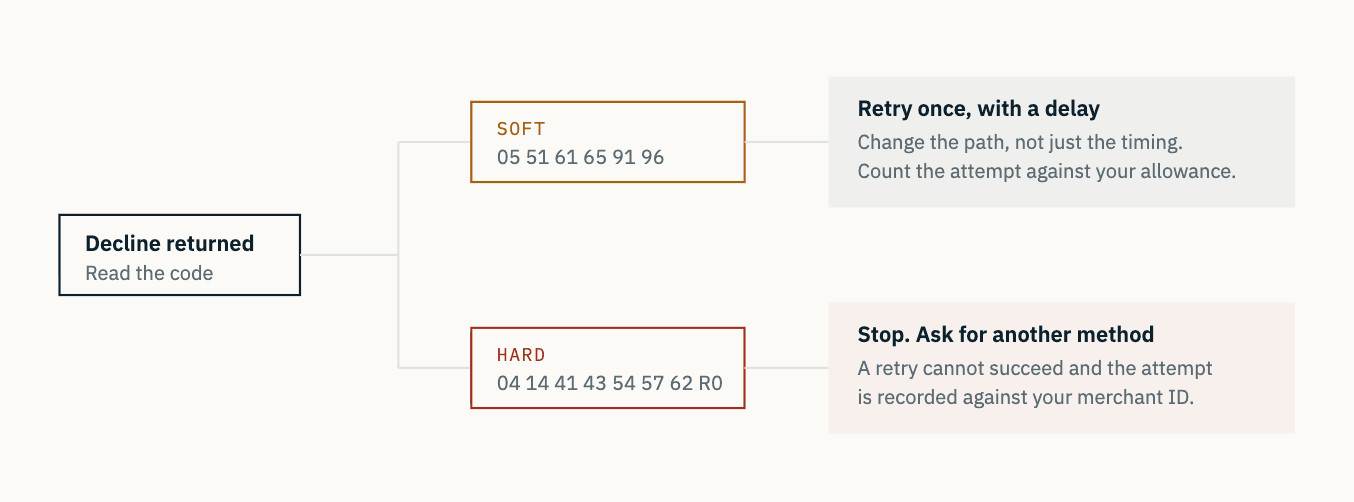
The distinction matters more than the individual codes, because it determines whether a retry is a recovery or a violation.
Most self-inflicted decline rates come from treating the lower branch like the upper one.
Soft declines are temporary. The issuer might approve the same transaction under different conditions or at a different time. Hard declines are terminal. The card cannot be used.
Retrying a hard decline achieves nothing and creates two real costs. It burns the network's permitted retry allowance, and it feeds the issuer's risk model evidence that your merchant ID generates repeated invalid attempts. Card networks cap the number of authorisation attempts for the same transaction and monitor merchants who exceed them. Check the current thresholds with your provider before you configure retry logic, because they change.
Why cross-border declines are a different problem
This is the part that surprises most Indian merchants. The same card, the same customer, the same amount, gets approved on a US checkout and declined on yours. Four reasons.
The issuer is scoring geography. Every authorisation request carries the acquirer's country. When a US issuer sees a card-not-present transaction acquired in India, it applies a different risk model from the one it applies to a domestic transaction. Nothing about your business changed. The origin of the request did.
The BIN and the acquirer are mismatched. Authorisation rates are strongly correlated with whether the issuing country and the acquiring country are the same. Local acquiring exists precisely to remove this mismatch, so a French customer's card is presented to their issuer as a locally acquired transaction rather than a foreign one.
Your stack is sending less data than the issuer expects. Address verification is not part of the domestic Indian flow, so most Indian checkouts do not collect or forward it. Foreign issuers use it as a trust signal. Absence is not neutral. It is read as a weaker request.
There is no domestic rail to fall back on. When a card fails domestically, you offer UPI or netbanking. When a card fails at 2am for a customer in Germany, there is no fallback unless you have built one.
The seven changes that actually move authorisation
Ranked by the size of the shift we see when merchants make them.
Local acquiring in the customer's market. The largest single lever. It changes how the issuer classifies the transaction before it evaluates anything else.
Dynamic routing with real failover. Not a static primary and backup, but routing that reads the response in real time and moves the next attempt to a path with better observed performance for that BIN, country and amount. Detailed in our dynamic routing guide.
A deliberate 3DS strategy. Authentication is a lever, not a switch. Where exemptions are available for low-risk transactions, using them removes a step where customers abandon.
Network tokenisation and account updater. Removes expired-card and reissued-card failures from your recurring base entirely. Highest return available to any subscription business, and the least frequently implemented.
Data completeness and descriptors. Collect and forward billing data. Make the statement descriptor recognisable, because an unrecognisable descriptor generates disputes, and dispute history feeds back into future authorisation decisions.
Currency presentment. Showing the customer their own currency reduces abandonment and can change how the issuer treats the transaction.
Retry discipline. Fewer, better-timed retries beat more retries.
Declines sit in the numerator, in acceptance capacity, and they are the most expensive leak in the model because the loss is total. A transaction that fails to authorise does not lose you a percentage. It loses you the entire order, and usually the customer, who does not try again.
Every other leak in cross-border commerce takes a slice. This one takes the whole thing.
What we see from the inside
I have spent twenty-eight years in payments, including years at Visa working on CyberSource, and the thing that has stayed constant is this: issuer trust is earned by the pattern of your traffic, not configured in a dashboard.
Merchants ask us to turn on better authorisation. There is no switch. What there is instead is a set of conditions that make an approval more likely, applied consistently until the issuer's model learns that your traffic behaves well. Local acquiring, complete data, sensible authentication, disciplined retries. Do those for a quarter and the curve moves. Do them for a week and nothing happens.
The other thing I would say to anyone building for global customers from India: your domestic payments experience is actively misleading here. Domestic acceptance in India is excellent, and it is excellent because of rails and behaviours that do not exist outside it. Assume none of it transfers. Build the cross-border path as its own system, because that is what it is.
Code 05, "do not honour", is a generic issuer refusal. The issuer's risk model declined the transaction and chose not to disclose the reason. It is the most common cross-border decline code and it is a bucket rather than a specific diagnosis.
Most commonly because the issuer sees a card-not-present transaction acquired in India and applies a stricter risk model, because the request carries less data than the issuer expects, or because the customer abandoned a 3D Secure challenge before authorisation was attempted.
Only for soft declines, and only with controlled timing. Hard declines such as invalid card, stolen card or restricted card should never be retried. Card networks cap authorisation attempts per transaction and monitor merchants who exceed them.
A soft decline is temporary and the same card may be approved later or under different conditions. A hard decline is terminal for that card. Treating the two the same is the most common cause of self-inflicted decline rates.
Yes, and it is usually the largest single lever available. Local acquiring presents the transaction to the issuer as domestic to the customer's market rather than as a foreign-acquired transaction, which changes the risk model applied to it.
Because cards expire, get reissued, and get replaced after fraud. Without network tokenisation and an account updater, your stored credentials silently go stale and renewals fail with codes 54 or 14.
It depends on where you start and on your mix of markets. Merchants moving from a single cross-border acquiring path to local acquiring with dynamic routing typically see a material double-digit improvement in approval on their largest markets.
The numbering is largely aligned and the operational meaning is stable, but the exact wording and some edge codes differ by network. Treat the code as a category and the network documentation as the authority for specifics.