FIRA Analyzer: see what your international payment actually costs
Your FIRA records the rate your money was really converted at. Upload it and we'll work out the effective FX markup and what the payment cost you against the mid-market rate on that date.
Get in TouchUpload your FIRA (Foreign Inward Remittance Advice) and get a breakdown of what the payment actually cost.
PDF, PNG, or JPEG, under 10MB.
Skip the hidden fees. See what your earnings are worth.
PayGlocal keeps pricing transparent, so you always know what you’ll receive.
The document
What is a FIRA?
A FIRA, or Foreign Inward Remittance Advice, is the document your bank issues when an international payment lands in your account. It records who sent the money, how much arrived in foreign currency, the exchange rate applied, the charges deducted, and the purpose code the payment was booked under.
It's your proof that export proceeds were realised, which is what your authorised dealer bank, your auditor, and your GST filings all need.
FIRA, FIRC, and eFIRA get used interchangeably and are not quite the same thing.
We've explained the difference hereHow to read your FIRA
Most people glance at the rupee amount and file the document. The cost is in the fields around it.
- 1
The foreign currency amount
What your client actually sent, before anyone touched it. Check this against your invoice first, because a shortfall here means a deduction happened before the money reached India, usually at a correspondent bank.
- 2
The exchange rate applied
The single most important number on the document. This is the rate your bank actually converted at, not the rate it quoted or the rate you saw on Google that morning.
- 3
Bank charges and commission
Usually a handling or commission line, often with GST on top. These are visible and easy to find.
- 4
The purpose code
An RBI classification that tells the regulator what the payment was for. Getting this wrong causes problems later when your bank tries to close the entry against your export.
- 5
The credit date
You need this to compare the rate applied against the mid-market rate on the same day. A rate that looks fine against today’s market can look very different against the market on the day it was booked.
The arithmetic
(mid-market rate on the credit date − rate on your FIRA) ÷ mid-market rate on the credit date × 100
Worked example, illustrative figures only
Say $10,000 landed on a day when the mid-market rate was ₹95.20, and your FIRA shows a rate of ₹94.20. The gap is ₹1.00 per dollar, so the markup is 1.05%, and the cost of that markup alone is ₹10,000. Any bank charges and GST sit on top of that.
The cost nobody quotes
What is an effective FX markup?
The effective FX markup is the gap between the mid-market rate on the day your payment was converted and the rate your bank actually gave you, expressed as a percentage. It is the part of the cost that never appears as a fee, because it's built into the rate itself.
It is usually larger than the visible fees, and it's the number nobody quotes you upfront.
The analyser above does this calculation for you, pulling the mid-market rate for your credit date automatically.
What else your FIRA is used for
The cost breakdown is one use. The document has three others.
Closing the entry against your export
Your authorised dealer bank reports export transactions to the RBI's Export Data Processing and Monitoring System (EDPMS), and evidence of realisation is what lets the entry be closed.
Getting your eBRC
The electronic Bank Realisation Certificate flows from proceeds being realised and reported, and it's what export incentive schemes ask for.
GST and audit
Your accountant needs the rupee amount, the rate, and the charges to book the transaction correctly.
The RBI sets the framework for all of this through its Master Direction on Export of Goods and Services and the A.P. (DIR Series) circulars issued under it.
PayGlocal is authorised by the Reserve Bank of India as a Payment Aggregator - Cross Border - Inward & Outward (PA-CB-I&O), which covers both directions of cross-border flow.
Frequently asked questions.
A FIRA, or Foreign Inward Remittance Advice, is the document your bank issues when an international payment credits your account. It records the sender, the foreign currency amount, the exchange rate applied, the charges deducted, and the purpose code. It is your evidence that export proceeds were realised.
A FIRC is the older certificate format, largely replaced for export proceeds. A FIRA is the advice your bank issues per remittance. An eFIRA is the digital version, issued electronically rather than as a physical document. Which one you receive depends on your bank and the transaction type.
Ask your bank. Most banks issue it on request through net banking or the trade finance desk, and some charge a fee per certificate. If you collect through a cross-border payment aggregator, the FIRA is usually issued automatically on each settlement rather than on request.
It's the gap between the mid-market rate on the day your payment was converted and the rate you actually received, as a percentage. Unlike a fee, it never appears as a line item. It is usually the largest single cost on an international payment and the one nobody quotes upfront.
Yes. We securely store the information from your FIRA and use it only to generate your cost breakdown and support the related service. The bank and transaction details in your FIRA are NOT used for any unrelated purpose or marketing activity.
Because banks add a margin to the mid-market rate rather than charging it as a visible fee. The rate quoted to you is already marked up, and handling charges plus GST usually sit on top. The analyser works out how large that margin was.
More tools
Currency Converter
Convert between 35+ currencies at real-time mid-market rates.
Open tool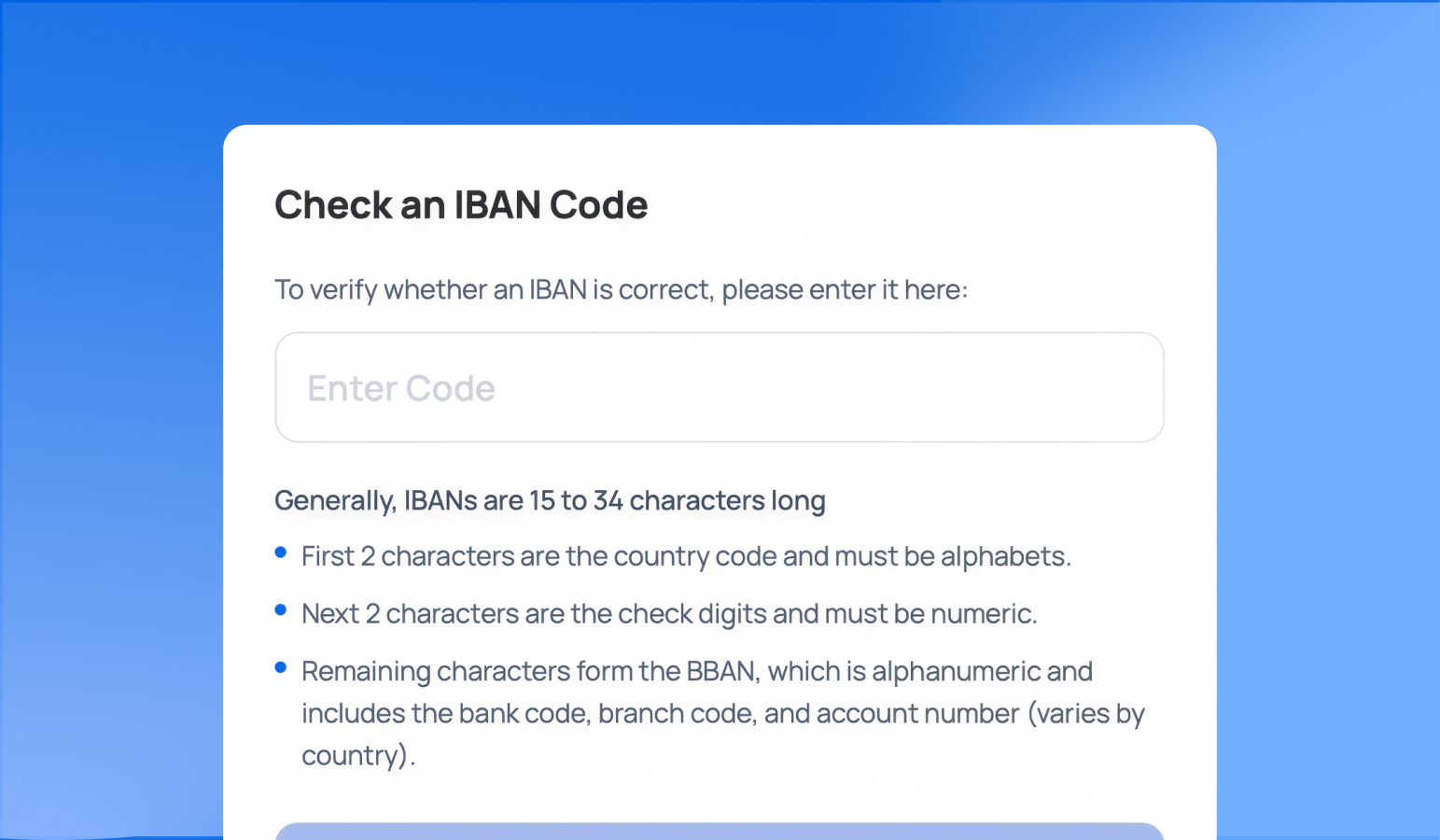
IBAN Validator
Validate any IBAN and see the country, bank code, and account details.
Open tool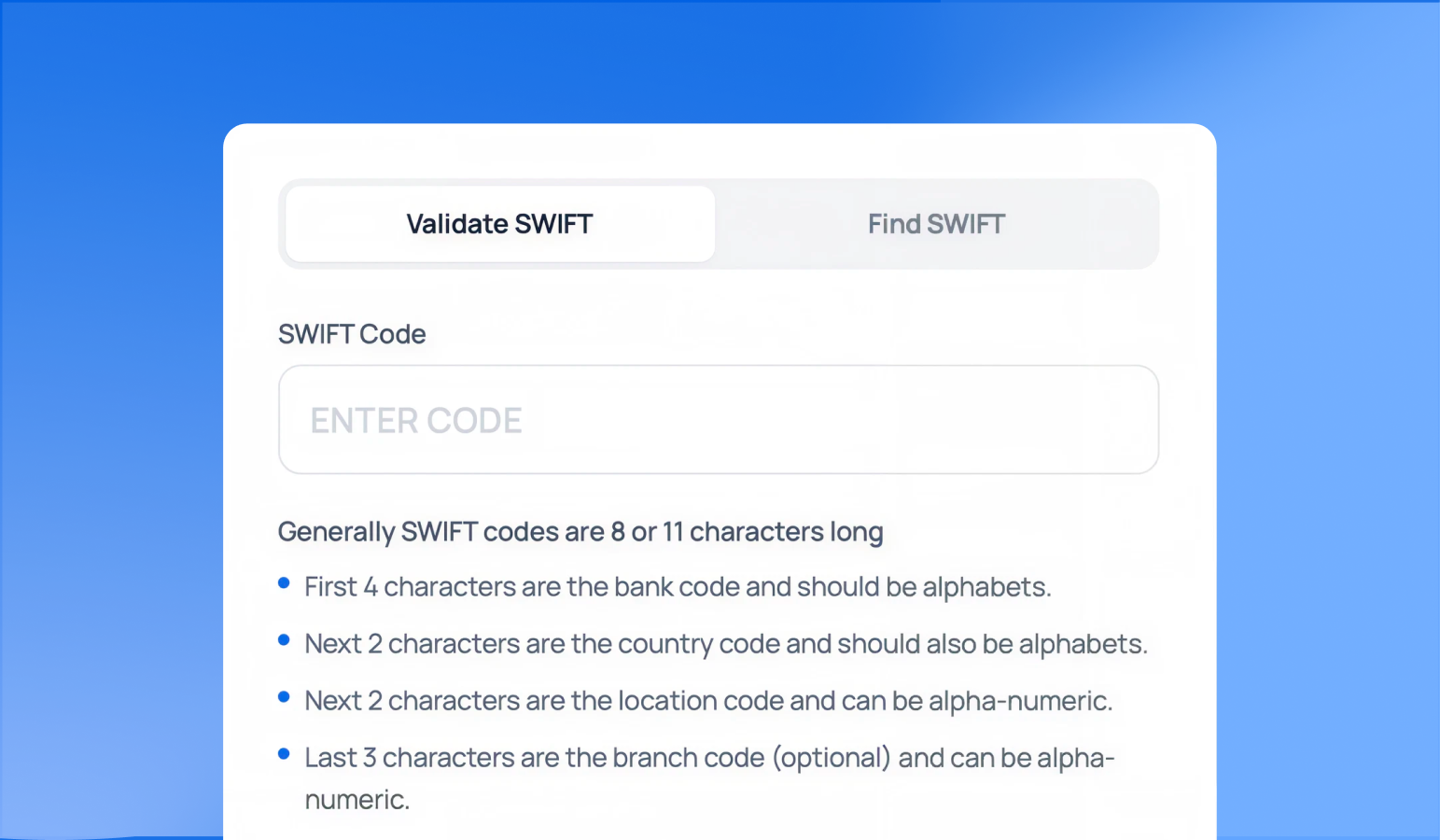
SWIFT/BIC Code Finder
Validate a SWIFT/BIC code or find one by bank, country, and city.
Open toolSkip the hidden fees. See what your earnings are worth.
PayGlocal keeps pricing transparent, so you always know what you’ll receive.