
An overseas client is ready to pay your invoice, but their bank asks for a SWIFT code. You have an account with the State Bank of India (SBI), so which code should you share? Is there one State Bank of India SWIFT code for every account, or does your branch have a different one?
The answer depends on how the payment is being sent. SBI has a commonly listed general SWIFT/BIC, but it also provides specific instructions for inward remittances and maintains a directory of SWIFT-enabled branches. Using the correct details can help your payment reach the right account without unnecessary queries or delays.
In this guide, we explain SBI SWIFT codes, where to find your branch's code, how international transfers work, and what Indian exporters and freelancers should check before sharing payment instructions.
TL;DR
- A SWIFT code, also called a BIC, identifies a bank or a banking unit for international payment messages. It usually has 8 or 11 characters.
- SBININBBXXX is widely listed as SBI's general SWIFT/BIC, but it is not automatically the right code for every inward remittance.
- SBI's own guidance also specifies SBININBBFXD for certain inward transfers and branch-specific codes for others. Check the instructions for your transfer with SBI before sharing a code.
- International senders typically need your beneficiary name, account number, bank and branch details, SWIFT/BIC, and payment purpose. An IFSC is not a replacement for SWIFT.
What is the State Bank of India SWIFT code?
A SWIFT code is an identifier used in international banking messages. It helps the sending bank identify the receiving financial institution. The same identifier is also known as a BIC, short for Business Identifier Code.
The code SBININBB is associated with State Bank of India, and you will often see it written in 11-character form as SBININBBXXX. However, SBI uses additional SWIFT codes for different branches and remittance routes. The general code alone is not enough to determine the correct payment instruction for a particular customer.
For example, SBI's NRI inward-remittance FAQs specify SBININBBFXD for eligible smaller inward remittances. Its official SWIFT-enabled branch directory lists other codes for individual branches.
The safest approach: ask your SBI home branch or forex desk which SWIFT/BIC your sender should use for your account, currency and transfer amount. Do not select a code solely because it appears at the top of a search result.
How is an SBI SWIFT code structured?
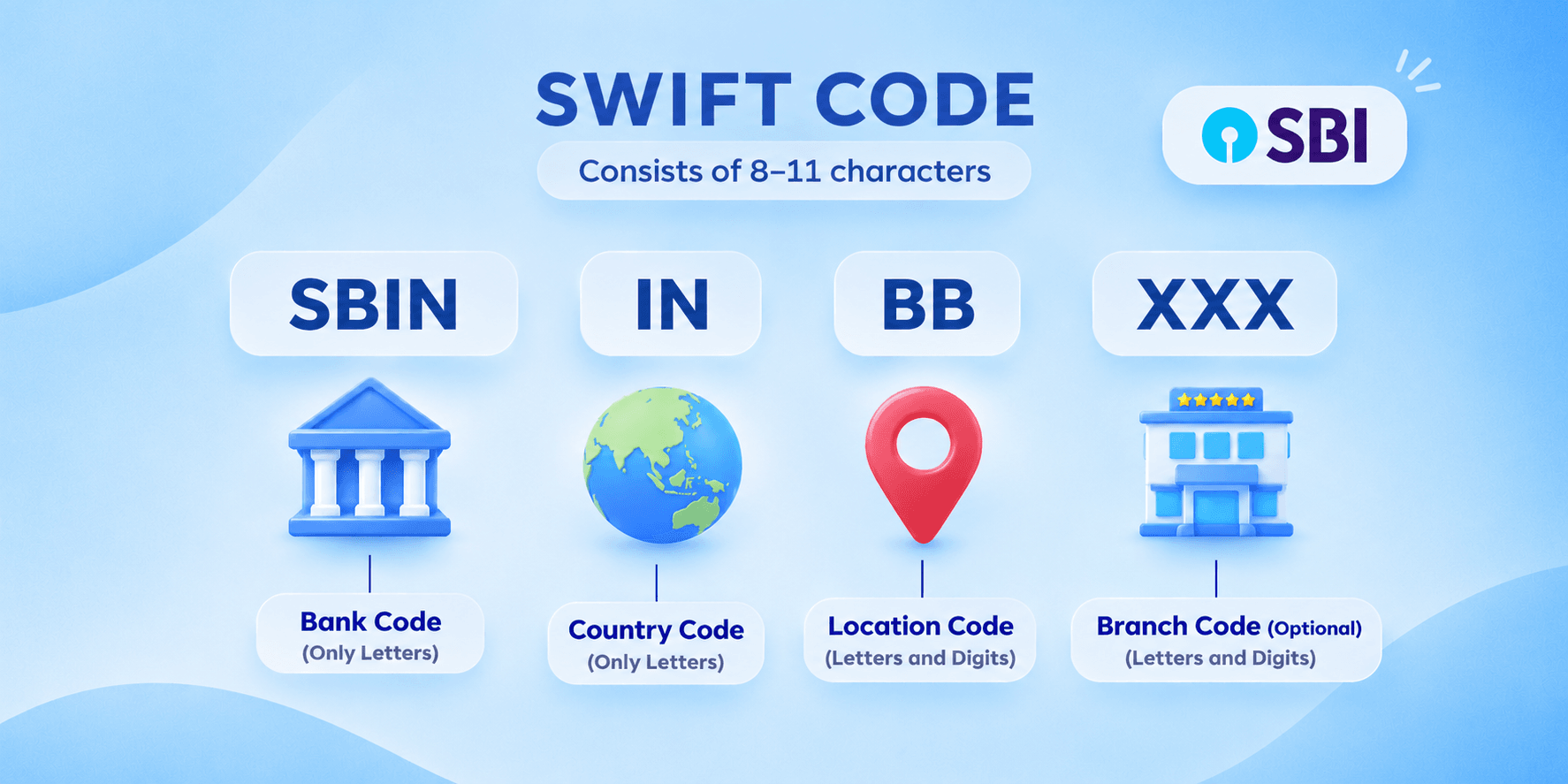
Most SWIFT/BIC codes contain either 8 or 11 characters. Take SBININBBXXX as an example:
- SBIN: the bank identifier for State Bank of India.
- IN: the country identifier for India.
- BB: the location identifier.
- XXX: the optional three-character branch identifier often used for the primary office in an 11-character representation.
If the last three characters are different, the identifier may refer to another banking branch or unit. SBININBBFXD, for instance, has a different final three-character suffix because SBI uses it for a designated remittance function.
An 8-character BIC identifies a business party, while the optional three-character suffix distinguishes a branch or organisational unit. This structure is defined by the international BIC standard.
Is SBININBBXXX the SWIFT code for every SBI branch?
No. Although SBININBBXXX commonly appears in online SWIFT directories, SBI has multiple SWIFT-enabled branches with their own codes. Some branches do not have an individual SWIFT code at all.
More importantly, SBI's instructions for incoming wire transfers do not simply tell everyone to use SBININBBXXX. They may direct the sender to SBININBBFXD, the beneficiary's branch code or a nearby linked SWIFT-enabled branch.
There is also a difference between SBI's published guidance pages: its general NRI FAQs mention a USD 10,000 threshold for using SBININBBFXD, whereas a remittance page for particular overseas corridors mentions USD 25,000. These are not figures to apply indiscriminately to every transfer. The applicable instructions may vary by remittance route or product, so confirm them with SBI before the sender initiates payment.
SBI SWIFT codes for selected branches in India
SBI publishes a searchable list of SWIFT-enabled branches. Examples from its official branch directory include:
- Mumbai Main Branch: SBININBB110
- Delhi Main Branch: SBININBB104
- Bengaluru Main Branch: SBININBB169
- Hyderabad Main Branch: SBININBB122
- Pune Main Branch: SBININBB238
These are examples of named branches, not universal codes for everyone in those cities. Your account may be held at a different branch, or SBI may instruct your sender to use another SWIFT-enabled branch for the transfer.
Always check the current SBI directory and confirm the code with your home branch. Branch names and routing arrangements can change.
How to find the correct SBI branch SWIFT code
1. Check SBI's official SWIFT code directory
Visit the SBI SWIFT codes page. Search for your branch name, city or branch code, then note the matching SWIFT/BIC. Check that the listed branch is the one SBI wants you to use for inward remittances, not just one with a similar name.
2. Ask your SBI home branch or forex desk
This is particularly important if your branch is not in the directory, the transfer is large, or your sender asks for a correspondent bank. SBI can confirm whether to use the home branch, a linked SWIFT-enabled branch or a designated remittance code.
3. Cross-check with a SWIFT/BIC lookup tool
You can use PayGlocal's free SWIFT/BIC Code Finder to look up or validate the structure of a code. A successful lookup does not prove that the code is appropriate for your specific SBI account. Confirm the final details with your bank before sending them to a client.
What is the difference between an SBI SWIFT code and an IFSC code?
Both identify banking information, but they perform different jobs.
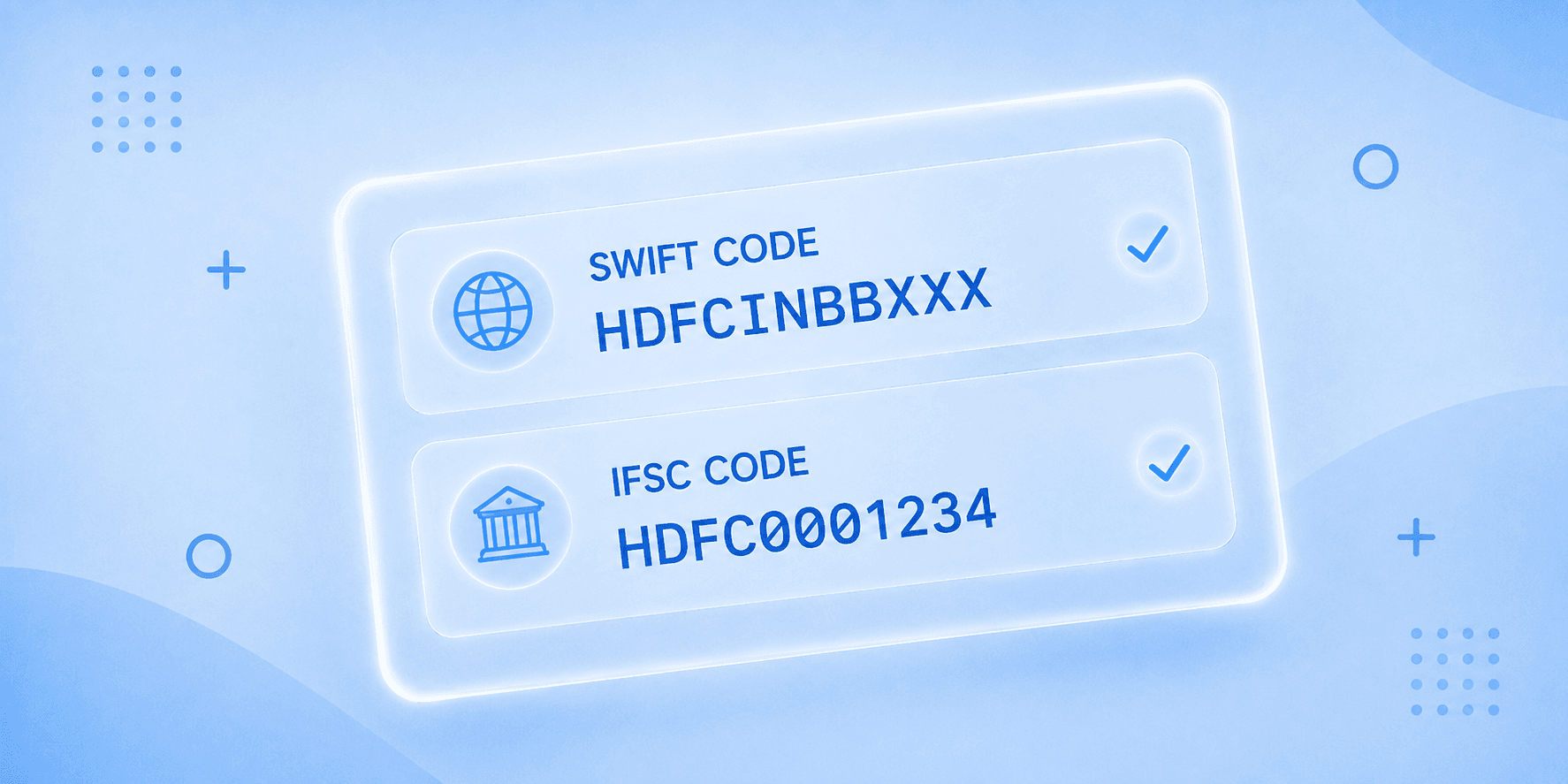
- SWIFT/BIC: identifies a bank or banking unit in international financial messages. It is relevant when a sender abroad initiates a SWIFT transfer.
- IFSC: identifies a bank branch within India's domestic banking system, including services such as NEFT and RTGS.
For an international transfer into India, your sender may need the SWIFT/BIC to identify SBI, while SBI can use your account and branch details, including IFSC where requested, to route the credit internally. An IFSC alone cannot replace the SWIFT/BIC in an international wire instruction.
India also does not generally issue IBANs for domestic bank accounts. If an overseas payment form insists on an IBAN, ask the sending bank how to provide an Indian account number rather than inventing an IBAN.
What details are needed to receive an international payment in an SBI account?
Before an overseas client sends money, share a complete set of verified receiving details. Depending on the sending bank and currency, these can include:
- Beneficiary name: the name exactly as registered on the SBI account.
- Beneficiary account number: your complete SBI account number, checked for errors.
- Receiving bank: State Bank of India, with the applicable branch name and address.
- SWIFT/BIC: the code SBI has confirmed for the transaction.
- Branch/IFSC information: if requested by the sender or SBI.
- Payment purpose: a clear description such as payment against an export invoice, with the invoice number where applicable.
- Correspondent bank details: only if the sending bank or SBI requires a particular intermediary arrangement.
SBI's foreign inward remittance instructions describe the beneficiary, branch, purpose and correspondent details that can form part of a wire-transfer message.
For an export payment, include the correct commercial documentation as well. The SWIFT code identifies the receiving bank; it does not replace an invoice, a valid payment purpose or any applicable FEMA documentation.
How does an international SWIFT transfer to SBI work?
Here is a simplified example. An Indian design agency invoices a UK client for GBP 3,000 and asks the client to pay into its SBI account.
- The agency checks its inward-remittance instructions with SBI and shares the verified banking details.
- The UK client's bank uses those instructions to initiate the international transfer.
- The payment message identifies the receiving bank and beneficiary. One or more correspondent banks may handle the funds if the banks do not settle directly.
- SBI receives and processes the remittance, which may involve compliance checks, documentation and currency conversion.
- The agency receives the credited amount in its account and obtains the relevant inward-remittance documentation where applicable.
The exact transfer time depends on the sending bank, currency, cut-off times, correspondent banks, holidays and any information requests. A SWIFT code does not, by itself, guarantee same-day receipt.
What charges apply to SBI international SWIFT transfers?
The amount that reaches your account may differ from the amount your client sends. There are several possible reasons:
Sending bank charges
The overseas bank may charge the sender to initiate a wire transfer. The fee depends on its own pricing and the payment arrangement.
Correspondent bank deductions
An intermediary bank may deduct charges while passing the payment along. Whether those costs are paid by the sender, shared or borne by the recipient depends on the transfer instructions and banks involved.
SBI handling charges
SBI may apply receiving or processing charges according to the remittance product and its current tariff. Review the applicable schedule or ask your branch for the total charges before quoting a payment method to a client.
Foreign exchange conversion
If the money is converted into INR, the conversion rate matters as much as any visible fee. A small difference in the rate can have a meaningful impact on a high-value invoice.
For example, if a client sends USD 5,000, a difference of ₹0.75 per USD between two conversion rates changes the INR amount by ₹3,750, before other fees. This is an illustrative comparison, not an SBI rate quote.
When comparing international collection options, look at the final INR amount received, not only the advertised transfer charge.
What should Indian exporters and freelancers check before receiving money through SBI?
Receiving a SWIFT payment is only part of the process. If you are collecting money for exported goods or services, keep your invoices, customer details, transaction references and applicable bank documentation together.
In particular, check the following:
- Invoice and purpose: ensure the stated reason for the payment matches the underlying transaction and the purpose information supplied to the bank.
- Foreign exchange documentation: ask your bank for the applicable inward-remittance advice or other records required for your accounts and tax work.
- Export compliance: check any relevant EDF, EDPMS or export-realisation requirements for your type of export under the prevailing FEMA rules.
- Reconciliation: match the amount credited to the invoice, noting the exchange rate, bank charges and any intermediary deductions.
A correct SWIFT code helps route a payment, but it does not automatically complete export compliance or prove that every invoice has been settled correctly.
What are common mistakes when using the State Bank of India SWIFT code?
Sharing a generic code without checking SBI's instructions
A code such as `SBININBBXXX` may appear in a public directory but may not be the instruction SBI wants used for your transfer. Confirm the correct receiving route first.
Picking a branch code from the wrong city or branch
A city can have several SWIFT-enabled branches. Match the exact branch name and ask SBI whether the code is appropriate for your account.
Mixing up SWIFT and IFSC
The two codes serve different purposes. Make sure the overseas client enters the SWIFT/BIC in the correct international transfer field.
Sending incomplete beneficiary information
A missing account number, mismatched name or unclear payment purpose can cause additional checks or delay processing.
Ignoring exchange rates and deductions
The sender may believe they paid the full invoice while you receive less after charges or conversion. Agree on who bears transfer costs and reconcile the credit when it arrives.
Using a code found in an old invoice
Even if a code worked before, verify the instructions when setting up a new client or payment arrangement, particularly if the receiving branch or currency has changed.
Can PayGlocal help businesses collect international payments without relying on every client's SWIFT transfer?
Yes. For eligible Indian businesses receiving payments from overseas customers, PayGlocal's Multi-Currency Accounts offer a different way to collect international payments. Depending on the currency and payment route, businesses can share local collection account details with their clients rather than asking them to initiate a traditional cross-border wire to an Indian bank account.
PayGlocal supports collections in 33+ currencies, with transparent FX information, INR settlement within 24 hours once the required conditions are met, and automated FIRA documentation for eligible collections. This can make recurring export payments easier to track and reconcile.
A PayGlocal collection account is not the same as an SBI bank account or a universal replacement for SWIFT. The available rails depend on the currency and account arrangement, and your existing Indian bank account remains relevant for INR settlement.
If you receive overseas payments regularly, comparing the net INR amount, documentation and payment experience across available methods can help you choose the right setup.
Key takeaways
The State Bank of India SWIFT code you see in an online directory is a useful starting point, but it is not a substitute for SBI's actual receiving instructions. Verify the applicable SWIFT/BIC, your beneficiary information, the transfer route and any correspondent details before an overseas client sends money.
For businesses collecting international payments regularly, it is also worth comparing how much money reaches your Indian account after transfer charges and currency conversion, along with the documentation you receive.